The words hung in the air like smoke from a dying fire, acrid and impossible to ignore. “We won’t need you this time, Eleanor. But make sure to leave the house clean.” My daughter-in-law Chloe spoke with that particular tone she reserved for me—the one that somehow managed to be both dismissive and commanding at once, as if I were staff rather than the woman who owned the roof over her head.
I stood in the kitchen, drying a plate that wasn’t even mine, watching her adjust her designer sunglasses atop her perfectly styled hair. The suitcase at her feet had cost over a thousand dollars—money that had come from my savings, though she’d never acknowledge that particular detail. My son Kevin scrolled through his phone beside her, his thumb moving mechanically across the screen, seemingly oblivious to the exchange happening mere feet away.
“Did you hear me, Eleanor?” Chloe’s voice sharpened. She always used my first name like a weapon. “The house needs to be spotless. Floors, bathrooms, and please don’t touch our things.”
Our things. In my house. The irony would have been funny if it hadn’t hurt so much.
I nodded, as I had for two years now, because that’s what mothers do. We keep quiet. We endure. We forgive, over and over, until we forget what it feels like to be anything other than invisible.
Kevin finally glanced up from his phone. “Mom, you good?”
The question was perfunctory, asked out of habit rather than genuine concern. I wanted to scream at him, wanted to ask when exactly I had stopped being his mother and become just another piece of furniture in his marriage. Instead, I smiled the way I’d learned to smile—small, harmless, unobtrusive.
“Of course, honey. Have a wonderful time.”
The children appeared then, twelve-year-old Caleb with his serious eyes and seven-year-old Lily trailing behind him. Caleb hugged me tight enough that I could feel his heartbeat against my chest. “I’m going to miss you, Grandma.” Lily pressed a sticky kiss to my cheek. “Why can’t you come with us?”
Chloe pulled Lily away with more force than necessary. “Because your grandmother has things to do here. Let’s go.”
The door closed with a solid thud that seemed to echo through the suddenly empty house. I stood in the silence that followed, staring at the keys they’d left on the table—keys to my house that they used as if they had every right to them. Something inside me cracked, but this time the fracture felt different. This wasn’t the familiar breaking of heartache or disappointment. This was clarity, sharp and sudden as shattered glass catching light.
I walked to what had once been my bedroom before it became the “guest room” because they “needed” the master suite for their family. I opened the drawer where I kept important papers, and there it was: the deed to the house, my name printed in formal black letters. Eleanor Marie Peterson. Owner.
It had always been in my name. They had never owned a single brick of this place, despite acting as though they held the title to every corner of it.
My hands shook as I picked up my phone, not from fear but from something I hadn’t felt in years—a sensation that took me a moment to recognize as determination. I dialed a number I’d sworn I would never call again.
“Caroline.” My voice came out steadier than I expected. “It’s Eleanor. I need your help.”
The silence on the other end stretched so long I thought she might hang up. Then my younger sister’s voice, unchanged despite fifteen years of estrangement, came through clear and careful. “Eleanor? What happened?”
“What happened,” I said slowly, “is that I stopped being myself. And I’m going to get myself back.”
I had seven days before they returned. Seven days to reclaim the life I’d let slip through my fingers like water.
That night, sleep eluded me entirely. I sat in the living room nursing a cup of chamomile tea that grew cold in my hands, studying the walls of what was supposed to be my sanctuary. There’s a particular kind of invisibility that settles over women of a certain age—we fade from view not because we’ve aged, but because we’ve learned to make ourselves small enough to fit into the spaces others have left for us.
I hadn’t always been this way. Eleanor Peterson used to be a name people spoke with respect. I was twenty-eight when my husband Arthur died, leaving me with a five-year-old son, no savings, and a mortgage that seemed insurmountable. A semi-truck on a rain-slicked highway had split my life into before and after in the space of a single heartbeat.
But I didn’t sink. I couldn’t afford that particular luxury.
With the fifty thousand dollars from Arthur’s life insurance—a fortune that disappeared faster than I could have imagined—I opened a small stationery and gift shop in the town square. Eleanor’s Corner, I called it. Nothing fancy, but it was mine. For thirty years, that shop was my second child. I opened at seven in the morning and closed at eight at night, selling notebooks and greeting cards, making copies, sending faxes. I knew every customer by name: Mrs. Gable who bought poster board weekly for her grandchildren’s school projects, Mr. Henderson who trusted me with his legal document printing, young mothers who came in harried and left smiling after I’d helped them find the perfect birthday supplies.
With the income from that business, I paid for Kevin’s private school education. I bought him new uniforms every year even when I wore the same blouse through three seasons. I paid for coding classes and tutoring sessions and everything else I’d never had as a child. When he got into the state university, I sold my 2005 Honda Civic—a car that still ran perfectly—to cover his tuition.
“When I graduate, Mom, I’m going to pay you back for everything,” Kevin would tell me while I ironed his presentation shirts at midnight. “You’ll see.”
And I believed him, because that’s what mothers do. We believe.
When he graduated, I took out a thirty-thousand-dollar loan to give him the down payment for his first condominium. “It’s an investment, Mom,” he’d explained with the confidence of youth. “When I sell it, I’ll pay you back with interest.” I signed the papers without hesitation.
Two years later, he sold that condo. I never saw a single dollar of that money.
“I invested it in a business opportunity,” he told me, his eyes bright with certainty. “It’s going to make us rich, Mom. Just be patient.”
Then he met Chloe, and patient became permanent.
The first time I saw her, instinct whispered warnings I chose to ignore. It wasn’t her expensive clothes or the way she spoke in carefully curated sentences. It was the way she looked at my house, my shop, at me—as if calculating value, assessing what could be extracted. But Kevin was in love, and when your son is in love, mothers step aside.
Their wedding cost eighty thousand dollars. I contributed twenty thousand, closing my shop for three days to secure the bank loan. At the reception, Chloe seated me at a back table near distant cousins whose names I didn’t know. Kevin was so consumed with photographs and toasts that he barely acknowledged my presence. Watching my son dance under lights I’d helped pay for, I began my slow disappearance.
When Caleb was born three years later, they needed help. “Just for a few months, Mom,” Kevin had said. “Until Chloe can get back to work.” I welcomed them without question. The months became years, and my house gradually transformed into theirs.
Last year, Chloe convinced Kevin it was time for me to rest. “You’ve done enough, Eleanor. Now we’ll take care of you.” They pushed me to sell Eleanor’s Corner, and I complied because I was tired and they seemed so certain. The shop sold for one hundred fifty thousand dollars. Kevin invested most of it in his “business.” Chloe bought new furniture for my living room. I was left with sixty thousand in an account I barely touched, because every time they needed something, there I was, wallet open, questions unasked.
Sitting in the darkness of my living room that first night alone, I caught my reflection in the window—a sixty-seven-year-old woman with gray hair pulled into a loose ponytail, wearing a robe that had seen better years. When had I stopped being Eleanor and become simply “the mother-in-law”? The woman who cleaned bathrooms she didn’t dirty and cooked meals nobody thanked her for?
But that night, something fundamental shifted. I remembered the woman who had opened a shop with a child in her arms and fear in her chest—but who did it anyway. The woman who never gave up when banks denied loans, when customers were scarce, when nights felt endless. That woman was still here, buried beneath years of accommodation and acquiescence.
She was alive, and it was time for her to resurface. Because you can take everything from a woman—her house, her money, her time—but there’s one thing you can never steal: the moment she decides she’s had enough.
Morning arrived with unexpected clarity. Sunlight streamed through the guest room window, and for the first time in months, I woke thinking not about their needs but about mine. I made real coffee—the whole bean kind I kept hidden because Chloe complained it “wasted electricity.” The aroma filled the kitchen like a promise.
I found an old notebook from the shop and began cataloging. Not with resignation but with the eye of an owner reclaiming stolen property. The modern gray sofa Chloe had bought with business money dominated the living room. My wooden rocking chair—the one Arthur gave me for our fifth anniversary—sat shoved in the hallway, buried under toy boxes. I moved it, sat in it, felt it creak in recognition. Where have you been? it seemed to ask.
“Right here,” I whispered. “Just lost for a while.”
I continued my inventory through every room. The glass dining table that had replaced my pine one, the table where Kevin had carved “K + M = love” with a nail when he was eight. I found it dusty and forgotten in the storage room, one leg wobbly but the carved declaration still visible. My master bedroom had become theirs, walls painted gray instead of the sky blue I’d chosen because it reminded me of happier times. Their king-sized bed—purchased with two thousand borrowed dollars never repaid—dominated the space. Chloe’s clothes consumed the closet. I counted twenty-two pairs of her shoes.
I owned three.
In the top drawer, I found a folder. Inside were printed emails that made my blood run cold.
“Kevin, my love, I finally convinced your mom to lend us another $5,000 for the business. She’s so naive she didn’t even ask what it was for. With this, we’ve gotten $12,000 from her total. And the best part? She thinks we’re actually going to pay her back someday “
My hands trembled so violently I dropped the paper.
Another email detailed their plan to convince me to sign a power of attorney that would let them use my house as collateral for loans. “She won’t even notice. It’s our chance to get the money we need. I’ve almost got her convinced.”
I sat on the floor of my own bedroom reading how they plotted to steal the only security I had left. But I didn’t cry. I had no tears left for them.
I took the entire folder, placed it in my bag, and called Caroline again. “I need you to come over. I found something you need to see.”
She arrived fifty-three minutes later, driving a simple white Toyota. When I opened the door, we stood in silence for a long moment. Fifteen years of estrangement hung between us like fog.
“Eleanor,” she said simply.
“Caroline.”
We didn’t embrace immediately. Too much time had passed, too many words left unspoken. But when she entered and I showed her the emails, her jaw tightened with professional fury.
“This is attempted fraud,” she said flatly. “Did you sign anything?”
“No. Not yet. They were still working on convincing me.”
Caroline closed her eyes briefly. “If you had signed that power of attorney, they could have sold this house without your knowledge, taken out mortgages, emptied accounts—all legally, because you would have given them permission.”
The weight of what I’d almost lost pressed down like physical force.
“There’s something else you need to know,” Caroline continued, her voice carrying the weight of years. “Fifteen years ago, when you stopped speaking to me, it wasn’t because I wanted your money. It was because I told Kevin no.”
I looked at her, uncomprehending.
“He came to my house when he was twenty-six. Said he needed ten thousand dollars urgently for a business opportunity. He claimed you’d refused. I had just started my law practice and didn’t have that kind of money, but I took out a loan anyway. I gave him everything, made him sign a promissory note. He promised to repay me in six months with interest.”
Caroline’s voice cracked slightly. “I never saw a penny. When I tried to collect, Chloe kicked me out of their apartment, calling me a gold digger. Kevin just watched from behind her and said nothing. When I came to you, to the shop, to explain, you screamed at me. You told me I was jealous, that I’d always envied your success, that I couldn’t stand to see you happy. Kevin had filled your head with lies, convinced you I was inventing debts to blackmail him.”
Tears streamed down my face. “Oh God, Caroline. I didn’t know.”
“I know,” she said gently. “That’s why I’m here now.”
She took my hands in hers. “For fifteen years I was angry. But I also missed you every single day. When you called yesterday, I knew you’d finally opened your eyes.”
“Forgive me,” I whispered. “Please.”
“I forgave you long ago,” she said. “What I didn’t forgive was not fighting harder to make you see the truth. But now we can fix this.”
Over the next hours, Caroline outlined a plan with legal precision. The house was in my name—entirely, solely mine. Kevin had no rental agreement, no lease, no legal right to occupy it. The emails provided evidence of attempted fraud. I had every legal right to reclaim my property.
“But he’s my son,” I whispered.
“I know,” Caroline said. “And we’re not trying to destroy him. We’re trying to save you.”
We began that very day. Caroline brought a locksmith named Tony who changed every lock in the house. When he handed me the new keys, their weight felt significant, real. “Your fortress is ready, ma’am,” he said with a kind smile.
Next, we went to the bank. I discovered Kevin still had access to my account through a supplementary card I’d given him years ago for “emergencies.” We canceled it immediately and opened a new account at a different bank. My sixty thousand dollars moved to safety within hours.
Then came the reclaiming. We brought my rocking chair back to the living room. We moved Chloe’s gray sofa to storage. We retrieved my pine table, cleaned it until it shone, and placed it back in the dining room where it belonged. We tackled the master bedroom, packing their belongings with respectful efficiency. By Wednesday evening, I slept in my own bed again, surrounded by lavender-scented sheets and photographs of Arthur.
I cried that night, but not from sadness—from relief so profound it felt like resurrection.
Caroline had another idea on Thursday. “When they come back, they’ll try to discredit you. They’ll say you’re senile, manipulated. You need witnesses—people who know the real Eleanor.”
I spent the afternoon calling former customers from the shop. Mrs. Gable, Mr. Henderson, Mrs. Sylvia the teacher. One by one, I explained what was happening. One by one, they offered unwavering support. “Count on me, Eleanor,” became a refrain that wrapped around me like armor.
On Friday, Caroline arrived with a young woman who looked to be in her early twenties. “Eleanor, this is Paloma,” Caroline said. “She’s a nursing student who needs a room to rent near the hospital. She can pay seven hundred fifty a month.”
I stared, confused. “I’ve never rented—”
“Hear me out,” Caroline interrupted. “You have extra rooms. This gives you income and company. But more importantly, when Kevin and Chloe return and see someone else living here, they’ll immediately understand that everything has changed.”
Paloma spoke softly, respectfully. “My mother was Lupita Mendoza. She had a stationery shop back home—Lupita’s Corner. You met her at a conference years ago and gave her advice that saved her business.”
Memory flooded back—a young, scared woman at a stationer’s conference in 2005. I’d shared suppliers, contacts, everything I knew, asking nothing in return.
“Your mother,” I said, voice breaking. “How is she?”
“She passed away two years ago,” Paloma said quietly. “Cancer. But she always talked about you. She said you were the most generous person she’d ever met.”
“Like you,” Paloma added, eyes bright. “When Caroline told me your story, I knew I wanted to help however I could.”
“When can you move in?” I asked.
“My things are in the car.”
And just like that, my house began to fill with life again.
Sunday arrived with clear skies that mocked the storm brewing in my chest. Caroline came early to help me cook, knowing I needed distraction. Paloma studied quietly at the dining table. At 4:47, my phone buzzed: We’re almost there. 15 minutes out.
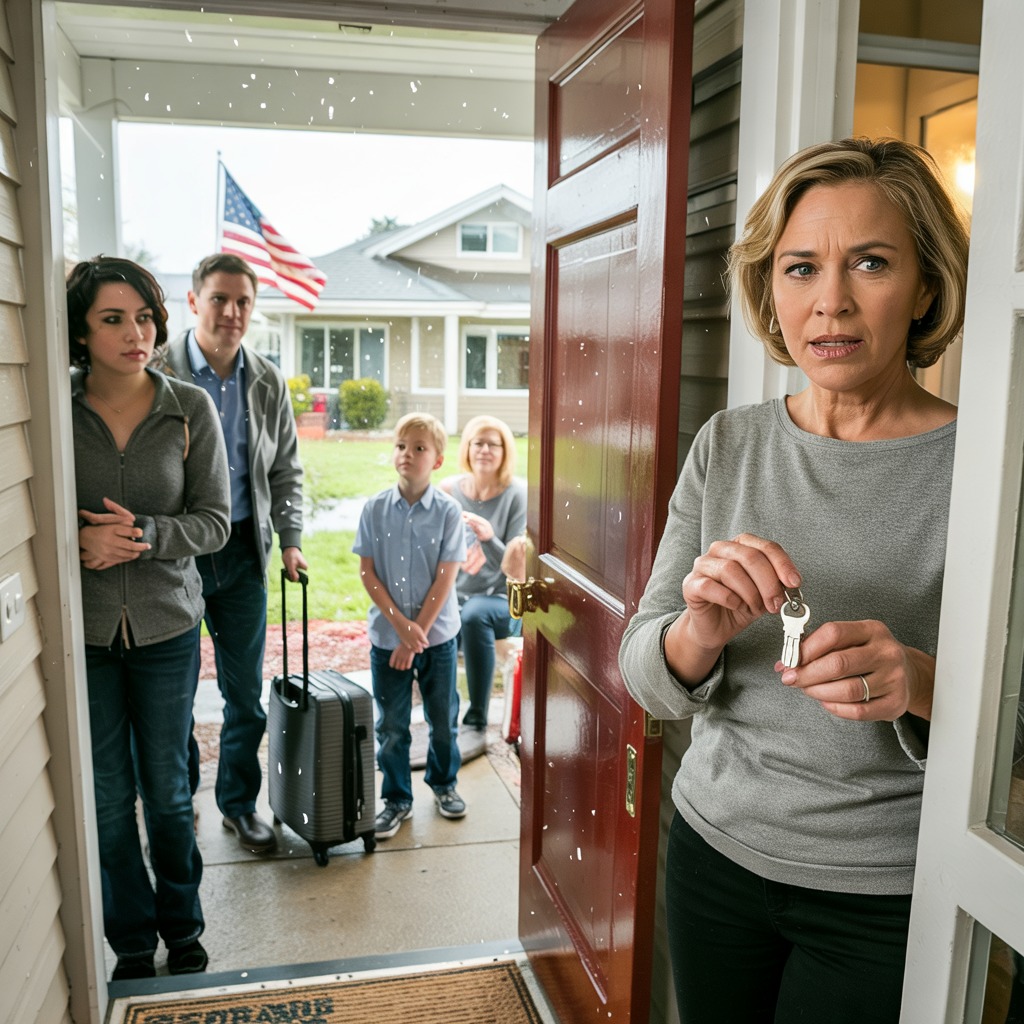
My stomach twisted. I heard the car pull up, doors slam, excited children’s voices. Then came the unmistakable sound of a key scraping uselessly against a lock that no longer recognized it.
Silence. Another attempt. Chloe’s irritated voice cutting through the air: “What the hell, Kevin? Your key isn’t working.”
The doorbell rang, insistent and demanding.
Caroline touched my hand. “Breathe. You are the owner of this house.”
I opened the door.
They stood there—Kevin in his polo shirt and sunglasses, Chloe in a white resort dress, hotel wristband still on her wrist, the children behind them with colorful backpacks. But they weren’t looking at me. They were looking past me.
Caroline sat in my rocking chair with coffee in hand. Paloma worked on her laptop on the sofa. Two women, calm and present, in what Kevin and Chloe had considered exclusively their territory.
“Hello, Kevin,” Caroline said evenly. “It’s been a while.”
Kevin paled. Chloe turned red with fury. “What is she doing here? Eleanor, what’s going on?”
The children ran to me, hugging tight. “Hello, my loves,” I said, kissing them. “I missed you so much.”
“Why don’t the keys work?” Kevin asked, frozen at the threshold.
“Because I changed the locks,” I replied, my voice firm and clear.
The silence that followed felt thick enough to drown in.
Chloe exploded. “This is our house!”
“No,” I said, and that simple word carried years of suppressed truth. “This is my house.”
Kevin pushed past without asking, looking around as if seeing everything for the first time. The gray sofa was gone. Their clutter had vanished. The house smelled of lavender and coffee instead of Chloe’s cloying perfume.
“Mom, what did you do?” His voice mixed confusion with growing anger.
“Your things are packed,” I said steadily. “In boxes, ready for you to take.”
Chloe ran upstairs. We heard doors banging, her voice rising in disbelief. She stormed back down, face contorted with rage.
“Who do you think you are?”
“I’m the owner of this house,” I replied. “And I need my space back.”
Caroline stood, folder in hand. “Kevin, perhaps I should explain. This house is deeded solely in your mother’s name. You’ve been living here without a contract, without paying rent, without contributing to expenses. Legally, you are guests. Your mother has decided she needs her space back.”
Kevin pointed a shaking finger at Caroline. “You manipulated her. You’ve always wanted to drive us apart.”
“No one manipulated anyone,” I said, stepping forward. “Kevin, for two years you’ve treated me like hired help in my own home.”
“We gave you a roof over your head!” Chloe screamed.
The laugh that escaped me was bitter and surprised even myself. “You gave me a roof, Chloe? This is my roof. The only thing you’ve done is take everything from me underneath it.”
Paloma gathered her things to leave, but I stopped her. “Stay. They need to understand I’m not alone anymore.”
Kevin stared at Paloma. “And who are you?”
“I rent a room here,” she said quietly.
Chloe’s laugh was hysterical. “You opened a hotel now?”
“Your mother-in-law took back her house,” Caroline corrected. “And she has every right to do with it as she pleases.”
“This isn’t over,” Kevin threatened. “Mom, you’re going to regret this.”
I walked closer, looking into the eyes I’d known since his birth. “Kevin, I found the emails. The messages between you and Chloe where you laugh at me, where you plan to use my house as collateral, where you call me naive.”
His face drained of color. “Mom, I—”
“You have until six tomorrow evening to collect your belongings,” I said. “If you need more time, we can discuss it. But you are not living here anymore. Not like this.”
Chloe opened her mouth to protest, but Kevin grabbed her arm. “Let’s go.”
The children looked at me with tears streaming. “Grandma, don’t you love us anymore?” Lily sobbed.
I knelt before them. “I love you with all my heart. None of this is your fault, and I will always be your grandmother. I promise.”
Chloe yanked them away. “Let’s go, kids. Your grandmother has lost her mind.”
I watched them leave, watched the car disappear around the corner. When the silence returned, I collapsed. Caroline held me as I cried. Paloma brought water. They stayed while my body shook with sobs I’d held back for years.
“You did it,” Caroline whispered. “Eleanor, you did it.”
And despite the pain radiating through every part of me, despite feeling like my heart had shattered, I also felt something I hadn’t experienced in years: freedom. Because sometimes closing a door is the only way to open a window.
The following weeks brought a campaign of manipulation I hadn’t anticipated. Text messages arrived in waves, each one designed to wound: “We’re in a hotel paying $250 a night we don’t have because of your selfishness.” “The kids are crying, asking why their grandma doesn’t love them.” “Everyone in the family is going to know who you really are.”
I blocked their numbers that night, setting boundaries in the digital space as I had in physical reality.
But the attacks came from other directions. Relatives who never called suddenly had opinions. Cousin Beatrice arrived with concern and cheap perfume. “Kevin says you’ve gone crazy, that Caroline is manipulating you.”
I showed her the emails, explained the years of financial exploitation, the plan to use my house as collateral. She left pale and silent, doubt replacing certainty.
More visitors came—Julio, concerned neighbors, all bearing Kevin’s version of events. To each, I presented evidence: the deed in my name, the fraudulent emails, the documented pattern of manipulation. Some believed. Others left unconvinced. But I had planted seeds of truth.
On Thursday, Kevin arrived with a moving truck. He looked terrible—exhausted, unshaven, defeated. “Mom, are you really doing this?”
“It’s already done.”
Movers carried out boxes while Chloe grabbed belongings violently, slamming drawers, her fury palpable. When she descended carrying a final box, she spat her venom. “You’re a bitter old snake who can’t stand to see her son happy. When you’re alone, rotting in this house with no one to care for you, you’ll regret losing your family because of your pride.”
“No,” I said, voice steady. “I lost you because you never saw me as family—only as a resource to exploit.”
Kevin approached as the last box loaded. “Mom, is there really no way to fix this?”
For a moment, I saw the boy he’d been—the child I’d raised, whose tears I’d dried. But that boy had grown into a man who’d used me, lied to me, plotted against me.
“There is a way,” I said. “It’s called consequences. It’s time you faced them.”
His eyes hardened. “So this is goodbye.”
“No, Kevin. It’s ‘see you later’—when you’re ready to talk honestly, without manipulation. I’ll be here.”
He shook his head. “You’re a stranger.”
“No, Kevin,” I said softly. “You turned your mother into a stranger. I just stopped allowing it.”
He left without looking back.
The storm continued through social media. Chloe posted publicly: “There are people who forget what family means, who choose money and selfishness over their own grandchildren…” She attached photos of the children looking sad. Comments flooded in, most condemning the “heartless grandmother.”
But then my former customers began responding: “I’ve known Eleanor Peterson for 25 years. She’s the most hardworking, honest woman I know. If she made this decision, she had valid reasons.” One by one, voices of truth countered the lies. By evening, Chloe had deleted her post.
On Monday, I sat in Dr. Patricia Hernandez’s office for a psychiatric evaluation. Three hours of questions, memory tests, logic problems. I walked out with an official document stating I possessed full mental faculties, intact memory, complete capacity for decision-making. No evidence of dementia or psychiatric alterations that would compromise judgment.
Caroline smiled when I showed her. “This is your shield, Eleanor.”
She posted the certificate to the family group chat with a simple message from my account: “I am in full possession of my faculties. The decisions I’ve made regarding my property are mine, conscious, and fair. I will not allow myself to be defamed.”
The silence that followed was absolute. Kevin left the group.
Then came an unexpected visit. I was watering the garden when a car pulled up. Caleb and Lily emerged—alone.
“We ran away,” Caleb explained. “Dad and Mom were running errands. They left Lily with the neighbor and me home alone. I took the money I’d saved and got us an Uber. Grandma, we missed you.”
Lily clung to me, crying. “Mommy says you hate us.”
“That’s a lie,” I said, kneeling. “A terrible lie. You are my family and always will be.”
Caleb looked at me with eyes too old for twelve years. “Grandma, I heard them talking. Mom told Dad they were going to get money from you—that you were dumb. And that if you wouldn’t give it to them, they’d tell everyone you were crazy so they could keep the house.”
The world tilted. Caroline, who’d been inside, appeared with her phone recorder. “Caleb, could you repeat that on tape? So your grandmother has protection?”
He did. His clear, certain voice documented everything.
When Kevin and Chloe arrived to collect the children, fury radiated from them. But something had shifted. Kevin knelt before me, tears streaming. “Mom, I’m so sorry. I’ve been the worst son in the world. I used you. I lied. I let her treat you like dirt because it was easier than facing my own failures.”
He sobbed. “I’m ashamed. If you never forgive me, I understand. But I need you to know I love you and I finally understand everything you sacrificed.”
Chloe sneered. “Are you seriously going to grovel?”
“Yes,” Kevin said without looking at her. “Because she deserves it. And I’m done with this toxic partnership.”
“I filed for divorce this morning,” he added quietly.
Chloe stared, rage transforming to shock. “What?”
“I can’t do this anymore. This isn’t a marriage. It’s destroying all of us.”
She grabbed her purse and left with a final curse. The perfume lingered, but she was gone.
“What are you going to do?” Caroline asked Kevin.
“Get a real job. Find an affordable apartment. Try to be a better father and a better son.” He looked at me. “If my mom will let me.”
I hugged him while he cried like the child he’d once been.
“I forgive you,” I whispered. “But forgiving doesn’t mean forgetting or going back to how things were. If you want to be my son again, you’ll build it with actions, day by day. I’m setting firm boundaries. No more money. You won’t live here. I will love you, but I will also protect myself.”
“I understand,” he sobbed. “You deserve it.”
The months that followed brought gradual healing. Kevin found work as a hardware store manager. He rented a modest one-bedroom apartment. The children visited every other weekend on a legal schedule Caroline helped establish. The first visit, Lily hugged me for ten minutes without letting go.
Chloe disappeared into her own bitterness. The divorce finalized messily but completely.
With Paloma in the house, life developed new rhythms. She cooked when I was tired. I helped her study. We became family by choice rather than obligation.
One evening, Paloma suggested converting part of the garage into a workshop. “We could offer craft classes to neighborhood women, charge a small fee.”
The idea excited something dormant within me. Three months later, Eleanor’s Workshop opened. We started with five students and grew to twelve. It brought income, but more importantly, it brought laughter, stories, companionship. It brought me back to myself.
Six months after everything changed, Kevin arrived alone on a Saturday afternoon. He brought a lavender plant in a terracotta pot.
“I know you like the smell,” he said. “I wanted to bring you something that grows. As a symbol.”
We sat in the living room—me in my rocking chair, him on the sofa. He told me about his promotion at work, his therapy sessions, the credit card he’d finally paid off.
“How did you know it was time to say enough?” he asked. “How did you find that strength?”
“I didn’t find it,” I said. “It was always there, just buried under years of fear and the need to please. When I finally dug it up, I realized I had never been weak.”
He nodded, tears shining. “I’m going to spend the rest of my life being the best version of myself. Not for you—for me, for my kids.”
“That’s all I want,” I told him.
That night, Caroline visited with wine. Paloma studied in her room. I sat in my rocking chair, looking around at my reclaimed home.
“You know what’s strangest?” I said to Caroline. “For years I thought losing Kevin would destroy me. But when I closed that door, I discovered a whole universe waiting on the other side.”
Caroline raised her glass. “To the universes we discover when we close the right doors.”
One year later, the workshop buzzed with fifteen women embroidering and sharing coffee. Kevin arrived with the children. They came every weekend now.
“Grandma, look what I made,” Lily said, showing me a drawing of a house with flowers. “It’s your house because it’s the prettiest in the world.”
Caleb, now thirteen and thoroughly teenage, sat beside me. “Grandma, my teacher assigned us to interview someone important. Can I interview you? I want to write about the bravest person I know.”
My eyes filled. “It would be an honor.”
That evening, after everyone left, I went to the garden. Roses I’d replanted bloomed vivid and strong. Bougainvillea climbed the wall. Lavender scented the cooling air. I sat on the bench Caroline had given me, the one with a plaque reading: “For Eleanor, who reclaimed her garden and her life.”
I looked up at the emerging stars and didn’t think about what I’d lost. I thought about what I’d gained: dignity, peace, my home; my sister Caroline; a friend in Paloma; a workshop full of women who called me teacher; a healthier relationship with my son; the pure love of my grandchildren.
Most importantly, I had won myself back.
I breathed deeply. The air smelled of damp earth and night-blooming jasmine. I smiled, because true wealth isn’t measured in possessions but in what you refuse to let anyone take from you.
I had reclaimed the most valuable thing of all: my right to live in peace in my own home, being simply and completely myself. Sometimes the happy ending isn’t getting back what you had—it’s discovering you deserved something infinitely better all along.