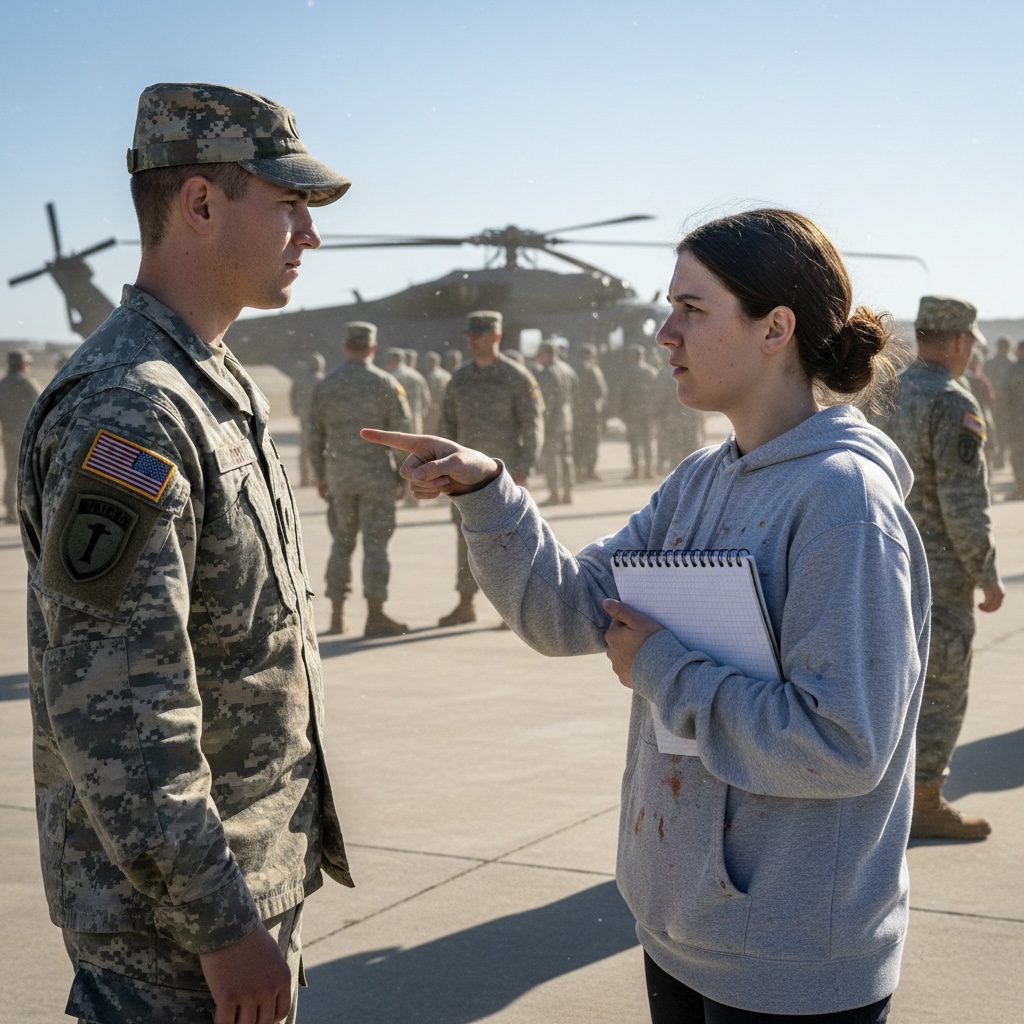
She Was Just a Freshman — Until Delta Force Choppers Landed on Campus for Her
Montana wore its Sunday best that Thursday—red-brick halls, gold leaves, a sky so clean you could hear your own thoughts. Zara Blackwood was nineteen, paint on her fingers, a freshman who sat in the back row and drew margins around the world so it felt safer.
Ten-forty-seven a.m.: the sound changed. Not wind. Not a commuter helicopter. Rotors—heavy, military—coming lower instead of passing over.
Three matte-black birds slipped out of the blue and settled on Northview’s quad with machine precision, as if the lawn were a landing pad someone forgot to tell the students about.
Phones rose. Coffee cooled in open hands. Professor Sinclair’s voice floated from a window—”Everyone back from the lawn, please”—and then the PA crackled campus-wide.
A tall officer stepped from the lead helicopter like a sentence with no extra words. His voice was even, amplified, unavoidable: “We’re looking for Zara Blackwood.”
Zara felt her body do the thing it had been trained to do long before dorm check-ins and meal plans: cover, angle, exits, lines of sight. She had picked Northview because nobody looked twice at a girl in an oversized sweatshirt. Because normal was a language you could learn if you practiced hard enough. Because she’d promised herself she could be just “Zara the art major,” not the person who slept facing doors and traced air vents with her eyes.
By the time Sergeant Cooper’s knock patterned her door—three, pause, two—half the campus knew her name. The other half was deciding what kind of story it wanted to be a part of.
Outside, the lawn had turned into a staging diagram: cordon here, students there, blades ticking down. The colonel—Blackthorne—took her in with one practiced look, the kind that reads posture as fluently as transcripts.
“You’ve been difficult to find,” he said, and the crowd learned a new noun for the quiet girl from Maple Ridge: Sergeant.
Glass cracked with a sharp sound somewhere to the east; heads tilted up. Zara didn’t. The sound was wrong for an accident; the angle was wrong for luck.
Her voice, when it came, didn’t belong to a freshman. It belonged to the life she’d been hiding from:
“Second-floor east—line of sight at forty-five degrees puts the origin at…”
She pointed—not at the helicopter, not at the crowd—but toward the one place that made perfect sense to anyone who truly understood how real risk works: the clocktower.
And in that moment, everyone on Northview’s quad learned that Zara Blackwood had never really been a freshman at all.
Two Years Earlier
Zara Blackwood joined the Army at seventeen with her parents’ reluctant signatures and a recruiter’s promise that she could “see the world.”
What she saw was sand. Mountains. Compounds lit by green night vision. The inside of armored vehicles. The faces of translators who trusted her with their lives. The kind of world most people only see in movies, where the stakes are real and mistakes are measured in casualty reports.
She was good at it. Too good. The kind of soldier who could read a situation three moves ahead, who learned Pashto and Dari faster than anyone expected, who volunteered for assignments other people avoided.
By eighteen, she’d made Specialist. By nineteen, she was attached to intelligence units operating in places the news didn’t name. She’d seen things that made sleep a luxury and silence a trigger.
Then came Kandahar.
The operation was supposed to be routine—a convoy escort, some meetings with local leaders, back to base by nightfall. But intelligence had been wrong about the insurgent activity in the area. Wrong about the IED placements. Wrong about how many hostiles were waiting.
When the lead vehicle hit the explosive, Zara’s training took over. She pulled two wounded soldiers from the wreckage while rounds snapped overhead. She called in their position, directed fire, kept everyone alive until the QRF arrived.
She was awarded the Bronze Star with Valor. She was also diagnosed with acute stress response and recommended for medical discharge.
The Army offered her options: extended therapy, reassignment to a desk job, medical retirement with full benefits.
She chose something else.
“I want out,” she told her commanding officer. “Honorable discharge. GI Bill. And I want to disappear.”
“You’re nineteen years old, Specialist Blackwood. You have a future in the military—”
“I had a future. Now I just want a life.”
Six months later, she was enrolled at Northview College in Montana under a name that was legally hers but felt borrowed: Zara Blackwood, freshman, undeclared major, no remarkable history beyond a clean high school transcript from a town nobody had heard of.
She’d promised herself she’d be normal. Just another college kid figuring out what to study, who to be, how to exist without constantly scanning for threats.
She’d lasted exactly two months before the helicopters came.
The Clocktower
Colonel Blackthorne moved with the efficiency of someone who’d given this type of order a thousand times. His hand went to his radio. “Clocktower, second floor. Possible hostile. Lock it down.”
Four operators peeled off from the formation, moving toward the old stone building with weapons ready. Students scattered, screaming, finally understanding this wasn’t a demonstration or a prank.
Zara’s roommate Emma grabbed her arm. “What’s happening? Why are they here for you?”
“I can’t explain right now.”
“Zara—”
“Emma, please. Just stay here. Stay away from the windows.”
Blackthorne’s eyes were on her, assessing. “You sure about the tower?”
“Glass breaks at that angle, with that acoustic signature, it’s either a ricochet from height or a deliberate ranging shot. Given your arrival pattern and the crowd formation, anyone with tactical training would use the tower for overwatch.”
“Anyone with tactical training,” Blackthorne repeated. “Like you.”
“Like someone who knows you’re here for me.”
His expression shifted slightly—not surprise, but confirmation. “So they knew we were coming.”
“They’ve known where I was for weeks. This is the first time you gave them a target-rich environment.”
The radio crackled. “Tower clear. Found a spent casing, 7.62. Shooter’s gone, but he was here.”
Blackthorne’s jaw tightened. “Perimeter, now. Lockdown protocol. Nobody leaves campus until we’ve swept every building.”
He turned back to Zara. “You and I need to talk. Somewhere secure.”
“The admin building has a basement. Concrete walls, one entrance, no windows.”
“You’ve already mapped this campus.”
“I map everywhere I go. It’s a hard habit to break.”
The Basement
The admin basement smelled like old files and cement. Blackthorne dismissed everyone except Sergeant Cooper and one other operator—a woman Zara recognized from her deployment. Staff Sergeant Chen, intel specialist, the kind of person who remembered faces and details.
Chen’s eyes widened slightly when she saw Zara. “Blackwood. Didn’t think I’d see you again.”
“You two know each other?” Blackthorne asked.
“Kandahar, sir. Specialist Blackwood pulled my team out of an ambush. Saved four lives that day.”
Blackthorne looked at Zara with new assessment. “The Bronze Star.”
“It was just training,” Zara said quietly. “Anyone would have—”
“No,” Chen interrupted. “Not anyone. You read that situation faster than our officer did. Faster than I did. You saw the secondary IED before it detonated. You’re the reason we all made it home.”
Blackthorne set a tablet on the table between them. “Which is exactly why someone wants you dead.”
The screen showed a photo—grainy, taken from distance, but unmistakably Zara walking across Northview’s quad with her backpack and coffee.
“This was uploaded to a dark web forum six days ago,” Blackthorne continued. “Along with your current location, your class schedule, and a bounty.”
Zara’s stomach dropped. “How much?”
“Two million dollars. For confirmed termination.”
The number was absurd. Impossible. “I’m nobody. I was just a Specialist. I didn’t even finish my enlistment—”
“You were attached to Task Force Sentinel,” Blackthorne said. “You provided translation services for an operation that resulted in the capture of Khalid Nazari.”
The name hit like a punch. Khalid Nazari—high-value target, arms dealer, the kind of person who funded insurgencies across three countries. The mission that led to his capture had been her last before the convoy ambush.
“I was just the translator,” Zara said. “I didn’t capture him. I didn’t interrogate him—”
“But you identified him,” Chen said. “You’re the one who confirmed his voice on the intercepts. You’re the one who told us which compound he was hiding in. Without you, that whole operation fails.”
“And Nazari’s brother,” Blackthorne added, “has spent the last year hunting every person who was involved in that capture. Three operators are already dead. Two more are in protective custody. You disappeared, so you’ve been harder to find. But somebody found you.”
Zara’s hands were shaking. She pressed them flat against the table. “Then what do we do?”
“We get you out of here. Now. Protective custody, new identity, relocation—”
“No.”
Blackthorne’s eyebrows rose. “That wasn’t a suggestion, Specialist.”
“I’m not a Specialist anymore. I’m a civilian. And I’m not running again.”
“You think you can handle this on your own?”
“I think if you try to move me in broad daylight with three helicopters and a team of operators, you’ll paint a target so big even an amateur could hit it. I think whoever took that shot from the tower is still on this campus, waiting to see what you do next. And I think if you actually want to protect me, you need to let me blend back in.”
Sergeant Cooper spoke for the first time. “She’s not wrong, sir. Exfil under these conditions would be high-risk.”
“Everything about this situation is high-risk,” Blackthorne snapped. But he was thinking. “What do you propose?”
“Go. Make it look like you didn’t find me. Let the media think this was a mistake or a drill. I stay enrolled, stay visible, but I stay ready. You put a protection detail on me—undercover, not obvious. And we wait for them to try again.”
“Use you as bait.”
“Use me as an asset. I know how these people think. I know their patterns. And I’m not the helpless freshman everyone thinks I am.”
Blackthorne studied her for a long moment. Then he pulled out his phone and made a call. “I need authorization for a Level Three protection detail. Undercover assets, full surveillance package, indefinite duration.”
He listened, then looked at Zara. “They want to know if you’re combat-ready.”
Zara met his eyes. “I’ve been combat-ready since I was seventeen. I just wanted to pretend I wasn’t.”
Blackthorne relayed the message, listened again, then nodded. “Approved. But Blackwood—you follow our protocols. You don’t go anywhere without checking in. You don’t take unnecessary risks. And if we say move, you move. Understood?”
“Understood.”
“Good. Because if you’re wrong about this, you’re dead. And I don’t want to explain to Congress why I left a nineteen-year-old civilian as bait for international killers.”
The Protection Detail
The helicopters left an hour later with no explanation. Campus security issued a statement about a “training exercise” that had been “poorly coordinated” with the university. Students posted videos and theories online. Most people assumed it was some kind of military recruiting stunt gone wrong.
Emma cornered Zara in their dorm room that night. “Okay, what the hell was that really about?”
Zara had prepared for this. “I used to be in the Army. I left under circumstances that apparently weren’t as resolved as I thought. They needed to ask me some questions.”
“They sent three helicopters for questions?”
“It’s complicated.”
“Zara, everyone saw you point at the clocktower. Everyone heard you talking to that colonel like you were military. And now there are weird people on campus who are very obviously watching you.”
“What weird people?”
Emma pulled out her phone and showed Zara a photo. Two people sitting in the student union, both in casual clothes, both scanning the room with professional awareness.
“They’ve been there all afternoon,” Emma said. “And there’s a guy in a Northview maintenance uniform who I’ve never seen before fixing the same light fixture outside our building for three hours.”
So much for undercover.
“They’re keeping me safe,” Zara admitted. “From people who might want to hurt me because of things I saw when I was deployed.”
“Are you in danger?”
“Possibly. Probably. I don’t know yet.”
Emma sat down heavily on her bed. “This is insane. You’re nineteen.”
“I know.”
“What do you need from me?”
The question surprised Zara. “What?”
“I’m your roommate. If you’re in danger, if there are people watching you, what do you need me to do?”
Zara felt something tight in her chest loosen slightly. “Just… be normal. Go to class. Don’t let this change your routine. And if anyone you don’t know asks about me, don’t tell them anything.”
“Not even which classes you’re taking?”
“Especially not that.”
Emma nodded slowly. “Okay. But Zara? You can’t do this alone. Whatever this is, you need people. Even if those people are just worried roommates who have no idea what’s going on.”
“Thank you,” Zara said. And meant it.
Three Days Later
The next attempt came during her Thursday morning drawing class.
Zara was at her easel, charcoal in hand, sketching the still life Professor Martinez had arranged—bottles, fruit, dramatic lighting. The kind of assignment that felt absurd given that someone wanted her dead, but also strangely grounding.
She’d just finished shading a wine bottle when she noticed something off.
The campus maintenance truck outside the window. It had been there for twenty minutes, and nobody had gotten out. That wasn’t normal. Maintenance either worked or moved on.
She set down her charcoal and checked her phone. The protection detail had installed an app—innocent-looking weather widget that was actually a direct line to her security team.
She typed: Maintenance truck, north lot. Stationary 20+ minutes. Verify?
The response came in seconds: Not ours. Moving to intercept.
Zara stood smoothly, gathering her materials. “Professor Martinez, I need to use the restroom.”
“Can it wait? We’re mid-session—”
“No, sorry. Emergency.”
She walked out, not to the bathroom, but toward the nearest exit. The one that led away from the north parking lot. The one that put the most walls between her and whoever was in that truck.
Behind her, she heard raised voices. The protection detail moving in. A truck engine starting.
Then the gunshot.
Not loud—suppressed, professional. The kind of sound most people would mistake for a car backfiring or a textbook dropping. But Zara knew exactly what it was.
She ran.
Not panic, but tactical movement. Using cover, checking corners, moving toward the pre-planned extraction point she’d memorized her first week on campus.
Two more shots. Closer this time.
She rounded a corner and nearly collided with Staff Sergeant Chen, who grabbed her arm and pulled her into a doorway.
“Stay low. We’ve got three hostiles in play. Truck was a decoy—the real threat came from the science building.”
“Anyone hurt?”
“One of ours took a round in the vest. He’ll be fine. But Blackwood, these people are professionals. This wasn’t some hired local. This was coordinated.”
“They’re escalating.”
“Which means we need to escalate too. Blackthorne’s calling for full extraction. We’re getting you out of here.”
“No—”
“This isn’t a debate anymore. They just fired on a college campus in broad daylight. We can’t protect you here.”
Zara wanted to argue. But Chen was right. This had gone beyond controlled risk. This was war on civilian ground.
“Okay,” she said. “Where?”
“Safe house. Two hours from here. Full security package. You’ll stay there until we neutralize the threat.”
“How long will that take?”
Chen’s expression was grim. “As long as it takes.”
The Safe House
The safe house was a converted ranch forty miles outside Missoula. Surrounded by forest, single access road, security cameras covering every approach. The kind of place that looked rustic and peaceful until you noticed the reinforced windows and the fact that none of the doors had external handles.
Zara spent three days there, watching news coverage of “an active shooter incident” at Northview College that had been “quickly contained by campus security.” Students were interviewed. Professors expressed shock. Nobody mentioned helicopters or protection details or a freshman who used to be a soldier.
On day four, Colonel Blackthorne arrived with an update.
“We’ve identified two of the three shooters,” he said, setting photos on the table. “Both known associates of Nazari’s brother. The third one got away, but we’re tracking him.”
“So it was them.”
“No question. But here’s what concerns me—the level of coordination. The resources. The intelligence they had about your protection detail. Someone fed them information.”
“You think there’s a leak?”
“I think there’s someone with access to classified information who’s very motivated to see you dead. Which means this isn’t just about revenge anymore. This is about covering something up.”
Zara’s mind raced. “The Nazari operation. What if there was something I saw or heard that I didn’t realize was important?”
“We’ve been through your after-action reports. Your debriefs. Nothing stands out.”
“Then maybe it’s not what I reported. Maybe it’s what I could report if someone asked the right questions.”
Blackthorne leaned back. “Explain.”
“I was there for six months. I heard hundreds of conversations, translated dozens of intercepts. Most of it was routine—logistics, planning, surveillance. But what if there was something buried in all that data? Something that would be dangerous if it came to light?”
“Like what?”
“I don’t know. But if someone’s willing to kill me to keep me quiet, it means I know something worth killing for. We just have to figure out what.”
Blackthorne pulled out his phone. “I’m bringing in a debriefer. Someone who specializes in extracting information from deep cover operatives. If there’s something buried in your memory, she’ll find it.”
The Debrief
The debriefer’s name was Dr. Sarah Kohen, and she had the kind of calm intensity that made Zara think of chess players and surgeons.
They spent six hours in a windowless room, going through every conversation Zara could remember from her deployment. Every face. Every name. Every detail, no matter how small.
Around hour five, something clicked.
“Wait,” Zara said. “There was a meeting. Three weeks before the Nazari raid. I translated a phone call between Nazari and someone he called ‘the American.’”
Dr. Kohen leaned forward. “Tell me everything.”
“It wasn’t about weapons or money. It was about routes—shipping routes through Pakistan. Nazari kept talking about ‘the arrangement’ and how ‘the American’ needed to ensure the border inspections stayed light. I assumed he was talking about drug trafficking or something. I filed it in my report, but it wasn’t flagged as high-priority.”
“Do you remember anything else about this American? Anything that might identify him?”
Zara closed her eyes, reaching for the memory. “Nazari called him ‘Major.’ And he mentioned something about Virginia. About ‘your people in Virginia.’”
Dr. Kohen and Blackthorne exchanged a look.
“What?” Zara asked.
“Major. Virginia. Routes through Pakistan.” Blackthorne’s face had gone hard. “You just described a classified logistics operation. One that’s supposed to be moving supplies to our troops, not working with arms dealers.”
“You think someone in our military was working with Nazari?”
“I think someone with rank and access was using military resources to smuggle weapons. And when Nazari got captured, they knew he could identify them. So they need to eliminate everyone who might have overheard those conversations.”
“But I don’t know who the American is. I never saw him. I just heard him on a phone call.”
“But you could identify his voice. If we played you recordings of officers who’ve served in that region, you might recognize him.”
Zara’s stomach sank. “You’re saying someone in the US military put a bounty on me because I might be able to identify them as a traitor.”
“That’s exactly what I’m saying.”
The Identification
They brought her recordings—hours of them. Officers giving orders, conducting briefings, speaking in interviews. Most of them meant nothing to her.
Then, forty-seven minutes into the third session, she heard it.
A voice giving a routine logistics update in a Pentagon briefing. Calm, authoritative, unremarkable.
Except Zara’s entire body went cold.
“That’s him,” she whispered. “That’s the American.”
Dr. Kohen stopped the recording. “You’re certain?”
“I spent six months listening to voices. Learning inflection, cadence, dialect. That’s the voice from the phone call.”
Blackthorne looked at the file. His expression went from grim to something worse.
“Major Thomas Reeves. Currently assigned to Central Command logistics. Has access to shipping routes, supply manifests, border crossing protocols.” He looked up at Zara. “He also has access to classified information about witness protection and active investigations.”
“He’s the leak.”
“And he knows we’re closing in. Which makes you both a witness and a liability.”
“So what do we do?”
“We set a trap. We let him think he’s won.”
The Trap
The plan was simple in concept, dangerous in execution.
They would leak information that Zara had been moved to a secure facility in Montana for her own protection. They’d make it look like sloppy security—a transportation manifest that “accidentally” got filed in an unsecured database. GPS coordinates. Security protocols. Everything someone would need to plan an assault.
Except it would all be false. The real Zara would be somewhere else entirely, and the facility would be staffed with operators waiting for whoever came.
“He’ll send contractors,” Blackthorne predicted. “He won’t risk direct involvement.”
“But if we capture them, can we trace them back to him?”
“If we’re smart about it. If we let them think they’ve succeeded long enough to communicate with their employer. If we don’t spook them too early.”
“You want me to trust my life to perfect timing.”
“I want you to trust your life to the same people who pulled you out of Kandahar. We’re good at this, Blackwood.”
Zara thought about the convoy. The ambush. The way her training had kicked in automatically. The way she’d saved lives because she’d been prepared for the worst.
“Okay,” she said. “Let’s do it.”
The Endgame
The assault came three days later, at 2 a.m., exactly as predicted.
Four contractors, heavily armed, professional. They breached the facility with military precision, moving through corridors toward the room where Zara was supposedly sleeping.
They found a mannequin in the bed and twelve Delta Force operators waiting in the shadows.
The firefight lasted ninety seconds. Two contractors went down. Two surrendered when they realized they were surrounded.
In the safe house two hundred miles away, Zara watched it happen on a live feed, her heart pounding.
“We’ve got them,” Blackthorne said. “One of them is already talking. Gave up his contact—a burner phone that traces back to a military base in Virginia.”
“Reeves?”
“We’ll know in an hour.”
It took forty-five minutes. Long enough for a SWAT team to arrive at Major Thomas Reeves’s home in Alexandria. Long enough to find him packing a go-bag, clearly planning to run.
Long enough to arrest him before he could destroy the evidence on his laptop—evidence that showed three years of illegal arms deals, smuggling operations, and communications with Nazari.
Evidence that would put him in military prison for the rest of his life.
Three Months Later
Zara stood in the quad at Northview College, watching students hurry between classes, completely unaware that three months ago, this lawn had been a landing zone for military helicopters.
She’d come back. Not as a target, but as a student. The real kind this time.
Major Reeves was awaiting trial. The contractors had all pleaded guilty in exchange for reduced sentences. The bounty on her life had been withdrawn when Nazari’s brother learned that the American funding his revenge plan had been arrested.
Colonel Blackthorne had pulled some strings to get her full honorable discharge upgraded to include commendations she hadn’t received before. Staff Sergeant Chen had sent her a message: Proud of you, Blackwood. Stay safe. Stay normal.
Emma approached with two coffees. “You good?”
“Getting there.”
“Art History in twenty minutes. You coming?”
“Yeah. Let me just finish this sketch.”
Emma looked at the drawing Zara had been working on—the quad, rendered in charcoal, peaceful and ordinary except for three small details in the corner: helicopter silhouettes, barely visible unless you knew to look for them.
“You’re never going to be completely normal, are you?” Emma asked.
Zara smiled slightly. “Probably not. But I can be close enough.”
She closed her sketchbook, picked up her coffee, and walked toward class like any other freshman on any other Thursday.
Except she wasn’t just any freshman.
She was Zara Blackwood. Former Army Specialist. Bronze Star recipient. The girl who’d helped take down a traitor. The student who’d survived an international bounty with a combination of military training and stubborn determination.
She was nineteen years old, and she’d already lived three lifetimes.
But today, in this moment, on this campus in Montana where the leaves were gold and the sky was clean, she was just Zara.
And that was exactly what she wanted to be.
At least until the next helicopter landed.