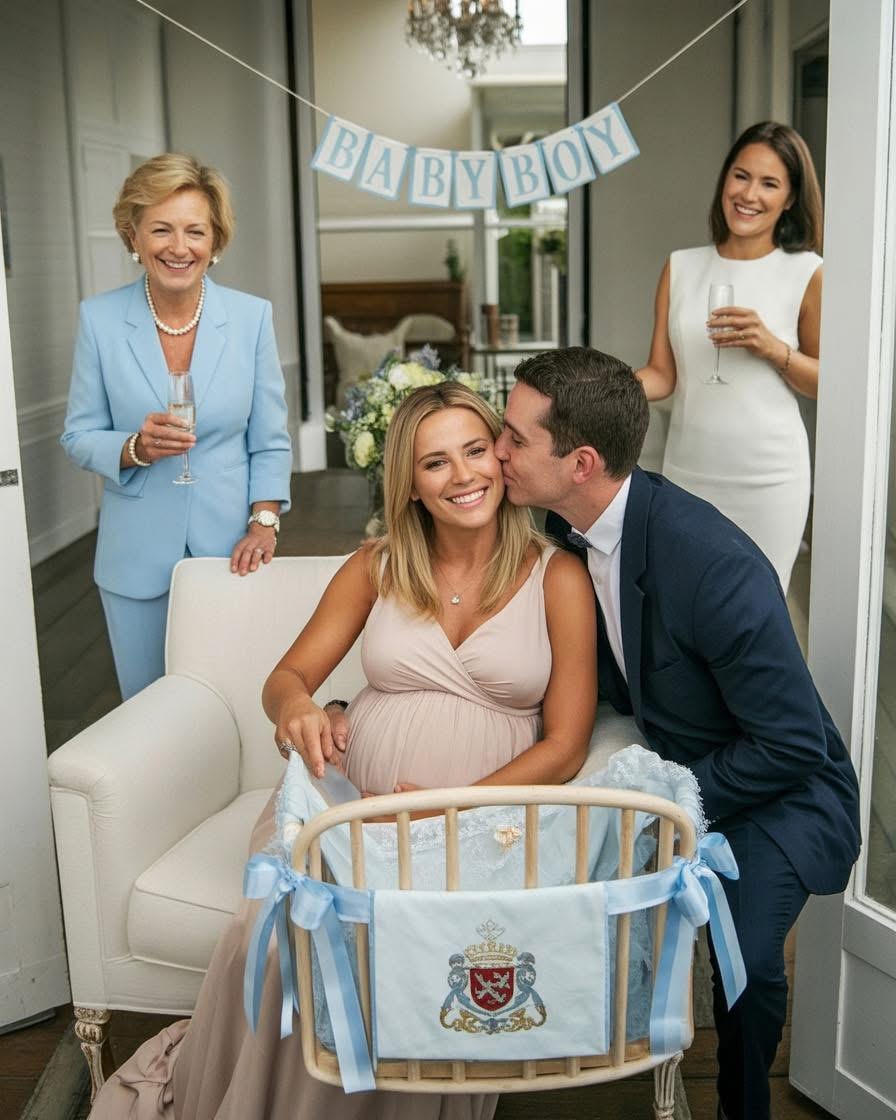
“I’m throwing a baby shower for my son’s mistress,” my mother-in-law smiled, handing me divorce papers and a $700,000 check. “You’re thirty-four and barren. Disappear.” I took the money, got on a plane to Paris—and quietly hired a PI. Six months later, on the day her “twin heirs” were born, DNA results hit her desk. At seven a.m., my Paris doorbell rang. It was her, mascara smeared, whispering: “Caroline… name your price.”
The day my mother-in-law celebrated my husband’s mistress with a baby shower was the day my old life ended.
I remember the color of the tablecloths—pale blue, embroidered with tiny silver crowns. The smell of gardenias twisted together with the sugary scent of fondant icing. The way the chandelier light glittered off the crystal champagne flutes and the silver rattle that would haunt me for months.
I stood near the edge of the living room, clutching a glass of sparkling water I hadn’t taken a single sip from, trying to stay invisible. I wore the dress Eleanor had picked out for me—a soft cream sheath that made me feel like an extra in a movie about someone else’s life. The Mitchell mansion was bursting with people: Houston’s finest, polished and perfumed, dripping diamonds and gossip.
But the star of the show wasn’t me. It was the woman sitting in the center of the room in a pale blue dress that clung lovingly to her eight-month belly. Her blond hair fell in soft waves, makeup flawless and glowing with that particular smugness that says, I’ve already won, and you’re just here to watch.
Amber Lawson. Twenty-eight. Event coordinator. The woman my husband had gotten pregnant with twins. The woman my mother-in-law had decided to crown as savior of the Mitchell bloodline.
“Everyone, everyone, please,” Eleanor said, tapping her spoon against a crystal flute. The room hushed instantly. That’s the kind of power Eleanor Mitchell commanded—one tiny sound, and Houston high society leaned in to listen.
She stood by the fireplace, her silver hair swept into an elegant chignon, pearls glowing at her throat, eyes bright with triumph. She looked radiant, decades younger, like having those babies in the room—even still in utero—had reverse-aged her.
“These past few years have been… challenging,” she began, letting her gaze sweep the room, catching every sympathetic face. “As many of you know, my son Derek and his lovely wife, Caroline”—her eyes flicked toward me, her smile tight—”have struggled to expand our family.”
The air shifted. People glanced at me. Quick, furtive looks, some sympathetic, some curious, some undeniably smug. I lifted my chin and forced my expression into something neutral. I had gotten very good at that expression over the years.
“But life,” Eleanor continued, “has a way of surprising us when we least expect it.”
She floated toward the chair where Amber sat surrounded by pastel-blue wrapped gifts and laughing women. Amber placed one manicured hand over her belly like she was posing for a magazine cover.
“We are blessed”—Eleanor’s voice shook theatrically—”beyond measure to announce that my son will soon welcome not just one, but two little boys into the world.”
The room burst into applause. Someone shrieked. Glasses clinked. Champagne flowed. I watched Derek, my husband of six years, lean down and press a kiss to Amber’s cheek. My stomach twisted so violently I thought I might actually throw up.
My husband didn’t even look in my direction.
“These boys,” Eleanor declared, lifting her glass high, “will carry on the Mitchell legacy. They are the future of our family. True heirs.”
The phrase rang through the room like a church bell. True heirs.
As if I were some faulty factory product that had failed quality control. As if every procedure, every injection, every surgery, every month of hope and disappointment and quiet sobbing in locked bathrooms counted for nothing because my body hadn’t cooperated on Eleanor’s preferred timeline.
I stared at the silver rattle someone handed to Amber, its polished surface engraved with the Mitchell family crest: a stylized M with a laurel wreath and a tiny lion’s head beneath it. The guests cooed, passing around glossy ultrasound photos of two indistinct gray shapes floating in a grainy black sea.
“Look at those noses! Definitely Mitchells.”
“Oh, those are Derek’s cheekbones for sure.”
“Twins! That’s what this family needed. Double the blessing.”
Someone whispered near me, not quite soft enough, “Well, at least now Eleanor can stop pretending she likes Caroline.”
I didn’t turn to see who said it. I already knew. It wasn’t that I hadn’t suspected the affair. The late nights at the office. The “urgent” flights that always got booked last minute. The way Derek had started flinching when I’d bring up our next round of fertility treatments, offering vague excuses about finances and timing.
I’d seen the signs. I just hadn’t wanted to connect them.
It took Eleanor all of three minutes to step from proud hostess to executioner.
“Caroline, darling,” she said, appearing at my side as if she’d materialized out of thin air. She looped her arm through mine, her grip deceptively light. “Come with me for a moment, would you? There’s something we need to discuss.”
I let her lead me down the hallway, away from the laughter and clinking glassware. The noise faded behind us, swallowed by the thick Persian rugs and oil paintings of stern Mitchell ancestors glaring from gilded frames.
She pushed open the door to the study. The room smelled like leather and old money—bookshelves lining the walls, a massive mahogany desk polished to a mirror shine, a decanter of bourbon glowing amber by the window.
“Sit,” she said, gesturing to one of the tufted leather chairs. I didn’t. My legs were trembling so badly I wasn’t sure I could sit without collapsing.
Eleanor walked around the desk, opened the top drawer, and pulled out a manila envelope. She laid it on the desk as carefully as if it were a bomb.
“This,” she said, “is the most generous thing I have ever done for anyone in my life.”
I stared at the envelope. “What is it?”
“Your future.” She slid it toward me. “Open it.”
My fingers felt numb as I flipped the flap and pulled out the contents: a stack of legal papers, thick and crisp. A petition for divorce. My name. Derek’s name. All laid out in cold, neat lines of black ink.
“What is this?” I asked, my voice coming out strange and far away.
“Don’t be obtuse, dear. Divorce papers. Derek has signed his portion already—you’ll see his signature at the bottom.” She tapped the third page with one perfectly manicured nail. “The rest just needs your signature.”
My eyes found Derek’s familiar scrawl and the world tilted. “He… already signed?”
“Of course.” Eleanor’s smile was small and bloodless. “We’ve been working with his attorney to prepare this for weeks.”
“Weeks.” I repeated the word, letting it sink in. While I’d been injecting hormones into my stomach and tracking ovulation and crying over negative pregnancy tests, my husband had been drafting paperwork to end our marriage.
My fingers brushed the second item in the envelope: a check. I pulled it out.
I’ve never forgotten the way those numbers looked on paper.
$700,000.00
The Mitchell family crest was embossed in pale blue in the top left corner. Eleanor’s signature, looping and elegant, sat at the bottom.
“I don’t understand,” I whispered.
“It’s quite simple, Caroline.” Eleanor clasped her hands on the desk and looked at me the way she might look at a maid who’d broken a vase. “You will sign the divorce papers. You will cash that check. Then you will leave Texas. Today, preferably. Tomorrow at the latest.”
My ears rang. “You’re… you’re paying me to leave?”
“I’m compensating you,” she corrected, tone impatient, “for the time you’ve spent… attached… to this family. Consider it a severance package.”
“I’m Derek’s wife.”
“Were,” she said sharply. “Were Derek’s wife. Past tense. Be realistic, Caroline. You know as well as I do that this marriage is over. My son will be a father in a matter of weeks. Those boys need a stable home. A family free of… awkward complications.”
“Awkward complications,” I repeated, not sure whether to laugh or scream. “You mean his actual wife.”
Eleanor sighed, an exaggerated exhale that said she was being very patient with someone very stupid. “You were married to him for six years. You tried—unsuccessfully—to give him children. You failed. He moved on. The situation is tragic, yes, but it is also perfectly clear.”
“I didn’t ‘fail’—” My voice broke. Heat burned behind my eyes. “We had medical issues. We—”
“You are thirty-four years old,” Eleanor said, her voice suddenly sharp as broken glass. “The doctors have told you, what, three times now? Four? That your chances of conceiving are less than five percent? That you’ve had ‘diminished ovarian reserve’ since your twenties? That the likelihood of a successful pregnancy is negligible?”
The words hit me like open-handed slaps. “You read my medical reports?”
“Of course I did. I needed to know what we were dealing with.” She waved off my outrage like it was a fly. “The point is, you are barren, Caroline. And this family needs heirs.”
Barren. She said it calmly, clinically, like a statistic, and something inside my chest splintered.
“You have twenty-four hours,” Eleanor continued, as if she were confirming a catering order. “You will leave Texas, leave my son, leave this house and everything that belongs to this family. You will not contact Derek again. You will not speak to the press, or our friends, or anyone about… private matters.”
“And if I don’t?” The words came out hoarse.
Her lips curled in a small, satisfied smile. “You don’t have the leverage you think you do, dear. You have no children, no career of your own, no claim to the business. You’re a housewife with a history degree and a very expensive wardrobe. What exactly do you imagine you’ll win if you fight this?”
I didn’t answer. Because the awful, terrifying part was that she was right about one thing: on paper, I didn’t look like much of a threat.
Eleanor reached into the drawer again and slid a slim silver pen across the desk. “Take the money,” she said. “Sign the papers. Be grateful.”
That should have been the moment I threw the check in her face. The moment I tore the papers in half and marched into the baby shower and dragged Derek out by his perfectly knotted tie and demanded explanations in front of everyone.
Instead, I picked up the pen.
My hand shook so violently I had to clench my jaw to keep my teeth from chattering. I signed my name in the little box beneath Derek’s, the ink spider-webbing out where a tear fell and hit the paper.
“Good girl,” Eleanor murmured, as if I were a dog who’d finally learned to roll over on command.
When I stepped out of the study, the party was still going strong. Someone squealed with laughter. There was a pop as a champagne bottle was uncorked. A cluster of women hovered around Amber, asking if she’d picked names yet.
Derek caught my eye across the room. For a brief, dizzy second, our gazes locked. I waited for him to cross the room. To look guilty. To look anything. He glanced away, said something to the man beside him, and cupped his hand around his glass as if shielding it from a wind only he could feel.
That was the moment my heart finally stopped trying to make excuses for him.
I left through the side door, the noise of the party muffled as it swung shut behind me. Outside, the Texas sun was blinding, reflecting off the pool and the polished chrome of the luxury cars lined up in the driveway.
My phone buzzed in my clutch. A text, from an unknown number: Your flight is at 9 p.m. tonight. First class to Paris. Ticket is in your email.
Eleanor had booked my escape route before I’d even signed.
I stood in the driveway of the house where I’d celebrated Christmases and anniversaries and fertility milestones. The house where I’d once danced barefoot in the kitchen with Derek while pasta boiled on the stove. The house where I’d sobbed quietly in the shower so he wouldn’t hear.
My fingers tightened around the check. Seven hundred thousand dollars.
I could have thrown it away just to spite her. Could have refused the money on principle. But principle doesn’t pay for plane tickets and lawyers and new lives on foreign continents. Principle doesn’t fund investigations or keep you safe when people richer and more powerful than you decide they’re done with you.
I slipped the check into my clutch, lifted my chin, and walked away.
The flight from Houston to Paris was just under eleven hours. Eleven hours of forced stillness in a metal tube hurtling through the sky, too loud to sleep and too quiet to stop my mind from replaying every moment of the last six years.
I pressed my forehead against the airplane window, the glass cold against my skin. Somewhere below us, the Atlantic churned, uncaring, the border between the life I’d had and whatever waited for me in Paris.
I thought about calling Derek. Thought about sending a message that said, How could you? or You coward, or I am pregnant—because I was. Eight weeks. A fact I’d confirmed three days earlier in our bathroom, hands shaking as two pink lines appeared on the test strip.
I hadn’t told him yet. I’d wanted to wait until after our next doctor’s appointment, until we’d heard a heartbeat. I’d been so afraid of jinxing it, of saying it out loud and having it vanish.
Now, the idea of telling him felt like some cruel joke.
Instead, I did the only thing that made sense. I pulled out my phone, turned on airplane Wi-Fi, and dialed my cousin Patricia.
She answered on the third ring. “Caroline? It’s… God, it’s three a.m. here. Are you okay?”
“No,” I said honestly. “But I’m alive. I’m on a plane.”
“What? Where?”
“Paris.”
There was a beat of silence. Then, more awake, “Start from the beginning.”
I told her everything. The baby shower. The silver rattle. The divorce papers. The check. Eleanor’s words, each one replayed with painful clarity in my mind.
“You’re telling me,” Patty said slowly when I finished, “that Eleanor Mitchell arranged a baby shower for your husband’s mistress, called those twins ‘true heirs,’ handed you divorce papers and a check for seven hundred thousand dollars, and told you to evaporate from Texas within twenty-four hours?”
“That about covers it.”
“And you took the money.”
“I did.” I swallowed. “And I signed the papers.”
On the line, I could hear her breathing, the faint rustle that meant she was pacing. “Okay. Okay. But seven hundred thousand is a lot just to make someone disappear. You’ve been married six years. You don’t have kids. If they really wanted to do this by the book, they could have offered you far less.”
“I know.” I stared at the seatback in front of me. “That’s what bothers me.”
“What do you mean?”
“Why now?” I asked. “They could have waited. Finalized the divorce quietly. Announced the twins after. Eleanor went out of her way to humiliate me. To make a show of it. To make sure everyone saw who was in and who was out before the ink was even dry.”
“She wanted a clean narrative,” Patty said. I could practically see her brain whirring. “Loyal matriarch, long-suffering son, tragic barren wife, glowing young mother of twins. It plays better in the press if you’re neatly removed from the picture before the babies arrive.”
“It felt… orchestrated,” I said. “Like this has been in the works for a while.”
“It probably has,” she agreed. “But still—paying you off to vanish, pushing the divorce that fast… it’s messy. And rich people usually hate messy. They had a reason to rush.”
“I think so too.”
There was a pause. “What do you want me to do, Carrie?”
“I want the truth,” I said. “All of it. And then I want to make sure Eleanor regrets underestimating me for the rest of her life.”
“Okay,” Patty said, and just like that, I felt a weight shift. “Here’s our first move. When you land, I’ll file to request Derek’s DNA as part of the divorce proceedings. I’ll argue it’s relevant because of the timing with the pregnancy—spousal rights, potential children, asset division. We get Derek’s DNA, and then we keep it. Secure, documented. In case we need it later.”
“In case those babies… aren’t his,” I finished.
“Exactly.”
I exhaled slowly. “Do you really think that’s possible?”
She hesitated. “I think whenever something feels this off? It usually is. At the very least, having his DNA gives us options.”
Options. I clung to the word like a life raft.
By the time the plane touched down at Charles de Gaulle, my grief had hardened into something sharper. I wasn’t disappearing. I was repositioning.
Paris smelled different from Texas. Houston smelled like hot asphalt and cut grass and humid air heavy with exhaust fumes. Paris smelled like coffee and bread and cigarette smoke, like wet stone and old books and something that felt like possibility.
The taxi dropped me in front of a narrow building on a quiet street in the Marais district. I’d booked the tiny one-bedroom apartment online in a sleep-deprived daze—a place with creaky wooden floors and a sliver of a balcony overlooking a cobblestone alley. When I stepped inside, it felt like the first thing in months that belonged only to me.
I dropped my suitcase in the middle of the living room and stood there, listening to the unfamiliar city sounds filtering through the open window: a scooter buzzing past, a dog barking, someone laughing in rapid French.
I pressed my palm to my belly, fingers splayed over the flat plane. “Hey,” I whispered. “It’s just you and me now, kid.”
The miscarriage happened three days later.
I woke up in the middle of the night with cramps so severe they stole my breath. At first I told myself it was jet lag, or nerves. Then I felt the warmth between my thighs. In the dim light from the streetlamp outside, my hands came away red.
Time blurred after that. I remember the panic-bright rush of adrenaline, fumbling with my phone to call an emergency number. A stranger’s voice in French, then in halting English, telling me to stay calm. The siren, thin and eerie. The sterile white of the hospital corridor.
The doctor—dark hair pulled back, kind eyes, glasses perched on her nose—introduced herself as Dr. Simone Lauron.
I remember her hand on my shoulder as she delivered the news I already knew in my bones. “I’m so sorry, Madame Mitchell. The pregnancy… has ended.”
The world tilted. I clutched the thin hospital sheet, knuckles white. My body felt hollowed out, like something vital had been scooped from inside me.
I’d lost a baby before I even had the chance to fully believe in its existence.
I didn’t cry in front of the doctors. I asked practical questions—about my hormones, about future fertility, about what I should do next. Years of medical appointments had trained me to be efficient around professionals.
It wasn’t until I was back in my little apartment, the discharge papers crumpled in my tote bag, that the dam cracked. I lay on the couch and sobbed until my throat burned and my eyes swelled shut. I cried for the baby that would never be. For all the babies who had never been. For the six years I’d spent contorting myself into whatever shape I thought might make me worthy of the Mitchells’ approval.
I let myself fall apart for one night.
The next morning, I called Dr. Lauron. “I’d like to schedule an appointment,” I said. “Not for gynecology. For… for talking.”
She paused. “For therapy?”
“Yes.”
“Can you come this afternoon? I had a cancellation.”
That first session with Simone was mostly me telling the story from the beginning. She didn’t interrupt much. Just asked a few gentle questions, took notes, and handed me tissues when I’d get choked up.
At the end, she said, “You have been through an extraordinary amount of trauma in a very short time, Caroline.”
“It feels… stupid to call it trauma,” I muttered. “People go through worse.”
She smiled faintly. “Pain is not a competition. What you experienced is real.”
Week after week, in that small office with the crooked framed print of Monet’s water lilies, we unpacked the six years I’d spent under the Mitchell microscope. And in between sessions, I started building a life. I took a marketing position at a small French cosmetics company. I stumbled through conversations in French. I learned to navigate the markets, to buy fresh bread in the morning and vegetables in the afternoon.
At night, when the quiet felt heavy, I reminded myself that I had options. That I wasn’t just hiding; I was planning.
Three weeks after I arrived in Paris, Patty called.
“Got it,” she said without preamble.
“Got what?”
“Derek’s DNA sample. The judge granted our request. Court-ordered paternity test. The sample is documented and sealed.”
I walked to the window, pressing my palm to the cool glass. “We’ll need it,” I said.
“So what’s our next move?”
“I need to know who Amber really is,” I said. “Where she came from. What she wants. Whether those babies she’s carrying are actually Derek’s.”
“That will require someone who can dig deeper than I can from court filings,” Patty said. “Let me make a call.”
The person she found was a man named Marcus Webb. His voice was low and steady, with the faintest hint of a Southern drawl. He didn’t waste words.
“What do you want to know about Ms. Lawson?” he asked.
“Everything,” I said. “Where she grew up. Who her parents are. How she met Derek. Whether she’s… who she says she is.”
“You’re thinking she targeted your husband.”
“I’m thinking,” I said slowly, “that Eleanor has been whining about the lack of grandchildren in every society magazine for years. If I were a young, ambitious woman with a flexible moral compass who wanted a shortcut into wealth, that would look like an opportunity.”
“And the children?”
“I want to know if they’re actually Derek’s,” I said. The words tasted bitter. “Because if they’re not, Eleanor just restructured her entire world around a lie.”
“Understood,” he said. “My fee is—”
“I don’t care,” I cut in. “I have seven hundred thousand reasons not to care about cost.”
He gave a short, humorless laugh. “All right.”
The first report came a month later.
I opened Marcus’s email in a café near my office, my hands trembling slightly as I scrolled through the attached PDF.
“Amber Lawson,” Marcus had written in his summary, “is not what she appears to be.”
She’d grown up in a small town in Oklahoma, nowhere near the polished sophistication she projected. Her father had a string of failed businesses and a mild gambling problem. Amber herself had bounced between community college and odd jobs, reinventing herself in each new social circle.
She had no formal training in event planning. The title on her LinkedIn was largely self-assigned, based on a handful of charity galas where she’d volunteered and then parlayed the photos into an online portfolio.
“What she does have,” Marcus wrote, “is an impressive talent for reading people.”
He’d traced her social media back two years. She’d followed every major Houston family online, studied their habits, learned which charities they favored, which restaurants they frequented. She’d attended three charity events in the six months before she “randomly” met Derek—each one chosen specifically because the Mitchells were sponsoring them.
“She researched him,” Marcus said when we spoke later. “Found out his routines. His clubs. His favorite scotch. She learned about your fertility treatments from an article quoting Eleanor, then made sure to be sympathetic when she and Derek started spending time together.”
My stomach knotted. “She knew, before she met him, that I couldn’t get pregnant easily.”
“She knew,” Marcus said, “that Eleanor was publicly obsessed with grandchildren. That there was a vulnerable man stuck between a demanding mother and a wife going through medical hell. And she moved in like a shark scenting blood.”
There were photos attached to the report: grainy shots of Amber entering and leaving expensive hotels, close-ups of her holding hands with a man who definitely wasn’t Derek.
A man I recognized.
“Victor,” I breathed.
Derek’s business partner. Victor Chin. The man who’d toasted our third anniversary. The man who had clapped Derek on the back at the baby shower.
“Their affair predates her relationship with your husband,” Marcus said. “I’ve got hotel receipts going back two years. Phone records. Photos.”
“So she was sleeping with Victor,” I said slowly, “while seducing Derek.”
“Seems that way.”
“Does Victor know she’s pregnant with Derek’s…” I caught myself. “With twins everyone thinks are Derek’s?”
“Based on what I’ve seen?” Marcus said. “Yeah, I’d say he knows they’re his.”
“Jesus.”
I closed my eyes, head spinning.
“Can we prove it?” I asked after a moment.
“That they’re his, not Derek’s? Sure. I have a contact at a hospital lab in Houston. When the babies are born, I can arrange a quiet comparison. Nothing official, nothing admissible in court. But enough to tell you the truth.”
“Do it,” I said.
The months slid by. Spring crept into Paris with shy blossoms on the trees and rain that turned the cobblestones slick and shining. I went to work, made friends with my coworkers, learned how to complain about the metro like a local.
In therapy, Simone and I talked about anger.
“I don’t want to be consumed by it,” I told her one day. “But I also don’t want to forgive them. Not now. Maybe not ever.”
“Forgiveness is not a requirement for healing,” she said. “Sometimes, recognition is enough. Naming what happened. Acknowledging it was wrong. Deciding what you will do with that knowledge.”
“What I want to do,” I admitted, “is burn their world down.”
“Revenge can be seductive,” she said. “It promises control. But it often binds you to the very people you want to escape.”
“I don’t want to be bound to them,” I said. “I want them to know what they cost me. And I want to walk away, knowing they finally see it too.”
“Then maybe,” she said, “we look for justice instead of revenge.”
“I want justice,” I decided. “With a side of consequences.”
She smiled. “That seems reasonable.”
The twins were born in April.
“They came early,” Marcus said. “A few complications, but everyone’s fine. Two boys. Healthy.”
I sat at my small kitchen table, fingers curled around a mug of coffee gone cold. “And?”
“And,” he said, “I got the samples. I’ll have results in forty-eight hours.”
Forty-eight hours later, my phone rang while I was in the produce aisle, examining tomatoes.
“It’s confirmed,” Marcus said. “Derek is not the father of those twins.”
I sagged against the cart. “You’re sure?”
“One hundred percent. The DNA comparison shows no match to Derek’s markers. The babies are a perfect match to Victor Chin, though.”
I paced between the apples and oranges. “Does Derek know?”
“Not yet,” Marcus said. “But you’ll want to hear this. I kept digging. Eleanor’s been paying a private investigator of her own for the last year. She knows about Amber and Victor.”
“Since when?”
“Before the baby shower. Before she handed you the check. At least six months before the boys were born.”
“She knew.” The words came out flat.
“She knew,” Marcus confirmed. “And she went ahead and presented those twins as Mitchell heirs anyway.”
I paced. “Why?”
“Because,” Marcus said, “your ex-husband’s fertility issues go deeper than you were told.”
My stomach tightened. “What does that mean?”
“Derek had a serious illness as a kid. High fevers, complications. One of the side effects is a high likelihood of sterility.”
A cold wave washed over me. “Eleanor… knew that?”
“For decades. The doctors told her his chances of fathering children were low. Very low.”
“She still pushed us through years of fertility treatments knowing that.”
“Looks like it. Maybe she hoped the doctors were wrong. Or maybe,” he said, voice dry, “she just liked having someone to blame.”
“That’s why she fixated on my ‘failure,’” I whispered. “Why she was so vicious. If Derek was sterile, that meant the problem was her bloodline, not mine. Easier to point the finger at me.”
“Exactly. So when Amber turns up pregnant, it’s Eleanor’s miracle. She doesn’t care whose DNA is actually involved, as long as she gets babies.”
“What about the family trust?” I asked suddenly.
“That,” Marcus said, “is where it gets fun.”
The Mitchell family trust had been set up by Derek’s great-grandfather. One of the ironclad clauses: control of the trust could only pass to a “direct biological heir bearing the Mitchell name.” If no biological heirs were produced, control would pass sideways to the next eligible branch.
“In your case,” Marcus said, “if Derek can’t produce biological children, and if those twins aren’t his, control of the trust goes to a cousin named Harold Mitchell in Tulsa.”
I almost dropped my phone. “Harold? The one Derek calls ‘Cousin Chainsaw’?”
“The very same. And from what I can see, Harold and Eleanor despise each other.”
“So if it comes out that the boys aren’t Derek’s…”
“Eleanor loses control of the trust,” Marcus said. “The money. The houses. The company. Everything. It all goes to Harold.”
The fluorescent lights buzzed overhead.
“Send me everything,” I said. “Every photo, every lab result, every financial record. I want copies of it all.”
Six months after I left Texas with a check in my clutch and my heart in pieces, my doorbell rang at seven in the morning.
I was in pajamas—old sweatpants and a T-shirt—cradling a mug of coffee, my hair in a messy bun. When I opened the door, the past stepped into my hallway.
Eleanor stood there, her usually immaculate hair slightly mussed, makeup smudged beneath bloodshot eyes. Her designer suit was wrinkled, the pearl buttons on her blouse mismatched. She looked like she’d aged a decade in six months.
“Caroline,” she said, her voice rough. “Please. I need your help.”
If she’d slapped me, I couldn’t have been more shocked.
I leaned casually against the doorframe. “You came a long way. Did Houston run out of people to insult?”
She flinched.
“May I come in?” she asked.
“I don’t know,” I said slowly. “Last time we were in a room together, you bought my absence from your life. I wouldn’t want to violate the terms of that arrangement.”
“Please.” Her composure cracked. “I wouldn’t be here if it weren’t important.”
I let the moment stretch, then stepped aside. “Fine. Come in. Wipe your feet. These floors are mine, and I actually care about them.”
She walked past me, nose crinkling almost imperceptibly at my modest furnishings. Even now, when she was clearly desperate, she couldn’t hide that instinctive judgment.
“Coffee?” I asked sweetly. “Or is it too pedestrian for Mitchell taste?”
“Coffee would be… lovely,” she said, sinking into the chair by the table like her bones had given up on her.
I set a mug down in front of her and took my seat across from her. For a moment, we just sat there, the silence thick between us.
Finally, she said, “The babies…”
“Ah,” I said. “The twins. Your ‘true heirs.’ How are they? Sleeping through the night yet?”
Something flickered in her eyes—shame, maybe, or memory. “There is something wrong. I mean… not wrong with them. They’re healthy. But something is wrong with the situation. This is all coming apart, Caroline, and I… I need you.”
I took a slow sip of coffee. “You mean, you need the barren ex-wife you paid to disappear?”
Color rose in her cheeks. She stared at the table.
“Tell me,” I said. “Exactly what’s ‘wrong.’”
She twisted the mug in her hands. “There are… questions. People are asking questions. About the boys. About… about their father.”
“You mean their biological father,” I said. “Victor Chin.”
Her head snapped up. “How did you—”
“If you’re going to ask me for help,” I said, “you might want to start from the assumption that I am not the stupid, broken girl you thought I was.”
She swallowed. “Do you… know everything?”
I reached to the counter and picked up a manila folder. I laid it on the table and opened it, spreading the contents between us.
Photos of Amber and Victor entering hotels together. Receipts. Phone logs. The lab report matching Victor’s DNA to the twins’. Financial records showing a payment to Amber from an account Eleanor controlled, dated just before the baby shower.
I watched the blood drain from Eleanor’s face.
“I know,” I said, “that Amber is a professional con artist who targeted your family. I know she was sleeping with Victor while seducing Derek. I know those babies are Victor’s sons, not Derek’s. And I know you knew that before they were born.”
Her shoulders sagged. “I didn’t mean for it to go this far,” she whispered.
“Yes, you did,” I said. “You meant for it to go exactly this far.”
Her eyes darted to mine. “You know about the trust conditions.”
“Biological heirs only,” I said. “Or everything passes sideways to Cousin Harold in Tulsa.”
She closed her eyes briefly. “If this truth comes out, I lose everything. The company. The properties. My life’s work.”
I lifted one eyebrow. “Your life’s work? Interesting way to describe sitting in a mansion and hiring decorators.”
Her head snapped up. “You have no idea what it’s taken to hold that family together. Everything I’ve done—every choice I’ve made—has been to keep the Mitchell name alive.”
“That may all be true,” I said. “But you don’t get to use your past sacrifices as a hall pass for present monstrosity.”
She opened her mouth, closed it. Her hands were shaking. “What do you want, Caroline? I will do anything. Pay anything. Just… help me.”
“What you built,” I corrected. “You haven’t thought of Derek as part of that ‘we’ in years.”
“Of course I have—”
“If you had,” I said sharply, “you wouldn’t have made him believe my body was the problem when you knew he’d been sterile since childhood. You wouldn’t have dragged us through years of treatments for a statistical impossibility just so you’d have someone to blame. You wouldn’t have thrown a party for his mistress and called her children ‘true heirs’ while I stood in the corner like furniture.”
Silence.
“You hurt me,” I said. “You broke me. You broke your son. You used us like props in your personal legacy play. And now that the set is collapsing, you come to me for help?”
Her eyes filled with tears. It was the first time I’d ever seen her cry without an audience.
“I didn’t know you were pregnant,” she whispered.
The words slammed into me.
“You… what?” I asked.
“I know about the miscarriage,” she said, voice shaking. “Patricia told me. I didn’t know. When I gave you that check, when I told you to disappear, I didn’t know you were… you had…”
“Would it have mattered?” I asked.
She stared at me, eyes rimmed red. And in that one, raw second, I saw the truth. No.
“I didn’t know,” she repeated, but it sounded more like a plea than a defense.
“I was eight weeks,” I said evenly. “We had tried for years, and when I finally saw two lines on that test, I thought… maybe. Just maybe, this time.”
Tears spilled over. “I am so sorry. I can never… there is nothing I can say that will…”
“You’re right,” I said. “There’s nothing you can say. But there are things you can do.”
She latched onto that like a drowning person spotting a lifeboat. “Anything. Name it.”
“Two point three million,” I said.
Her eyebrows shot up. “Two point three… why that number?”
“Seven hundred thousand was what you thought my silence was worth. Two point three million brings us to an even three. Three million feels like a more accurate valuation for what you took from me.”
She swallowed. “Transferred where?”
I slid a piece of paper across the table with my Paris bank account details. “There. Within seventy-two hours.”
“Done,” she said immediately. “I’ll call the bank—”
“I’m not finished,” I said.
She fell silent.
“In addition to the money,” I continued, “I want a written confession from you. A complete account of everything you did. When you discovered the twins weren’t Derek’s. Every payment to Amber. Every lie you told. Signed, notarized, and delivered to my cousin Patricia for safekeeping.”
Her face went slack. “A confession? Absolutely not. If that ever got out—”
“It won’t,” I said calmly. “Unless I decide you’ve stopped holding up your end of our bargain.”
“You’re blackmailing me.”
“Yes,” I said. “Consider it a legacy lesson: actions have consequences.”
“I could go to prison if that confession…” She pressed a hand to her chest.
I tapped the folder between us. “Eleanor, darling, the gun already exists. I’m just offering you the chance to determine where it’s pointed.”
Her jaw clenched. “If I refuse?”
“Then these documents go to Harold Mitchell. And to the firm that manages the trust. And to every society journalist who ever fawned over your ‘family devotion.’ Your world will implode, and you won’t have any say in how it happens.”
“You wouldn’t,” she whispered. “You’re not cruel.”
“I wasn’t,” I said softly. “You taught me.”
Tears trembled on her lashes. “You would really destroy Derek like that?”
“You destroyed him,” I said. “I’m just holding up a mirror.”
She stared at the table, breathing hard. I could see the calculation flickering behind her eyes.
“I’ll transfer the money,” she said at last. “And I’ll write what you asked.”
“Patricia will expect it within a week. In return, I will keep what I know to myself. For as long as you honor our agreement.”
She nodded, defeated. “You have my word.”
At the door, she hesitated. “Will you… will you ever be able to forgive me?”
I considered her: the trembling hands, the drawn mouth, the haunted eyes. The woman who had allowed fear to calcify into cruelty.
“I don’t know,” I said. “But I know that my ability to forgive you isn’t your right. It’s my choice. And it won’t be bought with money.”
She nodded, tears spilling over again. “I understand.”
At that moment, I realized she did. For the first time, Eleanor understood that there were things in the world she could not purchase, bully, or manipulate into submission.
The money hit my account three days later.
Patty called me, voice buzzing with a mixture of outrage and admiration. “I’ve seen some wild stuff in family law, but extorting your ex-mother-in-law for two point three million and a notarized confession may be my new gold standard.”
“I didn’t extort her,” I protested halfheartedly. “I offered her a mutually beneficial agreement.”
“That’s what extortion is,” she said, amused. “How’s the confession?”
“Thorough,” Patty said. “It reads like someone on the verge of a nervous breakdown trying to get right with whatever god guards rich people. She admits to knowing about Victor’s paternity, about paying Amber, about pressuring Derek not to ask questions. She even mentions how she used your infertility to deflect from Derek’s medical issues.”
Somewhere in my chest, an old knot loosened. “So if she ever tries to screw me again…”
“We have a nuclear option,” Patty said. “You’re in control now, Carrie.”
It felt good. Not in a gloating way. In a quieter way. Like finally having a safety net after years of walking a tightrope.
I didn’t buy an island. I did, however, upgrade my apartment to one with two bedrooms and a little terrace where I could drink my coffee and watch the city wake up. I invested in my company, taking on bigger projects, pushing myself in ways I’d once been too afraid to try.
For the first time in a long time, I made decisions without wondering what the Mitchells would think.
As for Derek, the universe and a furious woman named Rebecca Chin took care of that.
Rebecca was Victor’s wife—late thirties, smart, quiet, a dermatologist with a thriving practice. She had no idea her husband had fathered twins with a con artist.
I could have told her back then. But I’d waited. Until Eleanor came to my door. Until I had her confession. Until the boys were old enough that the truth wouldn’t hurt their basic needs.
Then, one evening, I dialed Rebecca’s office number.
“This is Dr. Chin,” she answered.
“Hello, Dr. Chin. My name is Caroline. I used to be married to your husband’s business partner.”
There was a pause. “Derek Mitchell.”
“Yes.”
“I see. Is this about the recent developments?”
“My call is about the twins and about your husband’s involvement with their mother. I have documentation. DNA tests. Photos. Financial records. All proving that your husband and Amber have been involved for years and that he is the biological father of her twins. Not Derek.”
When Rebecca spoke again, her tone was calm. Too calm. “I would like to see those documents.”
“I can email them to you.”
“Email is fine,” she said. “And Caroline?”
“Yes?”
“Thank you.”
There was a level of contained fury in those two words that made me almost pity Victor. Almost.
The fallout hit Houston society like a bomb. Marcus sent me links to article after article. The headlines were brutal.
“Mitchell Heir Scandal: DNA Test Reveals Shocking Truth.”
“Business Empire in Turmoil: Partnership Dissolves Amid Paternity Fraud.”
Rebecca filed for divorce within a week. Amber fled Texas with the twins, ending up working as a waitress in a San Diego diner. Derek called me once. I listened to his voicemail later, alone in my apartment.
“Carrie, it’s… it’s Derek. I know I’m the last person you want to hear from. I just… I needed to say I’m sorry. I was an idiot. I believed everything Mom told me. About you. About our chances. I let her convince me that the problem was you. I’m seeing a therapist now. I heard about the miscarriage. I’m so sorry, Carrie. You deserved support. You deserved love. I hope you’ve found something better. I hope you’re happy. You don’t have to call me back. I just needed to say… I’m sorry. For everything.”
I stared at my phone for a long time. I thought about the boy I’d met at that gala. The man who’d danced with me in the kitchen. The husband who’d held my hand during injections. The stranger who’d kissed his pregnant mistress at a party while I stood watching.
“I forgive you,” I said out loud to the empty room.
Then I deleted the message and moved on.
Eleanor kept control of the trust. Technically, anyway. Harold never got his hands on the Mitchell fortune because the lab results and confession remained locked away. But in every other way that mattered, she lost.
The society ladies who’d once hung on her every word now whispered whenever she entered a room. Derek moved to Austin, putting distance between himself and his mother. The twins grew up in California, far from the Mitchell name.
Everything Eleanor had tried to force into existence slipped through her fingers like water.
She wrote me a letter one year later. It arrived in a cream envelope, my name written in looping script.
I carried it upstairs, set it on my table, and stared at it for ten minutes before finally opening it.
Caroline,
I have spent the past year trying to justify myself. None of that changes the fact that I was cruel to you. I was cruel when I blamed you for something that was never your fault. I was cruel when I threw a party for his mistress and made you watch. I was cruel when I handed you money and treated you like an inconvenience to be removed.
I did not know you were pregnant when I did those things. If I had known… I would like to say I would have acted differently. I don’t know that this is true. That is perhaps the most damning realization of all.
I lost my son’s trust. I lost my daughter-in-law. I lost the grandchild you carried. I lost the only version of family that might have truly loved me back.
I do not expect your forgiveness. I do not deserve it. But I needed you to know that I understand, finally, what I destroyed. And that you were never the useless, barren girl I convinced myself you were. You were the only one in that house brave enough to leave when leaving meant starting over with nothing.
Except, of course, you did not leave with nothing. You left with my money. And you turned it into freedom.
I hope you are happy, Caroline. Truly happy.
– Eleanor
I read it twice, hands trembling. Then I folded it and placed it in the drawer.
I didn’t forgive her. Not yet. Maybe not ever. But I acknowledged that once upon a time, she had loved something other than money and control. That somewhere beneath the layers of pearl and poison, there was a woman who had been scared and desperate.
That didn’t excuse what she’d done. It just made her human.
My life in Paris didn’t turn into a fairy tale. That’s the thing nobody tells you about starting over: you still have to pay rent and do laundry and deal with coworkers who microwave fish in the office kitchen.
But it was mine.
I woke up to the sound of buses and birds. I walked to work, stopping for a croissant at the bakery where the owner now greeted me by name. I spent my weekends wandering museums, standing in front of paintings I’d once taught about and thinking, I made it all the way here. On my own.
Sometimes, when I’d see a family at the park, I’d feel a pang. An echo of the life I’d once pictured. But what I had instead was a quiet apartment in a city I’d chosen, a career I was good at, friends who knew me as Caroline, not as an accessory to a man or a name.
Simone and I eventually ended our sessions. “I think you know how to carry this on your own now,” she said.
“Will the anger ever go away completely?” I asked.
She smiled slightly. “Probably not. But anger can be a compass, not just a weapon. It can remind you what you will no longer tolerate.”
“Do you think I’ll ever try again?” I asked. “For a child?”
“I think,” she said, “that you will make choices from a place of self-respect now, rather than fear. Whether that leads you to motherhood or to a different path, only you can decide. And you do not have to decide today.”
So I didn’t. I let the question sit beside me instead of gnawing at me. A possibility, not a verdict.
I sometimes thought about Amber. Not in a vindictive way. More in a baffled one. She had been so sure she could game the system. Instead, she’d ended up slinging coffee in a California diner, raising twins who would never inherit a Texas empire.
Part of me felt sorry for them. None of this had been their fault.
I sometimes stand on my little terrace in the evenings, the city spread out below me, and think about that day in the study. The gleaming desk, the crisp papers, the cool weight of the pen in my hand.
Eleanor thought I was signing away my future. She had no idea I was signing the first line of a new story.
And this time, I’m the one who gets to decide how it ends.
Eleanor thought she’d written me out of her story. She thought seven hundred thousand dollars would buy my silence and my erasure.
Instead, she funded my freedom.
She paid for my plane ticket, my rent, my therapy, my investigation. She paid for the coffee I drank while reading the lab results that undid her carefully curated narrative. She paid for the lawyer who now held her confession in a vault.
She paid, without meaning to, for the life I was always meant to have—not as someone’s wife or someone’s disappointment, but as my own person.
Eleanor thought I was signing away my future that day in her study. She had no idea I was signing the first line of a new story. And this time, I’m the one who gets to decide how it ends.