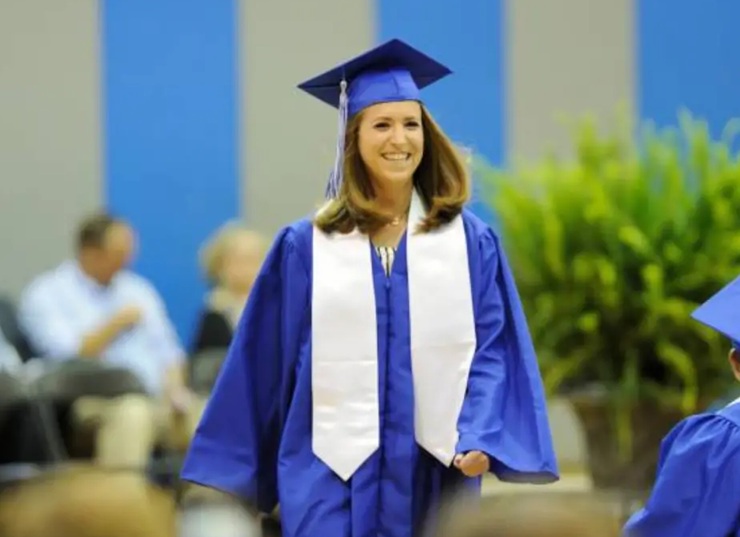
The last syllable of my valedictorian speech had barely left the microphone when my father’s voice cut through the arena like something thrown.
“Don’t clap — I paid for that degree, not her!”
It didn’t sound like anger. That was the thing that would stay with me longest afterward — the absence of anger in it. It sounded like correction. Like a man setting a record straight in front of witnesses because the record had been wrong and he’d been waiting for the right moment to fix it.
Two thousand heads turned toward section 114 with the eerie synchrony of a crowd that has just heard something it cannot immediately process. Programs stopped mid-flutter. A child’s bouquet from the campus bookstore drooped in someone’s loosening hand. The giant scoreboard screens still read CONGRATULATIONS, CLASS OF 2026 in the particular gold and blue of Hargrove University, and the brightness of them suddenly felt wrong — too festive, too certain, too loud.
I stood at the podium with my fingers locked around its edges, because if I let go, two thousand people would watch my hands shake.
The microphone picked up the faintest tap of my nails against the wood.
My honor cord brushed my wrist, and I remember thinking, with the strange clarity that arrives in moments of acute shock: I bought this cord myself. With tip money. Saturday double shifts at the restaurant on Clement Street, the kind of shifts that end with your feet aching and your hair smelling of fried food, the kind that you reframe in your mind as building character because the alternative framing is too heavy to carry.
My father was still standing in section 114, his navy blazer open, his chin lifted in the direction of the stage. He looked pleased. Not triumphant, not cruel — pleased, in the way a person looks when they have just delivered information they consider important and long overdue.
“Her gown, her books, her tuition — me,” he said, pointing down at the stage with the finger of a man identifying something that belongs to him. “She doesn’t get applause for what I paid for.”
The friends he’d brought — three of them, men I’d met at exactly two family dinners — sat behind him with their eyes fixed forward and their shoulders pulled in, performing invisibility with the determination of people who have suddenly and unwillingly become part of something they want no part of. A woman three rows below had been recording on her phone. She lowered it slowly, the way you lower something you’ve realized you shouldn’t be holding.
My chest was thundering so hard I could feel it in my back teeth.
I did not flinch.
This is the part of the story I want to be precise about, because it would be easy to make it sound like composure I was born with or courage I discovered in the moment. It was neither. It was preparation. It was the specific steadiness that comes not from being unafraid but from having already thought through what you would do if this happened, and having done the work that made the thinking possible, and knowing that the work was documented and verified and sitting in a folder that had already passed through the right hands.
I knew something my father did not know.
Dr. Pauline Hartwell, the Dean of Hargrove University, was sitting six feet from me in full academic regalia — the deep burgundy hood of her doctoral degree, the gold medallion of her office, the expression of a woman who has managed this institution for sixteen years and has developed, over those sixteen years, the particular quality of calm that belongs to people who have already made decisions and are simply waiting for events to catch up with the paperwork.
She had reviewed the folder three days ago. She had read every page of it. She had asked me one question when she finished, and I had answered it, and she had closed the folder and looked at me across her desk and said: I’ll make sure everything is in order for Saturday.
Her eyes flicked once toward the side aisle of the arena. I followed the movement without turning my head.
Two campus security officers were already in the aisle, moving toward section 114 with the unhurried certainty of people who were told to be ready and are now being ready.
My father, feeding off the silence that had fallen over the arena, continued.
“Don’t clap,” he said again, louder now, with the momentum of a man who has mistaken the absence of resistance for agreement. “You all think she did this on her own? I made this happen. Every semester. Every bill. That diploma has my name on it.”
I let him have the moment.
I let him stand in the lights of that arena and show two thousand people — faculty, families, graduating seniors in their gowns, the local newspaper photographer, the video crew from the university communications office — exactly who he was.
I let him do it because I had learned, over twenty-three years of being his daughter, that the most effective thing I could do was stop trying to interrupt the performance and let it finish. People reveal themselves completely when they believe they are winning.
Then I smiled.
It was small and controlled — the kind of smile that appears on a person’s face when they have stopped asking for permission and are simply proceeding. The kind that is not about happiness but about the specific relief of a decision that has already been made.
I stepped back to the microphone.
The arena went quiet in the way that large spaces go quiet when something is about to happen and everyone in them understands this simultaneously. I could hear a chair creak somewhere in the upper bleachers. I could hear the faint squeak of a sneaker on the polished floor near the stage stairs. My tassel moved against my cheek when I turned my head, and in that fraction of a second I saw my mother clearly — her hands smelling of dish soap, pressing my fifth-grade report card to the refrigerator with the flat of her palm like she was mounting something sacred, her voice saying: This one’s going somewhere.
She had died when I was fourteen. Ovarian cancer, diagnosed in February, gone by October, the kind of timeline that doesn’t leave room for gradual adjustment or proper preparation. It leaves only the fact of absence and the necessity of continuing anyway.
My father had remarried within eighteen months. This is not the villainous part of the story. People grieve in their own ways and on their own timelines and I had no claim on his. The part that required documentation was different.
My mother had applied, while she was still alive, for the Haverford Memorial Scholarship — a full-ride academic award offered through Hargrove University’s endowment, named for a family who had lost their own daughter to illness and wanted her name attached to the education of young women who demonstrated both academic excellence and financial need. My mother had filled out the application herself, during the months when she was still well enough to sit at the kitchen table for long stretches. She had submitted it two weeks before her diagnosis worsened. She had written in the essay section, in her particular looping handwriting, about her daughter who was going to be someone.
The scholarship was awarded posthumously — or rather, it was awarded to me, at seventeen, on the basis of an application my mother had begun and I had completed, under her name and mine, after she died. Full tuition, room and board, books, fees. Four years. Hargrove University’s most significant undergraduate merit award.
My father had not applied for it. My father had not funded it. My father had not been involved in the process at any point, including because he had not been particularly involved in my life at any point following his remarriage, a situation that had suited us both in different ways.
What my father had done — what he had been telling people for four years, at family dinners and neighborhood gatherings and apparently whatever conversation had preceded his appearance in section 114 today — was claim that he had paid for my education. Claim it with the specific confidence of a man who either had forgotten the actual sequence of events or had decided that the version he preferred was more useful.
What I had also done, beginning in my sophomore year when I understood the shape of what was happening, was keep records.
The scholarship award letters, dated and official. The disbursement records showing every semester’s payment directly to the university from the Haverford endowment. The emails I had sent my father, regularly, containing updates on my academic standing and financial situation, to which he had not responded but which were therefore timestamped and documented. The monthly transfers he had demanded from me — my share of “family expenses,” he called it — which I had paid from my restaurant earnings, which were also documented, and which constituted a financial flow in precisely the opposite direction from the one he was currently describing to an arena full of people.
The folder Dr. Hartwell had reviewed contained all of it, organized chronologically, with a cover letter from the university’s financial aid office confirming the scholarship record and a letter from my own attorney confirming the bank records.
My father had stood up in an arena of two thousand people and confessed, loudly and with considerable confidence, to a lie that was sitting documented in the Dean’s office.
I leaned into the microphone.
The arena was quiet in a way that arenas almost never are — not the focused quiet of an audience waiting for something they expect, but the held-breath quiet of people who are not sure what they are about to witness.
I spoke seven words. Calm, clear, unhurried. Loud enough for every corner.
“Mom’s scholarship paid for this degree.”
The sound of them moved through the arena and settled.
In section 114, my father’s expression changed. Not dramatically — there was no collapse, no cinematic crumbling. It was smaller than that. The pleased certainty went out of his face the way light goes out of a room when someone finds the switch, and what was underneath it was something I recognized from childhood: the specific look of a man realizing that the room has information he didn’t know the room had.
Dr. Hartwell stood.
She did not look at my father when she stood. She looked at the audience, at the graduating class, at the faculty seated in their regalia along the stage. When she spoke, she used the voice she used for commencement addresses — clear, authoritative, filling the space without effort.
“On behalf of Hargrove University,” she said, “I want to acknowledge what this class already knows: that the degrees being conferred today represent the individual work and individual sacrifice of each graduate. This institution has complete financial records for every enrolled student.” She paused, precisely. “Every one of them.”
The security officers had reached section 114.
My father looked at them and then looked back at the stage, and something moved through his expression that I did not have the energy or the inclination to name. His friends beside him were actively studying the floor.
One of the officers leaned down and said something close to my father’s ear. My father’s chin dropped for the first time since he’d stood up.
He left the arena between the two officers, and the crowd watched him go, and then — slowly, and then all at once, the way applause builds from scattered individual decisions into something collective and self-sustaining — the arena began to clap.
It wasn’t the polite applause that greets the end of an expected speech. It was something different. It had the quality of a crowd that has witnessed something it didn’t expect and is responding to it from an honest place rather than a polished one. Faculty members I had never spoken to were standing. In the student section, my classmates — people I had studied with and eaten terrible dining hall food with and pulled all-nighters with and leaned on in the particular ways that four years of proximity creates — were on their feet.
Somewhere in the crowd, I heard someone shout my name.
I stood at the podium and held it for a moment, not performing it, just receiving it — which is something I had never been particularly good at, having spent most of my life in the mode of giving rather than receiving, providing rather than accepting, being the one who made sure the balance was right. My mother had tried to teach me to receive things gracefully. She had said: Let people give to you sometimes. It doesn’t make you less.
I thought about her, then, in that arena with the applause moving through it like something physical. I thought about the kitchen table and the report card on the refrigerator and the scholarship application she had filled out with her looping handwriting during the months when she was still well enough to sit up, making a plan for a future she wouldn’t be in because she wanted to make sure I would be. I thought about the specific quality of her belief in me — not the loud, performative belief of people who need you to succeed for reasons that are about them, but the quiet, daily, actionable belief of a woman who applied for scholarships and pressed report cards to refrigerators and said, in the most ordinary voice: This one’s going somewhere.
She had been right.
Not because of what my father had provided, which was very little.
Because of what she had arranged, and what I had continued, and what four years of restaurant shifts and documented receipts and late nights and the particular stubbornness of someone who has decided that the narrative of their own life is not available for external revision had built into something that could stand up in front of two thousand people and be honest about itself.
The rest of the ceremony proceeded with the orderly momentum of institutional events that have contingency plans for disruption. Dr. Hartwell had, I would learn later, indeed made sure everything was in order for Saturday, which included a brief conversation earlier that morning with the university’s communications director about how to handle whatever might occur in section 114. The photographer from the local newspaper had captured the moment my father stood up, and the moment he left, and the moment I spoke into the microphone, and the decision about whether to publish any of it would belong to his editor and not to me.
What would be published, it turned out, was a photograph of me at the podium — not the dramatic moment but the one just after it, when the applause had started and I had straightened from the microphone and the expression on my face was the specific expression of someone who has been carrying something heavy for a long time and has just been allowed to set it down.
The caption read: Hargrove valedictorian addresses graduating class.
Which was accurate and which was, I thought, exactly sufficient.
My father was escorted to the campus public safety office, where a formal record was made of the disruption. The university’s general counsel had been made aware of the financial documentation situation and contacted him that evening. I do not know exactly what was said in those conversations. I know that the calls happened, and I know that there were no further public claims about who had paid for what.
After the ceremony, in the corridor outside the arena where families congregated and photographs were taken and the particular joy of ending something difficult and worthwhile filled the air, I found the people who mattered.
My roommate Priya, who had proofread my valedictorian speech four times and had been sitting in the student section with her hands pressed over her mouth during the whole of section 114’s performance. She hugged me without speaking, which was exactly right.
Professor Aldridge, my academic advisor, who had written two of the recommendation letters that had gotten me the research fellowship I was starting in September. He shook my hand and said: Your mother would be proud, and his voice was steady when he said it in the way that people’s voices are steady when they mean something completely.
Dr. Hartwell, briefly, in the corridor. She looked at me with the expression of a woman who has done many things in her career and found most of them professionally satisfying but some of them genuinely worthwhile.
“The Haverford family will be pleased to know what their scholarship made possible,” she said. “I’ll be writing to them.”
I thanked her.
“Thank your mother,” she said. “The application was exceptional.”
I stood in the corridor of Hargrove University with my diploma in its folder and my honor cord still around my neck and the noise of two thousand people celebrating the end of the thing they had worked toward, and I held both of those sentences — your mother would be proud and the application was exceptional — and I let myself feel them without deflecting.
This is still something I practice. Receiving. Letting things land.
The research fellowship began in September — molecular biology, the work I had been building toward since my sophomore year when I first understood what I was actually interested in, which was not what I had arrived thinking I was interested in, which is one of the better things that can happen to you in a university. I moved to a new city and a new lab and a new arrangement of my life that had no one in it telling me what my achievements cost them or what I owed for the privilege of pursuing them.
I called my father once, three months after graduation. Not to process the arena or to seek acknowledgment or to continue any version of the argument that had been running underneath our relationship since my mother died. I called because I had made a decision about what kind of daughter I was willing to be — not the kind that performs reconciliation to make others comfortable, but not the kind that closes doors without being sure they need to be closed.
He answered. We spoke for eleven minutes. He did not apologize. He suggested that I had embarrassed him. I told him that I understood he saw it that way, and that I hoped at some point he might consider the full picture of what had happened in that arena and why. He said the records were probably wrong. I said the records were very thoroughly right.
There was a silence.
“She would have wanted us to get along,” he said finally. He meant my mother.
“She wanted a lot of things,” I said. “One of them was for me to know my own worth. I’m working on it.”
I don’t know whether that sentence reached him. I know that it was true, and that I had earned the right to say it without apology.
My mother had applied for a scholarship in a hospital lounge while waiting for test results, on a legal pad balanced on her knee, writing an essay about her daughter in the looping handwriting I would have recognized anywhere. She had believed in a future she was not going to inhabit and had done practical, documented, actionable work to support it anyway.
The Haverford Memorial Scholarship had paid for four years of education at Hargrove University. Tip money from the restaurant on Clement Street had paid for the honor cord. Three jobs and a folder of records and the particular stubbornness of someone who had decided that her story was her own had paid for everything else.
I graduated valedictorian of the class of 2026.
I earned it.
Both of those sentences are true and neither of them requires permission.
My mother applied for a scholarship in a hospital lounge and wrote about a daughter who was going somewhere.
She was right.
I went.