Farrah Fawcett seemed untouchable — an icon of American pop culture whose image radiated perfection. She was America’s sunlit angel, the woman whose effortless smile seemed to stop time and whose red swimsuit poster hung in millions of bedrooms, turning her into a household name almost overnight. To the public, she appeared flawless and eternal. Yet beneath the feathered hair, the perfectly poised smile, and the glamorous persona was a deeply devout young woman from Texas who had once dreamed of a convent — a soul caught between the domestic aspirations of a traditional wife and the dazzling, demanding world of Hollywood.
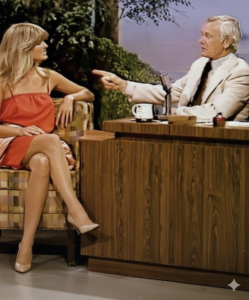
Her life became a quiet tug-of-war between image and identity, between the woman the world wanted her to remain and the woman she was struggling to become. It is a story not merely of fame, but of resistance — of a woman punished, at times, for wanting more than just to be pretty.
The Texas Girl Behind the Icon
Farrah Leni Fawcett was born on February 2, 1947, in Corpus Christi, Texas. Raised in a Roman Catholic household, she grew up in a world defined by faith, family, and modest ambition. Those who knew her as a girl described her as sweet, polite, and almost impossibly beautiful — though she herself seemed largely unaware of the power that beauty would later wield over her destiny.
In her teenage years, she briefly entertained the idea of becoming a nun. It was not celebrity she imagined, but devotion. The convent symbolized peace, structure, and purpose. Yet life had other plans. After high school, she enrolled at the University of Texas at Austin, where her beauty quickly became the subject of campus legend. She was named one of the “Ten Most Beautiful Coeds” multiple times, despite never formally submitting a photograph. Her face, it seemed, traveled ahead of her.
A Hollywood publicist saw her picture and urged her to move to Los Angeles. At first hesitant, Farrah eventually followed the pull of opportunity. The decision would forever alter the course of her life.
Becoming a Phenomenon
By the early 1970s, Farrah was working steadily in commercials and small television roles. She married actor Lee Majors in 1973, and for a while she seemed content in the role of supportive Hollywood wife. But in 1976, everything changed.
She was cast as Jill Munroe in the television series Charlie’s Angels. The show — about three glamorous women solving crimes — became an instant cultural sensation. Farrah, with her cascading blonde hair and megawatt smile, stood at the center of the storm.
That same year, a simple promotional poster altered pop culture history. Wearing a red one-piece swimsuit, hair tousled, smiling directly into the camera, Farrah posed in what would become one of the best-selling posters of all time. Over twelve million copies were sold. Dorm rooms, garages, teenage bedrooms — her image was everywhere. She was no longer simply an actress. She was a phenomenon.
But fame at that magnitude carries a cost.
The Price of Perfection
While audiences adored her, critics were less kind. Many dismissed her as merely a pretty face. Despite the show’s success, she felt creatively constrained. Jill Munroe was charming and athletic, but she was also safe — a character carefully packaged to appeal to mainstream audiences.
Farrah wanted more.
After just one season, she made the shocking decision to leave Charlie’s Angels. The move ignited a legal battle with producers and triggered public backlash. Fans felt betrayed. Industry executives labeled her ungrateful. In a culture that often rewarded compliance, Farrah’s decision to walk away was seen as rebellion.
But for her, it was survival. She refused to be frozen permanently as a pin-up fantasy.
The years that followed were not easy. Work slowed. The industry that had celebrated her now seemed uncertain about what to do with her. Yet Farrah persisted, taking on roles that challenged her image. She appeared in off-Broadway productions and dramatic television films that showcased vulnerability rather than glamour.
Her performance in the 1984 TV movie The Burning Bed, portraying an abused wife, stunned critics. Suddenly, the woman once dismissed as lightweight was earning Emmy nominations. She proved she possessed range, depth, and courage. The transformation was deliberate — and hard-won.
Love, Turmoil, and Reinvention
Behind the scenes, her personal life was equally complex. Her marriage to Lee Majors ended in 1982. She later entered a tumultuous, passionate relationship with actor Ryan O’Neal. Their love story was volatile, marked by deep affection but also public arguments and long separations.
In 1985, she gave birth to their son, Redmond O’Neal. Motherhood grounded her in ways fame never could. Friends say it was one of the few roles she cherished without ambivalence. In the quiet rituals of parenting — school events, bedtime stories — she found a version of herself untouched by Hollywood’s expectations.
Yet the pressures of celebrity never fully receded. The tabloids scrutinized her appearance, her relationships, her aging. For a woman whose image had once defined youthful perfection, the passage of time became a particularly cruel narrative in the media. Hollywood, after all, is often unforgiving to women who dare to grow older.
Farrah, however, refused invisibility. She pivoted again — this time toward art.
The Artist Within
In the 1990s and early 2000s, Farrah immersed herself in visual art. Sculpture and painting offered something acting rarely did: privacy. Creation without commentary. She studied seriously, exhibiting her work in galleries and earning respect from critics who had once dismissed her.
Art became both therapy and rebellion. It allowed her to express complexity without the filter of a camera lens obsessed with her appearance. She was no longer merely the subject; she was the creator.
Still, the world never entirely stopped seeing the poster first.
Facing the Unthinkable
In 2006, Farrah was diagnosed with anal cancer. The news stunned fans. The woman once immortalized as untouchable was now confronting a profoundly human vulnerability.
True to form, she faced the illness on her own terms. Rather than retreat from public view, she documented her treatment in a raw, deeply personal video diary. The resulting documentary, Farrah’s Story, aired in 2009 and revealed a side of her the world had rarely seen — frightened yet determined, fragile yet fiercely dignified.
The footage stripped away decades of polish. There were no perfect poses, no staged glamour. Just a woman fighting for her life.
On June 25, 2009, Farrah Fawcett died at age 62. Ironically, her passing was overshadowed in the news cycle by the sudden death of Michael Jackson later that same day. Even in death, the spotlight seemed to flicker elsewhere.
Yet over time, reflection softened the narrative. People began to remember not only the poster, but the persistence. Not only the hair, but the heart.
The Battle for Identity
The arc of Farrah’s life reveals a deeper cultural tension. She rose to fame during a decade when women’s liberation movements were reshaping American society, yet she herself was often reduced to decoration. She embodied the contradiction of the 1970s: empowerment wrapped in objectification.
Her departure from Charlie’s Angels can now be seen less as ingratitude and more as a bold assertion of autonomy. She demanded to be evaluated on skill rather than surface. She risked popularity for principle — a gamble that ultimately expanded her legacy beyond a single role.
In many ways, she was ahead of her time. Today’s conversations about typecasting, media objectification, and female agency echo battles she quietly fought decades earlier.
The Woman the Public Rarely Saw
Friends described her as warm, self-deprecating, and deeply loyal. She loved simple domestic routines — cooking, decorating, spending time with family. Fame never erased the Texas girl who once valued humility over glamour.
She maintained a strong spiritual foundation throughout her life. Though she did not become a nun, the devotion of her youth never fully left her. Faith offered solace during heartbreak and illness alike.
What makes her story compelling is not just the height of her fame, but the humanity beneath it. She was neither saint nor scandal — neither flawless angel nor tragic cautionary tale. She was complicated, evolving, striving.
Legacy Beyond the Poster
Today, Farrah Fawcett’s image remains iconic. The red swimsuit poster still circulates, shorthand for a particular era of American optimism and style. But her true legacy is broader.
She helped redefine what it meant for a television actress to demand serious roles. She proved that reinvention is possible, even after being typecast by an entire culture. She showed that vulnerability can coexist with strength.
Perhaps most importantly, she modeled the courage to outgrow expectations.
Her life invites reflection on how society consumes female beauty — how quickly it elevates and how readily it confines. Farrah resisted confinement. She stepped beyond the frame, again and again, even when the consequences were painful.
An Enduring Light
Farrah Fawcett’s story is ultimately about negotiation — between faith and fame, domestic longing and artistic hunger, public fantasy and private truth. The Texas Catholic girl who once imagined convent walls became a global sex symbol, yet she never stopped yearning for authenticity.
Behind the glossy magazine covers and television reruns was a woman who wanted to cook dinner in peace, to raise her son, to create art without commentary. She sought ordinary tenderness in an extraordinary life.
And that may be the most compelling part of all.
Because perfection is an illusion. Posters fade. Hairstyles change. Cultural tides shift.
But the courage to insist on depth in a world satisfied with surfaces — that endures.
Farrah Fawcett was never simply America’s angel.
She was a woman determined to be more than an image — and in that determination, she became timeless.