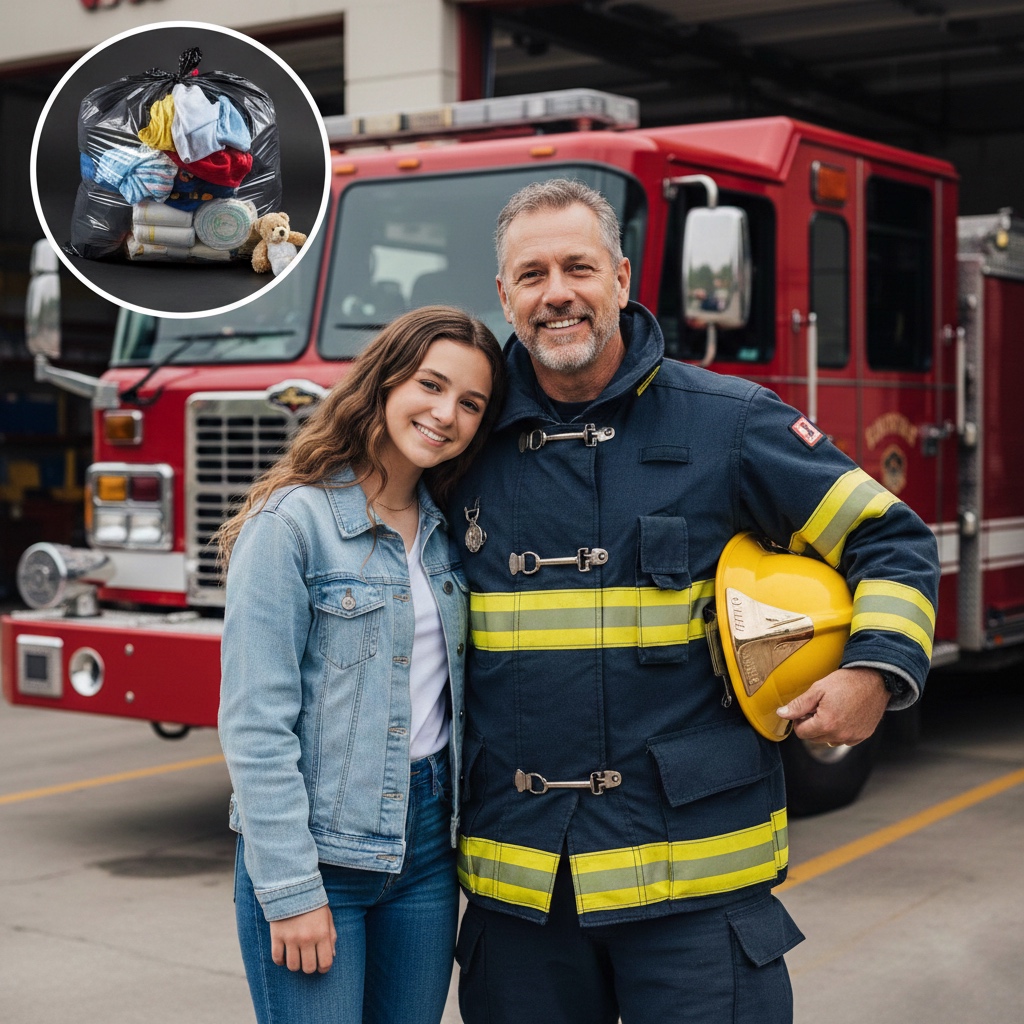
My name is Mark. I’m 42 years old, and I’ve been a firefighter for nearly half my life.
I’ve pulled strangers from burning buildings. I’ve crawled through smoke so thick it felt like drowning in ink. I’ve stood on rooftops at 3 a.m. with flames licking at the sky, feeling the heat blister through layers of protective gear. I’ve made split-second decisions that meant the difference between life and death.
Funny thing is, for all the fires I’ve fought, I never noticed the one quietly smoldering under my own roof.
For the past few years, it’s just been me and my daughter, Emily.
My wife, Sarah, passed away five years ago. Cancer. Fast and merciless. One year she was planning Emily’s sixteenth birthday party, arguing with me about what color to paint the kitchen. The next, I was holding her hand in a hospital room that smelled like antiseptic and inevitability.
When she died, the house didn’t just grow quiet. It became unbearable.
Silence has a sound, you know. It hums in your ears. It echoes in hallways. It lingers in rooms where laughter used to live. Every corner of that house carried her—her coffee mug by the sink, the faint scent of her shampoo in the bathroom, the indent in her side of the mattress.
I couldn’t breathe in that silence.
So I did what a lot of people do when grief gets too heavy to carry.
I ran.
Not physically. I didn’t move towns or sell the house. I ran into work.
I picked up extra shifts at the firehouse. Volunteered for overtime. Covered for guys who wanted a day off. If a call came in, I was first in the truck. If someone needed a fill-in, I was already pulling on my boots.
Charging into burning buildings felt easier than sitting at the kitchen table where Sarah used to sit.
In a fire, there’s clarity. There’s purpose. You know what to do. You follow training. You save who you can. You contain the damage.
Grief? That’s a fire with no hose strong enough to put it out.
I told myself I was being a good father. Providing for Emily. Making sure she never had to worry about money. That she had everything she needed—clothes, a car when she turned sixteen, college savings.
For a while, I even believed it.
At first, life at home seemed… manageable.
I’d come in well past midnight, exhausted and smelling like smoke. And there would be Emily, sitting at the kitchen table with two plates of food. She’d try to keep her eyes open, even though I knew she had school in the morning.
“How was your day, Dad?” she’d ask brightly.
I’d kiss the top of her head and drop into the chair across from her.
We’d talk about her classes, about the latest drama with her friends, about some band she liked that I pretended to know. I’d tell her watered-down versions of my day—never the worst parts. Never the things that might give her nightmares.
Every night, I’d promise, “Next week I’ll be home earlier.”
Next week never came.
Gradually, the pattern shifted.
Instead of Emily waiting at the table, I’d come home to a dark kitchen. A plate wrapped in foil sat in the fridge with a sticky note: Love you, Dad.
Her bedroom door, once wide open with indie music spilling into the hallway, stayed closed.
I’d knock softly.
“Hi, Dad! Everything’s fine!” she’d call out.
I’d stand there a moment, hand on the doorknob, debating whether to push it open. But I’d always stop myself.
“She’s a teenager,” I reasoned. “She needs space.”
It was a convenient explanation. It let me off the hook.
But in small moments—her quick, forced smile before school… the half-hearted hugs that barely brushed my chest… the way she seemed tired all the time—I felt something shifting.
It was subtle. Like hearing a faint crack under your boots on thin ice.
I noticed she looked worn down. Pale. Distracted.
I should have sat her down.
I should have turned off my phone and really listened.
Instead, I let exhaustion win. I’d sink into the couch, telling myself I’d talk to her tomorrow.
Tomorrow is a dangerous word.
It makes you believe you have time.
Then came the Saturday that changed everything.
It was my rare day off. No shifts. No alarms. Just quiet.
Emily was out—said she was studying with a friend. I decided to do something productive for once. Clean. Organize. Be useful at home.
I went into her room looking for a spare blanket for the guest room closet. Her room was tidier than usual. Bed made tight. Desk cleared.
That should’ve been my first clue.
I opened her closet.
At first, I didn’t see anything unusual. Jackets. Shoes. A couple of old dance trophies from when she was younger.
Then I noticed a plastic storage bin tucked behind a row of hanging clothes.
I pulled it out.
Inside was a tiny pale blue flannel onesie decorated with yellow moons.
I froze.
For a second, my brain refused to process what I was seeing.
I picked it up. The fabric was soft, worn slightly at the edges. It smelled faintly like baby powder.
My heart started pounding.
I dug deeper.
Another onesie. A small knitted hat. A baby blanket.
And at the bottom, stuffed tightly inside a trash bag—diapers. Wipes. More clothes.
The room felt like it tilted.
Emily was seventeen.
Seventeen.
My mind spiraled.
How had I missed this? All the late nights. The closed door. The exhaustion. The secrecy.
I felt heat crawl up my neck—not the kind from flames, but from fear.
Just then, I heard footsteps in the hallway.
Emily walked in.
She stopped dead when she saw me kneeling on the floor, holding the onesie.
Her face drained of color.
“Dad—” she whispered.
The look in her eyes wasn’t defiance.
It was devastation.
“Em…” My voice sounded foreign to my own ears. “Are you…?”
She shook her head so fast her hair whipped around her face. Tears spilled instantly.
“IT’S NOT WHAT YOU THINK!”
I stood slowly, holding the tiny piece of fabric like it might burn me.
“Then what is it?” I asked, trying to keep my voice steady. “Because it looks like—”
“They aren’t mine!” she cried. “I swear, they aren’t mine!”
Her reaction looked like guilt.
Or fear.
Or both.
“Then who do they belong to, Em?”
She looked down at her hands.
“I can’t tell you.”
That answer hit harder than if she’d admitted everything.
“Why not?”
“Because…” Her voice cracked. “Because you’ll make it worse.”
Make it worse?
I felt something heavy settle in my chest.
“Emily, I’m not angry,” I said carefully. “But I need to understand.”
She backed away slightly.
“I can’t, Dad. Please. Just… leave it alone.”
Leave it alone.
That terrified me more than any confession would have.
Because in that moment, I realized something far worse than the possibility of a teenage pregnancy.
My daughter didn’t trust me.
All the signs I’d brushed off came flooding back. The closed door. The late nights. The missing cash from my wallet I’d blamed on my own forgetfulness. The tired eyes.
Something was wrong.
And I’d been too busy playing hero to notice.
A few days later, I saw my chance.
I was home early—another rare occurrence. I heard the front door click shut and glanced out the window.
Emily was walking down the driveway, carrying the same trash bag.
I didn’t think. I grabbed my keys and followed at a distance.
She walked three blocks, then caught a bus across town.
Across town meant the older part of the city. The part with boarded windows and peeling paint. The part we usually drove through with doors locked.
She got off near a run-down neighborhood.
My chest tightened.
She approached a shabby duplex with cracked steps and a sagging porch.
She glanced around nervously before slipping inside.
I waited.
Five minutes. Ten.
Then I walked up and knocked.
Through the thin door, I heard it.
A baby crying.
And Emily’s voice.
Soft. Gentle. Soothing.
“It’s okay, I’ve got you… shhh…”
Relief hit me so hard my knees nearly buckled.
She wasn’t hiding a pregnancy.
The supplies weren’t for her.
But what was she doing?
The door opened suddenly.
Emily stood there, eyes wide with panic.
“Dad? What are you doing here?”
I stepped inside before she could block me.
The air smelled like formula and damp carpet.
In the living room stood a girl I vaguely recognized from school events. Mia.
She looked thinner than I remembered. Dark circles under her eyes. She cradled a toddler on her hip, while a newborn slept in a makeshift crib by the couch.
So this was where the onesies were going.
Mia swallowed nervously.
“I’m sorry it’s messy,” she said. “My little brother was up all night. Mom’s working another double.”
Emily’s hands were shaking.
“They didn’t have anything for the baby, Dad,” she said quietly. “No wipes. No clean clothes. I couldn’t just walk away.”
The pieces started clicking into place.
Mia’s father had left years ago. I remembered hearing something about her mom working two jobs.
Now I saw the reality.
Dishes piled in the sink. Empty cupboards. A space heater humming in the corner.
“Your mom knows it’s this bad?” I asked gently.
Mia looked down.
“She’s trying,” she whispered. “She just… can’t keep up.”
I’d seen this before on calls. Not neglect from cruelty. Neglect from exhaustion.
Emily looked at me like she was waiting for a verdict.
“I used my money,” she admitted. “And some of yours. I’m sorry. But I didn’t want you to say no.”
That stung.
Not because of the money.
Because she believed I would.
I took a deep breath.
“You were right to help,” I said slowly. “But you shouldn’t have had to do it alone.”
Her eyes filled with tears.
“I thought you’d call CPS.”
I crouched down to her level.
“I’m not here to tear anyone apart. I’m here to make sure everyone’s safe.”
I turned to Mia.
“We’re going to get you some help,” I promised.
Over the next few days, I made calls.
Not as a firefighter.
As a father.
As someone who finally understood that saving strangers meant nothing if I was losing my own child in the process.
I contacted child services—not to report, but to ask about support programs. I reached out to a local church that ran food drives. A social worker connected Mia’s family with emergency assistance.
We showed up with groceries. Diapers. Warm blankets.
By the end of the week, the duplex didn’t look perfect—but it looked steadier.
On the drive home, the car was quiet.
Then Emily said softly, “I really thought you’d be mad.”
I kept my eyes on the road.
“I’m proud of you,” I said.
She blinked at me.
“You are?”
“You saw someone drowning and you jumped in. That’s what we do.”
She gave a small, watery laugh.
“That’s what you do, Dad.”
I glanced at her.
“Yeah,” I said. “But I forgot something.”
“What?”
“You’re not supposed to fight fires alone.”
Her hand slid into mine across the center console.
For the first time in years, I felt like I wasn’t just paying the bills.
I was present.
That night, instead of heading to the station for an extra shift, I stayed home.
We ordered pizza. Sat at the kitchen table.
Talked.
Really talked.
About her fears. About losing her mom. About how she’d felt like she had to grow up too fast because I was always gone.
“I didn’t want to bother you,” she said. “You already deal with so much.”
I swallowed the guilt.
“You are never a bother.”
The fire I’d missed wasn’t dramatic.
It wasn’t flames licking at walls.
It was quiet.
It was distance.
It was a teenage girl learning not to rely on her father.
And that kind of fire doesn’t show smoke until the damage is already done.
I cut back my shifts after that.
Not entirely. Being a firefighter is part of who I am.
But I stopped hiding there.
I started coming home for dinner.
Started knocking on her door and actually walking in.
Started asking questions—and waiting for real answers.
Mia’s family stabilized over the next few months. Her mom found more consistent work with better hours. The kids had proper childcare support.
And Emily?
She smiled more.
Played her music with the door open again.
Sometimes, when I come home late now, she’s at the kitchen table—not because she’s waiting out of loneliness, but because she wants to share something.
And I sit down.
Because I finally understand something I should’ve known all along:
Being a good father isn’t about how many hours you work.
It isn’t about how much money you bring home.
It’s about being the safe place your child runs to when the world feels too heavy.
I’ve fought a lot of fires in my life.
But the most important one?
Was the one that almost burned down my relationship with my daughter.
And this time—
I saw the smoke in time.