You Belong Here
My name is Everly Mitchell, and I was thirty years old when I finally understood that some people will never truly see you, no matter how clearly you stand in front of them. By then I had almost everything the world said you were supposed to want: a design firm with a growing reputation, a feature on television, and a glass-and-stone villa overlooking the Atlantic. People used words like successful and inspiring when they talked about me. But there was a hollow place inside me that none of that touched, something old and familiar that went all the way back to a little girl sitting at the kitchen table, holding up a ribbon no one cared about.
We grew up outside Boston in a perfectly ordinary house with white siding and blue shutters and a maple tree in the front yard that dropped sticky seeds all over the driveway every summer. From the outside, we were a normal American family. Dad in his button-down shirts. Mom with her casseroles and holiday decorations. Two daughters, two years apart. Me, Everly, the older one. Madison, the younger. And from as early as I can remember, Madison was the favorite. It was not subtle, and it was not only in my head. It was baked into every birthday, every holiday, every ordinary Tuesday.
When I was seven, I won second place in my school art contest. I still remember the way my heart hammered when they called my name over the gym intercom, the way the ribbon felt when the principal pinned it to my shirt. That same day, Madison learned to tie her shoes. At dinner, I slid into my chair with the ribbon in both hands, started to speak, and my mother cut me off mid-sentence to watch Madison loop her laces on my father’s lap. He laughed like she’d done something miraculous. My ribbon went into a kitchen drawer under the batteries and rubber bands and was gone within a month. I went to my room and sat on the bed a long time, trying to understand what I had done wrong, and arriving at no good answer.
That was the pattern, year after year. My straight-A report card spent two days on the fridge before disappearing under Madison’s finger paintings. My academic award ceremony was the night my parents left early because Madison texted that she was hungry. My science-fair blue ribbon earned a slow, unfocused squint from my mother, while Madison’s baking-soda volcano, half of which had ended up on her shoes, was photographed from every angle. I stopped trying to compete around age twelve. I learned that no grade, no ribbon, no quiet achievement would outweigh whatever Madison had done that day. So I stopped looking for approval in the living room.
I found refuge in the old detached garage behind our house instead. It smelled like cedar and engine oil and the particular dusty warmth of a space that no one claimed. Sunlight came in through a cracked window in thin, slanting beams that turned the floating sawdust into something almost beautiful. There were shelves of old paint cans, a pegboard with tools, a stack of warped boards left over from some forgotten home project. Nobody told me to smile for pictures in there. Nobody asked me to step aside so my sister could stand in the front.
One sticky afternoon in August, when the cicadas screamed in the trees and the air outside felt like wet wool, I decided to build a table. I had no real plan, only a sketch on lined notebook paper, a pile of scrap wood, and a handful of tools I had watched my father use but never been invited to touch. The legs came out uneven. The edges were rough. One corner looked like something had taken a bite out of it. But when I drove the last nail in and stepped back, it was standing. It did not wobble. It did not collapse. It was crooked and imperfect and mine, entirely mine, because I had decided it should exist. That was the first thing in my life I could say that about.
That table became my homework desk in high school. I did my geometry worksheets there, my English essays, my secret sketches of rooms I had never seen but somehow already knew. I spent hours in that garage while Madison practiced dances in the living room and my parents cheered and recorded everything, and I was learning, quietly, that the world inside my head was worth building.
I left for college on a full scholarship I had researched and applied for on my own, on the slow library computers downtown. When I told my parents at dinner, my mother said, “That’s nice, honey, so you’re really serious about this decorating thing?” My father forked another piece of chicken and said a design degree would be good to fall back on in case I didn’t find a husband right away. Madison, fourteen at the time, asked if she could have my room when I left. I went back to the garage afterward, laid the scholarship letter flat on the table, smoothed it with both palms, and whispered, quietly but without embarrassment, “We’re getting out of here.”
When I packed my car that September, I took clothes, books, a lamp, a mug I loved, and the table. My mother watched from the front steps as I maneuvered it down the driveway, shaking her head at the thing. “Why are you taking that old piece?” she asked. “We could get you a real desk from IKEA.” I said I wanted this one and kept moving. I hauled it up three flights of stairs at the dormitory by myself, sweat soaking through my shirt, and set it under the window of my room. My roommate Tessa, who had purple streaks in her hair and was eating pretzels off her comforter, looked up and asked if I’d stolen it from a 1970s church basement. When I told her I’d built it myself at age twelve, her eyebrows went up. “That’s badass,” she said, and we pushed her flimsy particleboard desk to the side to make room for mine.
College was the first place I understood that I was genuinely good at something. My professor, Dr. Greene, a lean woman with steel-gray hair and sharp eyes, stopped behind my chair on the first day of studio and studied my sketch for a long time. “Miss Mitchell,” she said finally, “you see structure in relation to emotion. That’s rare. Don’t waste it.” Nobody had ever spoken about me that way before. Like the way my brain worked was an asset, not an inconvenience. I chased that feeling for the next four years, staying in the studio long after the lights dimmed, sketching layouts and building foam models and trying to figure out how people moved through space and how space moved back through people. I graduated with honors and a portfolio that made professionals raise their eyebrows in the careful way that meant they were impressed and trying not to show it.
I started my own business straight out of school. It was small at first, just me and that old table in a cramped second-floor studio in a neighborhood where the sidewalks buckled every winter. My early jobs were not glamorous. A dentist’s waiting room that smelled like antiseptic. A condo for a recently divorced man who wanted it to feel “less depressing.” A bakery owned by two sisters who disagreed about everything from the wall color to the pastry case. I took every job other designers turned down. I painted walls myself when contractors flaked. I learned to patch drywall from midnight YouTube videos and drove all over the state to meet clients who sometimes didn’t even hire me. But slowly, steadily, people started to notice that their customers stayed longer in the waiting rooms I designed, that the bakeries I reworked felt warm and easy, that the cramped apartments I touched suddenly felt like homes.
My parents still didn’t understand what I did. At Thanksgiving, my mother introduced me to her friends as “Everly, she does decorating or something,” and then went on for ten minutes about Madison, who worked in marketing and understood social media. I sent the wedding gifts I could afford, smiled in the group photos when I was invited, and went back to my studio and my work. By the time I was thirty, I had built something real: a firm with a small team, a reputation reaching beyond our state lines, and for the first time in my adult life, money left over when the bills were paid.
So I did something audacious. I bought land in the Hamptons, right on the Atlantic Ocean, and I designed a house for myself. My mother said “The Hamptons?” on the phone with a tone like I’d announced I was moving to the moon. My father chuckled in the background and told me not to come asking for help when the taxes hit, because they had Madison’s future to think about. I didn’t ask for help. Not once. The land sloped gently toward the water, a strip of wild grass and scrub leading down to pale sand, and the first time I stood there with the wind cutting across my face and the gulls crying overhead, I felt something inside me settle. This place felt like it wanted me.
I spent nights at my old table sketching and erasing until the house existed as clearly on paper as it did in my mind. Low, modern lines facing the water. Floor-to-ceiling windows that swallowed the ocean and the sky. Warm wood and stone that made the place feel grounded rather than cold. No grand staircase built for dramatic entrances. No formal dining room designed to impress people who didn’t deserve impressing. At the heart of the house, I designed a single long dining table. Sixteen chairs, all identical, spaced at equal distances. No head seat. No kitchen exile. No card table for the people who didn’t count.
It took two years to build, and they were some of the hardest and most satisfying years of my life. A shipment of tile arrived shattered. A storm ripped part of the temporary roof off in the night and flooded the framed kitchen. I stood ankle-deep in water in my rain boots, hair plastered to my face, half-laughing as I directed fans and dehumidifiers. Through all of it, the old garage table sat in the construction trailer under a layer of blueprints and coffee cups. It was the first thing to arrive on site.
A few months before the villa was finished, a producer from HGTV emailed me. Someone had mentioned “the young designer building her own place on the water,” and they wanted to film it. I read the email three times before I believed it. When I told my mother, she made a soft, noncommittal sound and said I’d always liked rearranging furniture. Madison texted asking if they would show my face on TV and whether she could be in the background since she was, in her words, pretty good on camera. I didn’t reply to that part.
I agreed to the shoot and set the filming dates for late summer, just after the house was finished. Somewhere in the middle of all the scheduling, I decided to throw a housewarming party. I wanted the people in my life to walk through that front door and understand what I had built, not just the structure but the life I was making for myself, plank by deliberate plank. Part of me, the part that was still a little girl with a ribbon, imagined my parents stepping inside and finally, finally having to look at me and see something undeniable.
I sent out invitations to clients who had taken early chances on me, to college friends, to my staff, and to my family. I called my parents on video chat so my mother could see the house in the background. I walked them through rooms with bare floors and half-installed light fixtures, holding the phone up so they could glimpse the ocean through the windows. My father said it was big, sounding more startled than anything else. My grandmother, who had apparently been listening from another room, called out that the view was beautiful. Madison leaned into the frame and told me she’d obviously come, like she was doing me a favor.
For the next few weeks, between punch lists and furniture deliveries, I planned the party. A menu of small plates, nothing fussy, the kind of food you eat while you’re talking. Low floral arrangements that wouldn’t block anyone’s sightline. A playlist soft enough to fill silence without demanding attention. Every time I walked past the long dining table, I imagined my family sitting there. I told myself it didn’t matter whether they were impressed. I told myself I had built this for me. But if I’m honest, I was still blowing on a small, stubborn ember: the hope that they would finally have to acknowledge who I was.
Two days before the party, I was in the villa checking last-minute details when my phone buzzed on the kitchen island. A text from my mother. “We’re not coming to your housewarming party. Your sister is also moving into a rented apartment.” That was it. No greeting. No apology. Just the announcement, flat as a grocery list, with the word also doing a kind of logic I was supposed to follow but couldn’t quite. I typed back asking why. After a pause, she replied that Madison needed their help that weekend and they had already promised. She said I would understand.
I scrolled back through our thread and found the message I had sent weeks earlier with the date and details. “Looks exciting,” my mother had written at the time. “We’ll see.” I thought about the plane tickets they had never bothered to book and the hotel they had never reserved, and the reason they hadn’t needed to invent one because Madison was always waiting there, ready-made. I felt the old ache rise in my chest, that familiar tangle of hurt and confusion and why not me. But it didn’t detonate the way it would have when I was a child. It just went quiet and flat.
I typed back two words. “It’s okay.” Then I put my phone in a drawer and went to stand in the dining room for a while, looking at the table I had built this house around.
I was not angry. That was the strange part. I felt like I had just woken up from a very long dream. Like I had been waiting my whole life for them to show up, and for the first time, I simply believed that they never would. So I stopped reaching for them, and I started reaching for the people like me.
I took my notebook to the terrace, sat with the ocean spread out in front of me, and made a different list. Not the people who were supposed to come, but the people who had been forgotten. In every extended family, there are the ones who hover near doorways at holidays, who eat standing up in the kitchen, who only get invited when someone needs extra hands to set up chairs. I wrote down twelve names.
My cousin Jacob, who made bad jokes at Thanksgiving to cover how uncomfortable he was, who had been quietly kind to me for years and had not been invited to the last reunion because his divorce had become final and my mother said it would be “awkward for everyone.” Aunt Barbara, my father’s sister, who worked a cashier job at the discount grocery and lived in a cramped apartment across town and ate in the kitchen at Thanksgiving because there was never quite enough room at the main table, though there was always room for Madison’s friends. My grandmother on my mother’s side, who had been told her stories were boring and had started staying home. My cousin Jennifer, who had two kids and worked two jobs and whom no one ever asked how she was doing. A quiet uncle who always sat alone in the corner. A shy cousin whose name the family consistently forgot.
The next morning, I opened my laptop and wrote a message to each of them individually. Not a group text. One message to each person. “I’m having dinner at my place in the Hamptons on Saturday. I know it’s short notice, but I’d love for you to be there. Come hungry.” Then I got to work. I called my caterer and ordered everything properly: roasted vegetables, slow-braised short ribs, grilled fish, fresh bread, three kinds of dessert. Nothing cheap. Nothing that would make anyone feel like an afterthought. I ordered sixteen sets of heavy white stoneware, matching water glasses, wine glasses, polished silverware. No mismatched plates. No chipped edges. Nobody was going to eat off my second-best china.
That afternoon, I sat at the old garage table in my office and wrote cards by hand, one for each place setting. The same message on every card, written slowly so my hand wouldn’t shake. You belong here.
The HGTV crew arrived Friday evening as the sky went thick and blue over the water. Sarah, the producer, shook my hand at the door and told me the place was even better in person. They set up cameras and bounced light off white boards while I moved through the rooms tightening screws, straightening cushions, wiping imaginary smudges off the stone counters. Late in the evening, Sarah asked me to stand near the windows in the living room with the ocean behind me. “Tell me why you built this house,” she said. I touched the back of one of the dining chairs and thought for a moment before I answered. “I wanted to create a space where everyone had a seat at the same table. Where nobody gets sent to the kitchen or the card table. Where there isn’t one person at the head and everyone else ranked below them.” Sarah nodded slowly. “Say that last part again,” she said. We worked until midnight. At some point someone asked about my design philosophy, and I heard myself say, “Justice is not a decoration. It’s a structure. You build it into the bones of a place.” I forgot I’d said it almost as soon as the words left my mouth.
Saturday evening came quickly. I lit candles as the sun slid down into the water, placed them along the center of the dining table and on surfaces throughout the house. Soft music played low from the speakers. The villa smelled like roasted garlic and rosemary and lemon. At a little before six, I stood by the windows and waited. The first set of headlights appeared at the curve of the drive.
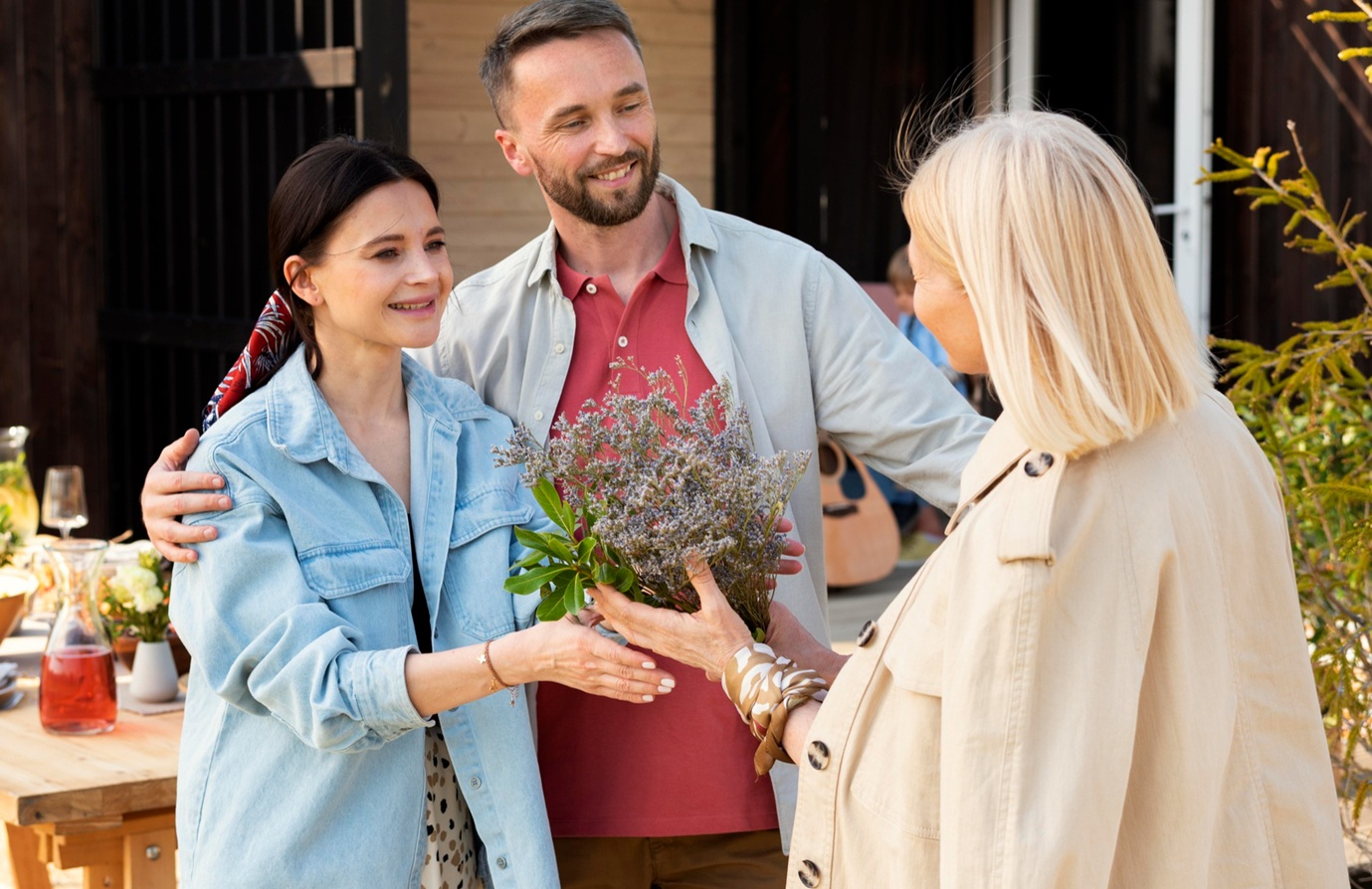
Jennifer’s battered minivan pulled up, and her two kids spilled out before the engine stopped, their voices high and excited. She stepped out after them, smoothing her dress, eyes wide as she took in the house. I met them at the door. “This is wow,” she said, clutching a foil-covered casserole dish to her chest. “I didn’t know what to wear.” I told her she looked great and meant it. Aunt Barbara arrived a few minutes later in her old sedan, clutching a pie wrapped in a faded dish towel, shoulders slightly hunched like she half-expected to be turned away. “I hope it’s okay I brought something,” she said at the door. “It’s more than okay,” I told her. “Come on. You belong here.” Jacob arrived in a used SUV, his teenage daughter Riley beside him with headphones around her neck. My grandmother stepped in wearing a modest blue dress with her hair set in curls, eyes moving slowly around the room. “Is this really all yours?” she whispered. “Yeah,” I said softly. “It is.”
When the last guest arrived, I closed the front door and turned to face the room. Everyone I had invited had come. Every single one of them. They moved through the house in small groups, touching surfaces gently, looking out the windows. Aunt Barbara ran her fingers along the plaster wall like she couldn’t quite believe it was solid. Jacob walked straight to the ocean-facing window and stood there for a long time. “I didn’t know people like us could live like this,” he said quietly, and the weight of what he meant settled over me without embarrassment or performance. These were people who had been told, in a hundred small ways over a lifetime, that the good things were not for them. That the nice table was not for them. That they should be grateful just to be in the building.
When we moved into the dining room, the candlelight trembled over sixteen identical place settings. People moved slowly to their chairs, picking up the cards. You belong here. Some smiled. Some blinked quickly and looked at the ceiling. Aunt Barbara pressed the card to her chest for a moment without saying anything.
We sat down together and the food came in waves, dish after dish, carried by the catering staff. Nobody had to hover in the kitchen filling plates while the real conversation happened somewhere else. The kids sat between the adults, not sent off to a folding table in the corner. We passed platters and baskets and bowls without ceremony. Grandma started telling a story about the first apartment she and my grandfather had rented as newlyweds, a tiny two-room place with a sagging porch. At other family gatherings, someone would have cut her off by now, told her they’d heard it, changed the subject to something shinier. Here, everyone listened.
At one point Jennifer leaned close to me, voice low. “I never get to sit at the main table,” she said. “It’s always me and the kids in the kitchen.” She paused. “Thank you for this.” “There is no main table here,” I told her. “That’s the point.” She blinked fast and nodded and turned back to her plate, and I saw her shoulders drop about an inch, like something she had been holding for a long time had been quietly set down.
The evening stretched. The kids drifted to the living room after dessert. The adults lingered over coffee and pie. Aunt Barbara talked about a recipe she wanted to try. Jacob talked about co-parenting and how tired he was of being treated like a cautionary tale at family gatherings. My chest ached that night, but in a new way, not from being overlooked but from the simple, slightly overwhelming weight of being exactly where I was supposed to be.
The HGTV episode aired the following week. I hadn’t planned to watch it, too caught up in work and the afterglow of that dinner. I nearly forgot it was happening until cars started pulling into my driveway that evening. Jennifer. Jacob. Aunt Barbara. Grandma. Riley with a sketchbook tucked under her arm. Jennifer held up a grocery bag as she got out of the van. “You didn’t think we were letting you watch your TV debut alone, did you?” We set up a projector on the terrace, aimed at a white sheet stretched between two poles, and settled onto chairs and cushions and blankets as the sun burned itself out over the water in long streaks of pink and orange.
The show opened with aerial footage of the coastline, the camera swooping toward the villa over the water, and for a moment I felt completely outside my own body watching a life I had made materialize on a sheet hung between fence posts. Then my own voice came through the speakers: “Justice is not a decoration. It’s a structure.” On screen, they showed the dining table, the identical chairs, the candlelight moving across the wood. “Oh, that’s good,” Grandma said quietly. “I like that.” When the credits rolled, everyone on the terrace clapped. Grandma dabbed at her eyes. Aunt Barbara looked proud in a way I had never seen on her face when she looked at me before, and the sight of it did something strange and permanent to me.
That was when my phone began to vibrate. Once. Then again. Then again. The screen lit up in a column of names. Mom. Dad. Madison. Mom again. I watched it for a moment, then turned it face-down. Jennifer noticed. “Are you going to answer?” she asked. “Not tonight,” I said.
By morning there were thirty-seven missed calls and a string of messages. “We saw the show. Why didn’t you tell us? Everyone is talking about it. You’ve embarrassed us. Call me back.” I read through them once and set the phone back down. Then I opened my notebook and found the list I had made of the forgotten ones. At the bottom, in smaller letters, I had written one last item: Stop waiting for them. I drew a line through it and wrote next to it, Done.
A few days later, my grandmother appeared at the front door with windswept hair and her purse strap mashed in her fist. I made tea and we sat in the living room with the ocean moving slowly through the glass. She told me my parents were telling everyone I hadn’t invited them, framing it as deliberate exclusion. “I know you did invite them,” she said. “And everyone who matters knows that too. But your mother’s been on the phone all morning playing the victim.” I told her I wasn’t going to defend myself. That everyone important to me already knew the truth. My grandmother reached across the coffee table and patted my hand. “Good,” she said. “That’s exactly what I wanted to hear.”
While we sat there my phone buzzed. My mother. I stared at it, then picked it up and set it on the table between us on speaker. My mother’s voice came through, carefully softened. “Everly. We watched the episode. There’s been a huge misunderstanding. The show made it look like we excluded you, but Madison was moving that weekend. You understand that, don’t you?” I told her calmly that I had saved her message, the original one where she said they weren’t coming, and I could show it to anyone who was interested. Her voice lost its softness immediately. “You’re exaggerating again,” she said. “We’ve always supported you.” Before I could respond, my grandmother leaned toward the phone. “Stop it, Linda,” she said, in a tone I had never quite heard from her. “I have been watching you do this since Everly was a child. Always turning away from her. Always choosing Madison. Every birthday, every holiday, you built the whole house around Madison’s comfort. You know it.” The line went dead. My mother hung up without another word. My grandmother looked at me over her teacup. “You did everything right,” she said. For the first time in my life, I believed that without reservation.
A few days after that, I heard tires on the gravel. Through the window I watched my mother’s SUV roll up, and all three of them get out: my mother, my father, Madison. They walked up the path slowly, taking in the landscaping and the sweep of water beyond the glass. Madison shaded her eyes looking up at the house and said, loudly enough for me to hear through the door, “I’ve always dreamed of a house like this.” I opened the door before they could knock.
My mother smiled, the polished smile she used when she wanted something from a waiter. “We need to talk, honey,” she said. “Work this out.” My father glanced past me into the house with appraising eyes and suggested I should host another housewarming specifically for them, then post photos of our reconciliation online to help restore their reputation in town. I actually laughed. Then Madison shifted sideways trying to see more of the living room and said she’d been thinking she could move in for a while, that I had all this space and it would help us reconnect as a family.
I looked at her for a long moment. At the practiced expression, the expectation, the complete absence of any awareness that what she was asking for was absurd. Then I pulled out my phone and opened the keypad. “If you’re not off my property in the next sixty seconds,” I said, keeping my voice very steady, “I’m calling the police.” My father’s mouth fell open. My mother grabbed his arm and said they were leaving, that I was being unreasonable. Madison muttered furiously as they walked back to the car. When they reached the SUV my father turned and shouted that I would regret this. I watched them from the doorway. “Watch me,” I said, and closed the door.
My hands shook for a while after that. Old instincts insisted I had done something wrong, that I had broken something beyond repair. Then I called Jennifer and told her what had happened. She laughed so hard she almost dropped the phone. “Are you okay though?” she asked, once she had recovered. “Really okay?” I looked around at the rooms I had designed, at the light falling through the tall windows, at the old garage table visible through the office doorway. “Yeah,” I said slowly. “I really am.” And I meant it more than I had meant anything in a long time. I had drawn a line and held it. They were on one side. I was on the other. And the other side was fine.
The months that followed were some of the quietest and fullest of my life. Jacob and I had lunch once a month at a little diner off the highway, peeling red vinyl in the booth, talking about work and parenting and what it feels like to be written as the problem in somebody else’s story. Aunt Barbara called on Sunday evenings just to chat, telling me about the customers she liked at the grocery store and the recipes she wanted to try. Jennifer brought her kids to swim in the ocean on warm afternoons; they tracked sand inside and dripped water everywhere, and I stocked extra beach towels and filled the pantry with the snacks that made their eyes light up. Grandma came whenever she wanted, sometimes staying for days, sleeping with the guest-room windows cracked so she could hear the waves. In the evenings, we sat on the terrace and she told me stories about her life, long, detailed stories that nobody had ever waited out to the end.
My business kept growing. The HGTV episode brought new clients and bigger projects. I hired two assistants, a meticulous man named Daniel who loved spreadsheets and a former art teacher named Mariah who had an eye for color that took my breath away. Around that time, the city approached me about designing a community arts center for a neglected neighborhood. The kind of project I had been dreaming about without knowing it. A place that would give kids somewhere to go when their own houses didn’t have room for them. The central room, I decided early on, would be called The Garage. A big, sunlit space with long tables and stools and supplies. Somewhere a kid could spend an afternoon on a concrete floor building something that belonged entirely to her.
Riley, Jacob’s daughter, had started spending more time at the villa by then. She would text me from school to ask whether her portfolio looked “too try-hard or not try-hard enough,” and she would arrive Friday afternoons and drop her sketchbook on my table and announce that she thought her drawings were terrible. I would flip through pages of clumsy and occasionally extraordinary sketches of facades and staircases and light and ask her what she had been thinking about when she drew them. One afternoon she looked up from my table and asked me, with the careful seriousness of a kid who desperately wanted to be told the truth and was terrified of it at the same time, whether she could actually do this. For real. Be an architect. I told her I thought she already was. I told her she just hadn’t gotten paid for it yet. A slow, disbelieving smile spread across her face, the kind you can’t perform. That summer she got into a pre-college architecture program on a partial scholarship, and the night the acceptance email arrived, Jacob called me from their kitchen with the phone on speaker so I could hear her reaction. “Tell her what you yelled when you opened it,” he said. “No,” Riley said. “She screamed, ‘Everly’s going to freak out,’” Jacob reported, cheerfully. “Not ‘Dad.’ Not ‘Grandma.’ You.” I laughed with tears in my eyes and couldn’t have explained why except that it felt like something being handed back to me that I had spent a long time not knowing I was missing.
We held Thanksgiving at the villa that year. Twenty-three people came. Jacob and Riley. Jennifer and her kids. Aunt Barbara. Grandma. A scattering of cousins I had reconnected with. Daniel and Mariah and their partners. A couple of clients who had become something more than clients. We pushed tables together and covered them with white cloths and the kids sat with the adults and nobody was separated or sent to another room. Grandma said grace. She thanked God for second chances and for people brave enough to build tables big enough for everyone. Aunt Barbara cried quietly into her napkin. Jacob raised his glass and said, “This is what family is supposed to feel like.” My phone buzzed during dessert. I glanced at the screen, saw my mother’s name, and deleted the notification without opening it, slipping the phone back into my pocket without a second thought.
After everyone left and the house settled into quiet, I walked through the rooms turning off lights. The dining room had crumbs and wine rings and a fork on the floor. The living room had scattered toys. The terrace had empty glasses and sticky dessert plates. It looked lived in. It looked loved. I stood in the doorway of my office and looked at the old table from the garage. Uneven legs. Rough edges. Still standing after all these years. I had built that table at twelve trying to create something that was mine, and now I had built this whole life the same way, piece by piece, on my own terms, without asking anyone for permission.
A year after the first episode aired, the network asked to come back. A producer called and said they kept hearing about the dinners, about how the villa had become a gathering place, and they wanted to capture it. I told him I would have to ask the people involved, because it was not only my story anymore. When I brought it up at the next villa dinner, Jacob said he did not need his eating face on national television. Riley said it could show people a different kind of family. Aunt Barbara said Cynthia from work had paused the last episode seventeen times to look at my kitchen cabinets and she had nearly fainted from the pressure. We compromised: the crew could come, but the focus would stay on the space rather than close-ups of guests. Faces at a distance. Voices layered over shots of rooms and hands passing dishes. When the producer asked, off camera, whether my parents would be part of the story, I told him we were not in contact. “Do you want to talk about why?” he asked. “No,” I said. “That’s not the story I’m telling anymore.”
The episode that aired showed the villa at golden hour, the long table lit with candles, figures moving warmly through the rooms. My quote about justice and structure played again, this time over footage of the arts center, which had opened its doors by then. On the first day, I stood inside and watched a group of kids flood into The Garage, spilling into the chairs and spreading their hands across the long tables, and felt something deep in my chest finally come unknotted. Somewhere in a town an hour away, I imagined my parents watching the episode, maybe switching the channel, maybe for one unguarded second catching a glimpse of what they had thrown away. I would never know. And for the first time, I did not want to.
A few days after the second episode aired, a letter came in the mail. Handwritten envelope, the return address a state I had never visited. I opened it at the kitchen island. It was from a woman named Margaret, written in neat, careful script. She said she had watched the episode and cried through all of it. Not because of the house, she wrote, though it was lovely. Because of the table. She said she grew up eating her Thanksgiving dinner standing at the kitchen counter while her brothers sat at the dining room table, and she had thought that was simply the way things were. She had three granddaughters now. This year, she wrote, she was buying a bigger table. I read it three times with my throat tight, then put it on the fridge with a seashell magnet. At the next villa breakfast, I pointed at it and told everyone that was the best review I had ever gotten. Daniel asked whether it was better than the magazine spread. “Way better,” I said, without hesitation.
These days, the old garage table still sits in my office. Its legs are still uneven. Its edges are still rough. When I run my fingers along its surface I can still feel the places where the sandpaper caught, the corner where something took a bite out of the wood, the general improbability of the thing given who built it and with what. I keep it because it is the truest object I own. It is the record of what I was before anyone told me what I was capable of, when I was just a twelve-year-old in a garage deciding, quietly and without ceremony, to make something that mattered.
Every dinner I host, I set out the same cards at the same identical place settings at the same long table with no head seat and no hierarchy. You belong here. I write them by hand each time, slowly, so the pen doesn’t shake. And every time I do, I think of that girl in the garage and the particular expression on her face when she drove that last nail in and stepped back and the thing held. Not pretty. Not perfect. But standing on its own. Built by her, for no one’s approval, in the only room in the house where nobody asked her to make herself smaller.
She is not standing in a kitchen doorway anymore, waiting to be invited. She is holding the blueprints. And we are finally, irrevocably, home.