Please, have some!” As I brought it to my mouth, I noticed a strange bitter smell. Smiling politely, I said, “I’m sorry, but could you try it first?” Instantly, her face froze. And then she did something shocking.
On the day I first met my mother-in-law, she offered me a special cookie. “It’s a token of welcome. Please, have some!” As I brought it to my mouth, I noticed a strange bitter smell. Smiling politely, I said, “I’m sorry, but could you try it first?” Instantly, her face froze. And then she did something shocking.
The first time I met my future mother-in-law, she welcomed me with a smile so polished it almost looked painted on.
Her name was Gloria Bennett, and she lived in a sprawling colonial house outside Richmond, Virginia, with white columns, trimmed hedges, and the kind of quiet wealth that seemed to press down on visitors before they even rang the bell. My fiancé, Daniel, had warned me she could be “a little intense,” but he said it the way men often excuse family cruelty—as if difficult women are weather patterns nobody can control.
I should have been on guard.
Instead, I was nervous in the ordinary way.
Daniel and I had been engaged for three months. I was thirty, worked as a pediatric physical therapist, and had spent enough time with him to believe I understood his silences, his carefulness, and the strange tension that always entered his voice whenever his mother called. He loved me. I knew that. But love does not always come with honesty about the family it expects you to join.
The house smelled faintly of lemon polish and cinnamon when we stepped inside. Gloria greeted Daniel first, touching his cheek with both hands as if he had returned from war rather than a twenty-minute drive. Then she turned to me.
“So you’re Julia,” she said warmly. “At last.”
Her hug was brief but firm, and when she pulled back, her eyes scanned me in one quick, appraising sweep—dress, shoes, posture, face. Not rude enough to object to. Just thorough enough to be understood.
Lunch was strangely pleasant.
That unsettled me more than obvious hostility would have. Gloria asked about my work, my parents, the wedding plans. Daniel’s father stayed mostly quiet behind his newspaper and iced tea. Everything was so smooth, so mannered, that I started to feel embarrassed for expecting anything difficult.
Then coffee was served in the sunroom.
And Gloria came in carrying a silver tray with three small iced cookies arranged on white china.
“These are special,” she said, smiling at me. “A token of welcome. Please, have some.”
The cookies were round, glazed in pale sugar, and dusted with something that looked like cardamom. Daniel reached for one automatically, but Gloria stopped him with a light tap on his wrist.
“Not that one, darling. This one is for Julia.”
That was the first moment something in me tightened.
Still, I picked it up. It looked ordinary enough. Sweet. Homemade. But as I brought it toward my mouth, I caught it—a faint bitter smell underneath the vanilla icing. Not almond. Not burnt sugar. Something sharper. Something wrong.
Years earlier, during my first year in pediatric rehab, I had volunteered briefly with a toxicology outreach program after a local accidental poisoning case. Some scents stay with you after that.
This one made the back of my throat go cold.
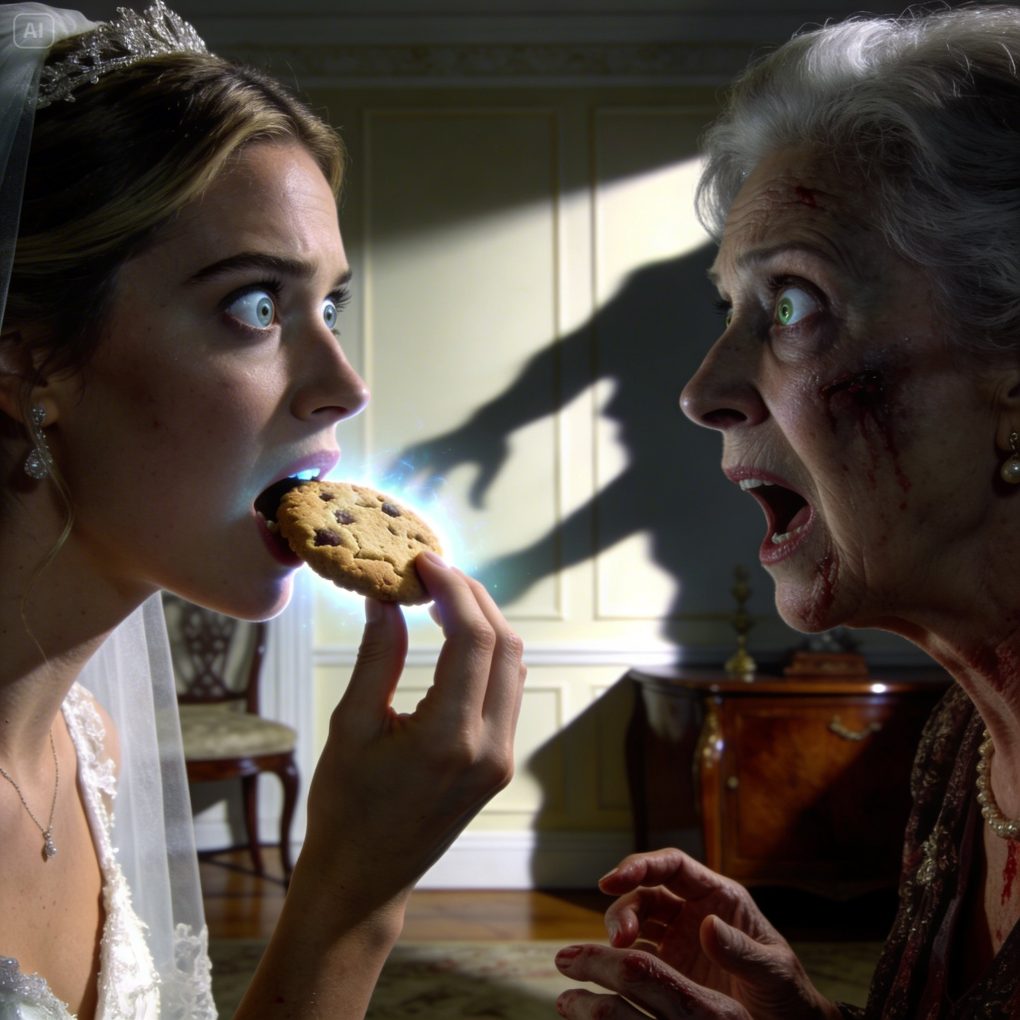
So I smiled politely and lowered the cookie just enough to say, “I’m sorry, but could you try it first?”
Gloria’s face froze.
Not confusion.
Not offense.
Recognition.
For half a second, no one moved. Daniel looked from me to his mother, startled. His father slowly lowered his newspaper.
Then Gloria did something so shocking that for a moment I thought I had imagined it—
she slapped the cookie out of my hand so hard it shattered against the tile floor.
And in the same breath, still smiling with her eyes gone dead, she said, “Daniel, I think your fiancée should leave.”
 Nobody spoke for three full seconds.
The broken cookie lay scattered across the white floor, icing cracked, crumbs spread like evidence. Daniel stared at his mother with a kind of confused disbelief that made him suddenly look much younger.
“Mom,” he said slowly, “what the hell was that?”
Gloria didn’t answer him.
She was looking at me.
Not with embarrassment. Not with the flustered irritation of a hostess whose gesture had been misunderstood. She was studying me with a terrifying calm, as if recalculating a problem she thought had already been solved.
Then she said, in a tone so even it made my pulse jump, “Julia, I don’t care for suspicion in my home.”
I stood up.
“Good,” I said. “Because I don’t care for whatever was in that cookie.”
Daniel’s father spoke for the first time then. “Gloria.”
Just her name. Nothing more. But it was the voice of a man who had recognized a boundary being crossed and was too afraid or too practiced to say it plainly.
Daniel stood too. “Mom, did you put something in that?”
She laughed lightly. “Honestly. Listen to yourselves. It was almond extract. She’s dramatic.”
“Then you eat one,” I said.
That was when the room changed.
Gloria turned to Daniel, not to me, and the warmth dropped out of her voice completely. “I told you not to bring another one of these girls into my house.”
Another one.
Daniel went pale.
I looked at him. “What does that mean?”
He didn’t answer.
His silence did.
A terrible, cold understanding began assembling itself in my mind—not fully, not yet, but enough to make me take one step backward toward the door.
Gloria saw it and moved first.
Not toward me. Toward the tray.
She grabbed the remaining two cookies and swept them into her hand as if trying to destroy the room’s central fact before anyone could inspect it. One fell. Daniel caught her wrist.
“Stop,” he said.
For the first time since I met him, his voice sounded truly afraid.
His father stood abruptly, chair scraping backward. “Daniel, let go of her.”
“No.”
That one word seemed to shock them all.
I took out my phone.
Gloria noticed instantly. “Put that away.”
“What was in the cookie?” I asked again.
She smiled then—a small, bloodless smile that did not belong in a family sunroom in the middle of the afternoon.
“If you’re smart, you’ll walk out now and be grateful this ended quickly.”
Daniel let go of her wrist as if it had burned him.
“What do you mean ended quickly?” he asked.
His mother turned to him with obvious disgust. “It means you keep making the same mistake. Finding women who think love entitles them to this family’s money.”
I stared at her. “This is about your estate?”
That made Daniel finally look at me fully, and what I saw on his face was worse than guilt.
It was recognition.
Recognition that I now knew there was a pattern.
“Julia,” he said quietly, “we need to go.”
“No,” I said. “We need to call the police.”
His father actually flinched.
Gloria laughed again, but there was something frayed underneath it now. “And tell them what? That I served you a cookie? Do you know how insane that will sound?”
I looked down.
One piece of the shattered cookie had landed intact near the leg of the coffee table. The icing was cracked, but the center remained dense and darker than it should have been. Without breaking eye contact, I picked up a napkin, bent, and carefully lifted the largest piece into it.
Gloria moved so fast it almost didn’t look human. She lunged across the table to snatch it from my hand.
Daniel caught her this time with both arms.
And as she struggled, really struggled, his father said in a voice of exhausted horror, “Not again, Gloria.”
The room fell dead silent.
I turned slowly toward him.
“Again?”
Part 3
No one wanted to answer me.
That was how I knew the truth would be worse than anything I had imagined.
Daniel still had both hands on his mother’s arms, not roughly, but firmly enough that she could no longer lunge for the cookie fragment wrapped in my napkin. Gloria’s face had changed in a way that made her seem years older—less elegant, less composed, stripped down to something mean and desperate.
His father sat down heavily and pressed his fingers to his eyes.
“Eight years ago,” he said, not looking at me, “Daniel was engaged to a woman named Marissa.”
Daniel shut his eyes.
My stomach dropped.
His father continued in the flat voice of a man reciting a private shame he has carried too long. “She became violently ill after dinner here. Gloria insisted it was shellfish contamination from a restaurant lunch she’d had earlier. There was no proof otherwise. Daniel wanted to believe that.”
I looked at Daniel. He still wasn’t looking at me.
“She left him three weeks later,” his father said. “Said she felt unsafe in this house.”
“Because she was,” I said.
Nobody argued.
Gloria finally spoke, cold and furious. “Marissa was a manipulative opportunist.”
“And the woman before her?” I asked.
That made Daniel go still.
There had been another.
He answered this time, voice barely above a whisper. “Nina. Two years before Marissa.”
I felt something inside me harden beyond repair.
“What happened to her?”
He swallowed. “She collapsed after tea here.”
The room went quiet again.
I looked at Gloria. “So this is your screening process?”
She lifted her chin. “I protect my family.”
“No,” his father said sharply, and it was the first time I saw any real life in him. “You poison women you think might marry above their station.”
That sentence seemed to crack the whole room open.
Daniel let go of her and stepped back as if he no longer knew what stood in front of him.
I called 911.
This time, no one tried to stop me.
Maybe because the truth was too visible now. Maybe because his father had finally chosen a side. Maybe because Gloria understood that the remaining cookie, the broken one on the floor, and the pattern she had hidden behind years of charm and plausible illness had become too large to smother with etiquette.
The police arrived twenty-two minutes later.
The officers were careful at first, skeptical in that reasonable way people become when summoned over a destroyed cookie and a family accusation. Then they saw Gloria’s attempt to wash the tray before they arrived. Then they heard the statements—mine, Daniel’s fragmented admission about the prior fiancées, his father’s low, miserable account of years of suspicion. Then an officer bagged the cookie fragment and asked why a woman would react with such panic to being asked to taste her own food.
Gloria asked for a lawyer before the field interview ended.
The tests took time, but not as much as you’d think. The cookie contained a concentrated amount of ground oleander and crushed sedative tablets—enough to cause severe illness, especially in someone who finished the whole thing quickly with hot coffee. Not a guaranteed clean murder. Something more deniable. Something that could look like an unexplained collapse, an allergic reaction, a cardiac event in the wrong person.
That was apparently her method.
Not dramatic poisonings.
Private medical crises with no obvious witness and every opportunity for confusion.
Marissa was found two states away and agreed, after some persuasion, to reopen her old report. Nina did too. Their stories were nearly identical to mine: a warm welcome, a special food or tea item served only to them, an odd bitter taste one noticed too late, sickness afterward, and Daniel’s family insisting it was stress, nerves, or outside contamination.
Daniel was not charged.
But I did not forgive him.
He knew enough to feel fear. Enough to recognize the freeze in his mother’s face when I asked her to taste the cookie. Enough to understand “not again” the moment his father said it. Yet he kept bringing women into that house anyway, held together by denial and inheritance and the weak hope that maybe this time his mother would behave.
That kind of cowardice may not be criminal.
It is still ruinous.
Weeks later, after Gloria was arrested and the story spread through the right circles, Daniel came to my apartment and asked whether I thought there was any path back from what happened.
I answered honestly.
“No. Because the moment I asked her to try the cookie, she showed me who she was. And the moment she froze, you showed me who you were too.”
He cried.
I didn’t.
The day I first met my future mother-in-law, she offered me a special cookie and called it a token of welcome. As I brought it to my mouth, I noticed a bitter smell and asked, politely, if she would try it first.
Her face froze.
And the shocking thing she did was not just slap the cookie from my hand.
It was reveal, in one violent second, that she had done this before—
and that I had been invited not to a family lunch,
but to a test I was never supposed to survive.