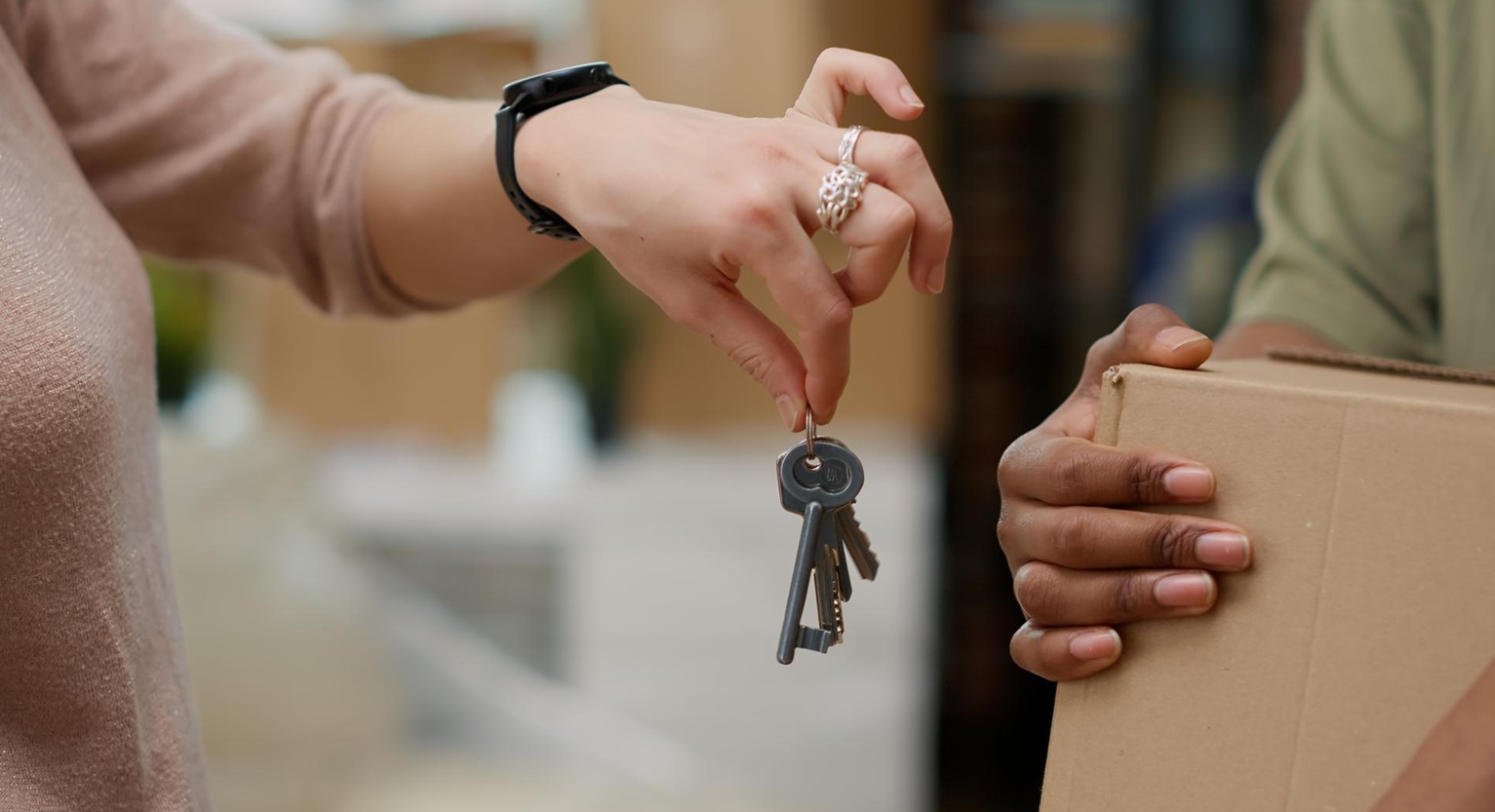
The motion alert came through at 2:17 in the afternoon Mountain Time, during a panel on pediatric dysphagia protocols, and I opened the app under the table the way you check a message you do not want the person beside you to see.
Camera two faces my living room. I do not get motion alerts from camera two. Camera one catches delivery drivers and the raccoon who learned to open the recycling bin. Camera three covers the back door. Camera two is inside, pointed at the middle of the house, and nothing triggers it unless someone is standing in my living room.
The thumbnail was small and blurred by motion. Blonde hair. A box being set down on my coffee table. I tapped it.
My sister Chloe was standing on the rug I found at an estate sale on Forty-Third Street, the one I carried to my car alone in the rain because nobody was with me and I did not care because it was the exact shade of green I had been looking for across four months of looking. She was standing on that rug in shoes I did not recognize, pulling out her phone, and she was relaxed in the specific way of someone who has already decided how something ends.
She said, laughing, into the phone: “Dad’s lawyer is putting it in my name. She’ll never get us out.”
I watched the clip once. Then again. Then a third time, not because the content was unclear but because I wanted the timestamp exact. 2:17 p.m. Mountain Time. March 12. I noted it the way I note a session observation at the clinic: date, time, presenting behavior, context.
Then I closed the app and listened to the rest of the panel.
I want to be precise about that part. I did not leave the room. I did not excuse myself. I sat in my chair with my lanyard around my neck and a woman from Johns Hopkins explained aspiration risk protocols for another thirty-five minutes, and I wrote a note in my laptop about thickened liquids and esophageal motility. I do not remember now what it said. But I wrote it because my hands needed something to do that was not shaking.
That is not strength or bravery or ice water in the veins. It is what happens when your body understands the situation before your mind has given permission to react. My chest was tight and my jaw was locked and my fingers had gone cold in the air conditioning, but I did not move, because moving meant choosing what to do, and I was not ready to choose yet. In my field, we do not react to the first data point. We observe, we document, we look for the pattern. The intervention comes last. The observation is everything.
When the panel ended I found a window alcove near the elevators, sat on the sill, and played the recording again. Not for content, which I had already memorized, but for logistics. What I had: a fifteen-second clip with audio, Chloe’s face visible, her voice clear, the sentence unambiguous, time-stamped by the camera system. My living room identifiable behind her by the bookshelf I built and the rug I carried through the rain.
I saved the clip to local storage. Uploaded it to cloud. Emailed it to myself with the subject line March 12, camera 2 and no body text. Three copies in three locations. Then I screenshotted the motion alert notification and the camera’s activity log, which showed no prior movement that day until 3:09 p.m., when my front door opened.
Eight minutes. That is how long it took from her walking through my door to saying the sentence that would end everything.
Then I called Gil Navarro.
Gil is my real estate attorney. I hired him two years ago when the title company flagged a lien question during my refinance, something the previous owner’s contractor had left tangled in the chain of title. Gil untangled it in eleven days. He charges three hundred twenty dollars an hour and never uses two words when one works, and he once told me the most dangerous clients are the ones who bring receipts. I liked him immediately.
He picked up on the second ring.
I told him I needed to play him something, a camera recording from my house, fifteen seconds. He did not ask why. I held the phone to the speaker and played the clip, and Chloe’s voice filled the alcove, tinny and bright against the convention center carpet.
Dad’s lawyer is putting it in my name. She’ll never get us out.
Then silence.
I counted, because silence has diagnostic value. The length of a pause tells you what the brain is doing behind it.
Gil’s pause lasted eleven seconds.
“This is criminal,” he said. “Not civil. Criminal.”
He told me forgery of a real property instrument was a Class C felony. Filing false documents was a separate offense. Depending on the number of people involved, conspiracy. He asked how much time I wanted to give them before we filed.
I said none.
He told me to get back to Kansas City, bring the recording, not call them, not text them, not go to the house first. Come to his office. And he told me not to delete anything off the camera: not the clip, not the activity log, not the motion alerts. The system was cloud-based, so it was time-stamped and server-verified. They could not claim I had fabricated it.
Then, two seconds.
“This is a good case,” he said. “This is a very good case.”
I hung up and changed my flight. The change fee was eighty-seven dollars. I paid it the way you pay for something that has already saved you more than it cost.
I need to tell you about the house, because without it the story does not have its full weight.
I bought it at twenty-six. A three-bedroom Craftsman bungalow in Brookside, hardwood floors under carpet, original built-ins, a garden plot in the back that was all weeds when I closed. No cosigner, no family money, no help from anyone whose last name matched mine.
I refinanced the floors on my hands and knees over a long weekend in November. I rewired the porch lamp myself after four hours of YouTube tutorials. I built the living room bookshelf from reclaimed wood I drove to Olathe to find, and it took three tries to get it level, and it still leans a quarter inch to the left, and I don’t care, because I built it.
But the guest room I finished first. Before I bought my own bed frame. Before I hung curtains in my bedroom. I bought the guest room pillows because they were the kind my mother liked, firm, cotton, no polyester fill. I know this because she mentioned it once in passing during a conversation she had not been conducting for my benefit, and I had been in the room, and I remembered, the way I always remembered.
The reading lamp for my father: warm light, adjustable neck, the kind he always said hotels never got right. I found it online and paid for expedited shipping and placed it on the nightstand at the angle I knew he preferred, because I had watched him adjust hotel lamps my entire childhood and had filed the information without deciding to.
The porch swing was Thanksgiving, three years ago. My mother, halfway through her second glass of wine, said to no one in particular: “I always wanted a porch swing, but your father says they’re pointless.” She forgot she said it before dessert. I drove to four stores the following weekend to find the right one. White oak, slatted seat, chains that didn’t squeak. I hung it myself on a Sunday afternoon while my neighbor Pam watched from across the street and offered to hold the ladder.
My mother sat on that swing exactly twice. Both times for less than ten minutes. Both times while checking her phone.
I built that guest room the way you build a case for a job you desperately want. Every pillow was a paragraph. Every lamp was a closing argument. See what I have made. See that I am not just the practical one. See that I pay attention, that I remember, that I build rooms for people who never asked for them, because I believed that if the room was perfect enough, they would finally stay.
They didn’t stay. They moved someone else in.
I landed at KCI at eight forty-two and drove straight to Gil’s office. He had the Jackson County Recorder’s website pulled up when I arrived and turned the screen toward me before I sat down.
A quitclaim deed filed six days earlier. Grantor: Rachel Ann Whitmore. Grantee: Chloe Marie Whitmore. Notarized by Dale R. Crenshaw, attorney at law. Witness: Janet Morris.
The signature at the bottom was someone else’s idea of mine. My R does not have a tail. It has not had a tail since I was twelve and decided tails were inefficient. The forgery had a tail that curled like a cursive textbook. Whoever produced it did not know me well enough to copy my handwriting, which told me everything I needed to know about how much attention my family had been paying for twenty-nine years.
“That’s not my signature,” I said.
Gil said he knew. He said forgery was a Class C felony, filing false documents was a separate count, and the notarization raised questions about Dale Crenshaw’s participation. He asked if I knew Crenshaw. I told him: semi-retired, my father’s college friend, Mizzou, thirty-five years, poker the second Tuesday of every month. He was at my parents’ house for Christmas two years earlier and I made him a plate.
Turkey and cranberry sauce and rolls I made from scratch because my mother said store-bought embarrassed her.
I drove to my house at ten-fifteen.
Chloe’s white Civic was in the driveway, parked at an angle, the way she parks everything, as though precision is something that happens to other people. There were curtains in the front window that I did not buy. I parked on the street and walked up my own front steps and unlocked my own door with my own key, which still worked, which meant they had not changed the locks yet, which meant they were either confident I would not find out or too disorganized to think that far ahead.
Both options were insulting.
Chloe looked up from her phone the way you look up when a waiter refills your water, acknowledging the presence without registering the person. She said oh, you’re back early, casual as weather.
I said the conference ended a day ahead. I set down my bag. I looked at the new throw pillows on my couch and the blanket I did not recognize draped over the arm of my grandmother’s chair and the vanilla bergamot candle on the side table, and I noted all of it with the attention I brought to clinical observations: neutral, complete, for the record.
My mother was in the kitchen.
Stephanie Whitmore was at my island, unloading groceries into my refrigerator, and she turned with the rapid recalibration I had seen in a hundred parent conferences, the adjustment of presentation to match the audience. She hugged me for two seconds, which is the length of a hug where the arms are doing what is expected while the body is already planning the next task.
She said she had thought she would help Chloe get settled while I was away. She reached for a can of soup. My cabinet, my shelf.
I looked past her shoulder. Down the hall. The guest room door was open.
I walked to it.
Chloe’s clothes in the closet. Chloe’s throw pillows on the bed where I had placed the firm cotton ones my mother liked. My father’s reading lamp was unplugged on the floor, cord coiled at the baseboard, set aside like something whose usefulness had passed. The slate blue duvet, the one my mother once said made her feel like she was in a nice hotel, was folded and stacked on the shelf above, replaced by a quilt I had never seen.
I stood in the doorway and counted four seconds. Then I walked to my bedroom, opened the closet, opened the fireproof safe. Combination lock, four digits, the year I graduated college. Inside: birth certificate, passport, the original deed to 4738 Oak Street. Signed by me. Notarized by the title company. Witnessed. Clean.
I took the deed. Put it in my bag. Closed the safe.
My mother asked, back in the kitchen, arranging fruit in a bowl I bought at the farmer’s market on Troost the first weekend I moved in, whether I minded Chloe staying a few days. She said it the way she said things that were already decided.
I said of course not. And that was the last lie I told her.
I crossed the street and knocked on Pam’s door.
Pam Jeffries is sixty-seven years old, a retired postal worker who has been in her house since before the neighborhood got trendy, and she opened the door holding binoculars and a glass of iced tea. She was either watching the street already or she lived this way as a general practice, and I was no longer surprised by either possibility.
She told me the blonde one had moved a beanbag chair into my house, and asked if she should get the hose.
I sat on her porch step and asked her to tell me exactly what she had seen the day they moved in. She picked up her phone, scrolled, and turned it to face me.
Fourteen photographs. The U-Haul in my driveway, license plate visible. My mother directing two men carrying a mattress through my front door. Chloe on my porch with a smoothie, watching. All time-stamped, all geotagged. She had taken them because something did not add up, she said, because you do not move furniture into someone’s house while they are on a plane unless you do not want them to see it happen.
I asked her to send them to me.
She said she already had. Check your messages.
I forwarded all fourteen to Gil before I stood up.
At his office an hour later, Gil placed the two deeds side by side on his desk. My original on the left: the R without a tail, the W with the heavier first stroke I have always applied to initial letters. The forgery on the right: theatrical R, tentative W, the handwriting of someone’s idea of me constructed without reference to the actual person.
He told me the witness name, Janet Morris, did not exist in any Missouri record: not the Secretary of State database, not voter rolls, not professional licensing boards. The address listed on the notarization was unoccupied commercial space. The witness signature was fabricated.
Then he told me that Dale Crenshaw had flipped.
Full cooperation, sworn statement, eighteen pages, complete timeline: who contacted him, when, what he was told, what he was paid. My father had given him two thousand dollars and a bottle of bourbon.
Two thousand dollars and a bottle of bourbon.
That is what my house was worth to them. That is what I was worth.
Gil read me the section of Dale’s statement describing the initial conversation with my mother when she first approached him about preparing the deed.
She said: Rachel’s the practical one. She’ll get over it.
I held the steering wheel at ten and two, the way my father had taught me when I was sixteen, the one genuinely useful thing he had given me, and my hands went completely still.
The practical one. She’ll get over it.
At fourteen I was sitting at the kitchen table doing algebra homework while my mother stood at the counter, phone between her ear and shoulder, peeling carrots. She was talking to her sister Linda and did not know I could hear her, or knew and had decided it did not matter.
She said: Chloe’s the one with spark. Rachel’s the practical one. She’ll manage on her own.
She said it the way you describe a household appliance. Reliable. Low maintenance. Doesn’t need attention.
I closed my textbook. Opened it. Finished the problem set. Got a ninety-eight on the exam. And I started managing.
I managed my way through high school and through a scholarship and through a master’s degree and a clinical fellowship and a career and a savings account and a house, a real house with a deed and a foundation and a porch swing I hung for a woman who sat on it twice and spent fourteen months planning a theft.
And I was sitting in my car with that sentence in my chest, the same sentence seventeen years later, not directed at Linda this time but at an attorney being asked to forge a document, and my mother’s assessment of me had not moved a single degree in all the years I had spent building things to move it.
She hadn’t seen the house. She had seen the square footage.
I called Gil.
“File everything,” I said.
He asked if I was sure. He said once this moved, it did not stop. He said these were my parents.
“They were,” I said. “Now they’re respondents.”
He told me he would have the criminal referral to the DA’s office by end of business the following day. Civil complaint to void the deed filed simultaneously. Bar complaint against Crenshaw in the morning.
All three at once, he said, so that each person learns about the others from their own attorney, not from each other, and they cannot coordinate a story they do not yet know they need.
The first call from my mother came at nine-fourteen the following morning, between my six-year-old with the lateral lisp and my four-year-old with selective mutism. I let it go to voicemail. Then the second at nine-sixteen. Nine-eighteen. Nine-twenty-one. Four calls in seven minutes, which is not a mother checking in but a woman discovering that the system she built is being taken apart and wanting to know who holds the wrench.
I called her back at lunch from my car in the clinic parking lot with the engine running, because I wanted to be able to drive away the moment the call stopped being useful.
The warm voice was gone. What remained was the operational voice underneath, clipped and hard, the voice she used when things were not proceeding as planned and someone needed to be corrected.
She told me I had no idea what I had done. She told me Dale was calling her husband in a panic and that bar complaints were not how family handled things. I told her Dale had notarized a forged deed with a fabricated witness, and that was not a family favor, it was a felony. She said this was a family matter and I had brought the state into family business and what was wrong with me.
I told her she had brought a lawyer in first. His name was Dale.
Then she pivoted, fast, from anger to grief, the way she always moved when one register stopped working: she mentioned my birth weight and a school play she attended in 2003 and the cost of my braces. Forty-three seconds without an apology or an acknowledgment that a forged deed existed.
When she paused for breath I said: is there anything else?
She hung up.
Chloe called twenty minutes later with crying that might have been real and a story about not knowing it was illegal, that their mother had said it was just paperwork, like transferring a car title. I told her I had her on camera. I told her exactly what she had said, laughing, comfortable on my rug. The irregular breathing stopped.
I told her to get an attorney. A different one from Dale. Then I hung up and went back inside and finished my afternoon sessions.
The meeting in Gil’s conference room happened two weeks after the filings.
My mother arrived in her church outfit: navy blazer, pearl earrings, the lipstick she wears when she wants to be taken seriously by people she considers important. My father behind her, slightly to the left, the position he occupies in all her photographs. Their attorney, Frank Devereaux, who had taken their case after two other firms declined, carried a briefcase and the expression of a man who understood the dimensions of what he had agreed to represent.
Gil opened a folder and placed the documents on the table without narration. He let the paper do what precisely assembled paper does, which is speak for itself.
The forged deed. The authentic deed beside it, signatures facing each other. Pam’s fourteen photographs, fanned across the surface. The voicemail analysis: my mother’s call to me at six forty-two in the morning, have a safe flight honey, followed by Chloe’s arrival at my house at four-thirty that afternoon, the straight line from love to logistics. Dale Crenshaw’s sworn statement, eighteen pages, placed last.
My mother stared at the table. Her hands were clasped, but the knuckles were white and the left thumb was pressing into the right palm hard enough to leave a mark. I know this because I was trained to watch hands.
Devereaux whispered something. She shook her head once, the gesture of a woman not yet ready to accept the dimensions of the room she is in.
She looked at me. “You planned this.”
“You planned it first,” I said. “Fourteen months, according to Dale.”
She said Dale was a liar. I told her he was a liar who kept receipts, that the check for two thousand dollars was on page eleven. Her mouth opened and closed and opened again, the rhythm of someone whose script has been removed mid-performance.
Their attorney put a hand on Kevin’s arm. My father had not spoken. He sat slightly folded, visible now in the way he was never usually visible, and he looked at me, and his eyes were wet, and his mouth began the shape of something. The word sorry, maybe. Or just the shape of a man who had chosen the wrong side of a door that was now closing.
My mother turned toward him.
He stopped.
Four seconds. I counted. Then whatever word it had been retreated back inside him, and he closed his mouth, and the silence was the loudest answer he gave that day or possibly any day.
She turned back to me, last attempt, the voice shifting to the register she kept for when all other strategies had been exhausted: the warning.
“When you’re alone,” she said, “when you have nobody, you’ll wish you still had a family.”
I looked at her for a moment. My mother. The woman who had carried me for nine months and assessed me for seventeen years and never once revised her conclusion.
“I have a family,” I said. “You’re just not in it.”
Not an argument. A closing statement. There was nothing to respond to and she did not try.
Gil gathered the documents. Devereaux asked for a recess that everyone present understood was a surrender. My mother walked out without looking back and my father followed, still behind her, still slightly to the left, and I walked out after them, not behind them, and the difference between those two positions was the distance of the last seventeen years.
The legal resolution: Kevin and Stephanie Whitmore were arraigned in Jackson County on two counts each, forgery and filing fraudulent documents. The case is pending. The forged deed was voided by court order. My title is restored and insured against future claims. Dale Crenshaw’s law license was suspended eighteen months pending full disciplinary review. Chloe received two years of probation and eighty hours of community service and sent me one text three weeks after the arraignment: I’m sorry, Rach.
I read it. I did not reply yet. Not deciding is also an answer, the kind that gives you room to breathe while you determine whether an apology is a door or a window.
Three months later I changed the locks for the second time. Not because I needed to; the first change was practical. The second was different. I chose brushed nickel hardware myself, solid, the kind that feels deliberate when you turn it, and I installed it on a Saturday morning with a screwdriver and coffee and Pam watching from her porch.
She told me I was stripping the screw.
I told her I wasn’t.
She told me I was stripping the screw and was too stubborn to use the drill.
She was right about the screw. I used the drill.
The guest room is my home office now. New desk, oak, simple. My diploma on the wall, my therapy materials organized on shelves by category and age range, because that is who I am and I have stopped apologizing for it. The firm cotton pillows are gone. The reading lamp is gone. The duvet is in a donation bag in the garage because I did not throw it away; I gave it to someone who might actually use it.
The porch swing is gone.
In its place: a bench from a flea market in Waldo that Pam insisted on one Sunday afternoon because she said I needed to touch grass and stop thinking like a lawyer. Green paint, slightly uneven, the left leg shorter than the right. I bought it because it would hold both of us.
We have eaten pie on it twice. Cherry, homemade, Pam’s crust cracked on one side because Pam bakes the way she does everything else: with confidence and no interest in aesthetics. We do not usually talk about the case or the deed or the fourteen months on those afternoons. We talk about her grandkids and the cardinal that keeps hitting her kitchen window and whether the house three doors down will ever finish their landscaping or if the mulch pile is now permanent.
She told me once that she almost came over to help when I moved in, all those boxes alone in the sideways rain, but she thought I might be the type who wanted to do it myself.
I told her I was.
She asked: and now?
Now I would let you carry one box, I said.
She laughed the short warm laugh that starts and ends in the same breath and said: one box, big spender.
I said: don’t push it.
What I know now, sitting on the uneven bench in the evening while the street does what streets do, is that the guest room was always the real document. Not the forged deed but the one I had been drafting for years: the room with the right pillows, the right lamp, the porch swing hung for a woman who said something at Thanksgiving and forgot it by dessert while I was already driving to the fourth store. The room that said see me, see what I have made, see that the practical one pays attention.
They saw the house. They saw the square footage and the location and the clean title and the value of the asset, and they built a fourteen-month plan around the assumption that the practical one would absorb it the way she absorbed everything, quietly, efficiently, without making a scene.
She was right about quiet and efficient. She miscalculated the scene.
I made a case instead.
The locks are changed. The camera app is closed, the three little white eyes no longer watching the rooms, because the rooms do not need watching anymore. They are entirely, finally, irrevocably mine, not because of the deed or the court order, though both help, but because every chair and shelf and window and inch of floor in this house was chosen by me, built by me, carried through the rain by me, and the people who come through the door now are the ones who knock first.
Pam has a key.
She has never once used it without calling ahead, which is everything you need to know about the difference between people who show up because they decided you matter and people who show up because they calculated that you’re useful.
Last week she knocked at seven in the evening with a casserole she said she had made too much of, which we both understood was not true. We ate it at my kitchen table and she told me about her youngest granddaughter’s first swim lesson and I told her about a patient, nothing identifying, just the shape of a small victory, a child who had been silent for months finally saying mama in a room with no expectation and no audience.
We did the dishes together and she went home and I locked the door and stood in my kitchen in the quiet that is finally the right kind of quiet, the quiet of a house that is simply inhabited rather than occupied, and I thought about the night I turned fourteen and closed my textbook and opened it and finished the problem set, the beginning of seventeen years of managing, of building, of demonstrating by accumulation that I was worth seeing.
I do not build things to be seen anymore.
I build things because I am good at it, and because the house requires maintaining, and because Pam’s bench needed a second coat of paint and I had Saturday afternoon, and because the work itself is the point, which is what it took me thirty-one years to understand.
The silver book keychain from the Future Scholars Program hangs on the hook by my door, next to my keys and Pam’s spare. I kept it because it belongs to the girl who was told she had the mind of a philosopher and then spent seventeen years proving it in the wrong courtroom, to the wrong judge, for a verdict that was never going to come.
It is on the hook now because I am not proving anything to anyone.
The house is mine. The locks are mine. The rug I carried through the rain and the bookshelf that leans a quarter inch to the left and the uneven bench on the porch and the plants on the windowsills that Pam checks when I am at conferences because she does not need to be asked.
All mine. All enough. All finally, exactly what I was building toward without knowing it, which was not the room for them but the life for me.