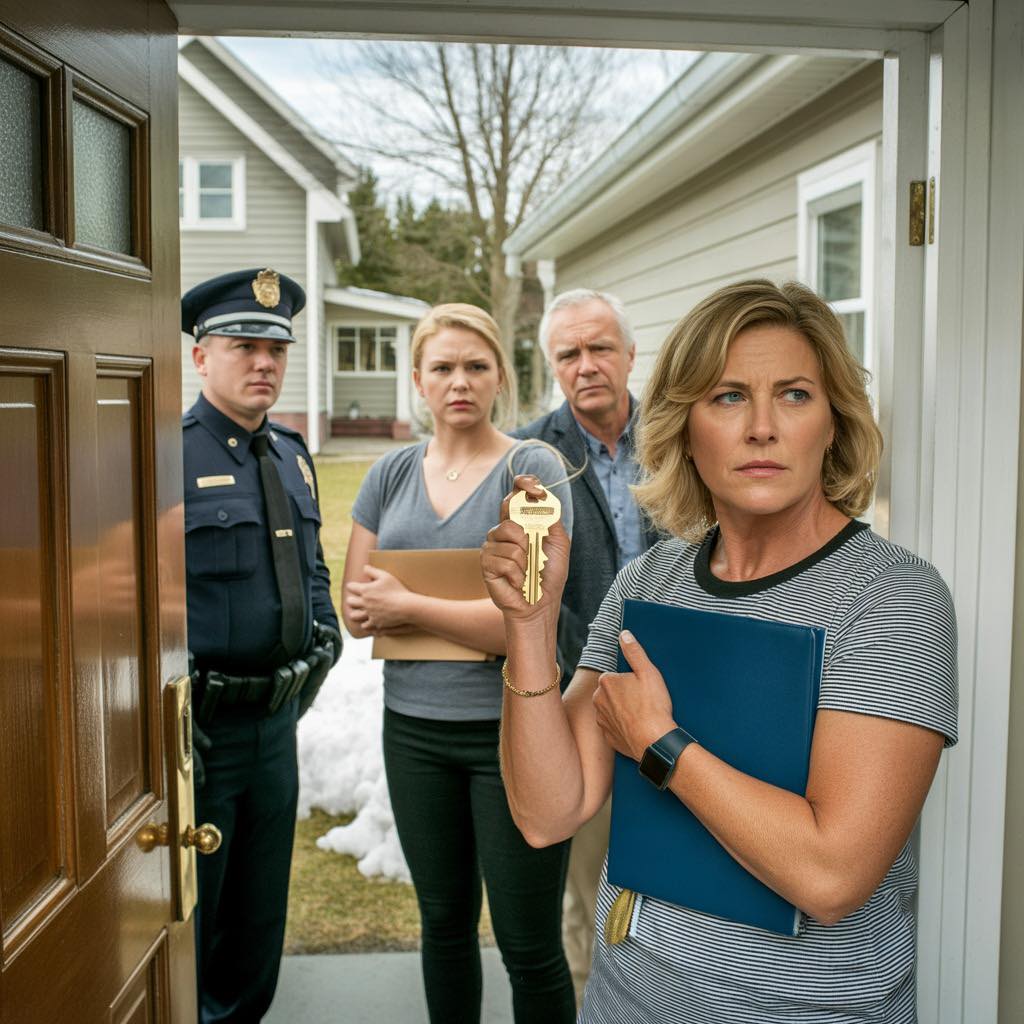
The brass key was cold enough to sting my palm, its weight oddly substantial for something so small. A tiny maple-leaf charm dangled from the ring, clicking softly against my wedding band like it was trying to tell me something I wasn’t ready to hear. I stood on the porch of a farmhouse I’d never been allowed to see, staring at a front door painted the color of storm clouds, while somewhere in the distance a radio played Sinatra from a neighboring property, the music thin and tinny across the vast Alberta prairie.
My hand trembled as I pushed the key into the lock. The mechanism turned with surprising smoothness, as though it had been waiting for this exact moment. The door swung open on well-oiled hinges, and what I saw inside stole my breath so completely that for one surreal second, I forgot I was a widow standing in a stranger’s house that somehow belonged to me.
That’s when I heard the tires on gravel behind me—the deliberate crunch of an approaching vehicle that hadn’t been there moments before.
Joshua Mitchell never demanded much during our twenty-four years of marriage. He didn’t demand dinner on the table at six o’clock sharp. He didn’t demand I iron his dress shirts or keep the house spotless or defer to his opinions on matters large and small. Joshua was the kind of man who asked politely, made careful lists, and then quietly did the work himself if you forgot or couldn’t manage it. He was an engineer by training and temperament—methodical, precise, unfailingly courteous.
So when he demanded something—when his voice sharpened into something hard and final, when his eyes went flat with an emotion I couldn’t quite name, when words came out like nails being driven into wood—my body learned to obey before my mind could construct an argument.
“Never go to the farm, Catherine,” he’d said one evening years ago, standing at our kitchen sink in our modest Minneapolis home with his sleeves rolled up and dish soap foaming to his wrists. Our daughter Jenna’s high school graduation photo hung slightly crooked on the wall behind him. He didn’t look at it. “Promise me you’ll never go there.”
I’d been loading the dishwasher, half-listening in the way you do when someone interrupts a routine task. “What farm?” I’d asked lightly, trying to inject humor into what felt like an oddly intense moment. “Did you secretly buy a dairy operation and forget to mention it? Are we suddenly cattle ranchers?”
He’d turned off the faucet with a deliberate twist, as though the sound of running water was suddenly unbearable. “Promise,” he’d repeated, and his voice carried a weight that made the kitchen feel smaller.
I remember laughing because the intensity didn’t match our surroundings—a middle-class kitchen in a quiet Minnesota suburb, maple cabinets we’d installed ourselves, linoleum that was starting to curl at the corners. This was not the setting for dark family secrets or mysterious prohibitions.
“Okay,” I’d said, still half-teasing. “I promise I won’t go to your mysterious Canadian farm that I didn’t know existed until thirty seconds ago.”
The relief that flooded his face was so profound it unsettled me. He’d stepped behind me, pressed his forehead to the back of my head, and for a moment I’d smelled cedar and something metallic, like old coins or blood. “Thank you,” he’d whispered against my hair. “Thank you, Cat.”
I’d assumed it was about childhood ghosts—everyone has those. I had my own demons from growing up in a house where love was conditional and criticism came more easily than praise. I’d understood the need to leave certain parts of the past locked away where they couldn’t hurt you anymore.
What I never imagined was that his forbidden farm was about land, money, and a battle he was waging in silence to protect me from enemies I didn’t know existed. And I certainly never imagined he would take that promise with him when his heart stopped beating on an ordinary Tuesday morning while he was reaching for his coffee mug.
Two weeks after the funeral, the world felt muffled and distant, like I was living inside cotton batting. Colors seemed duller. Sounds reached me from underwater. The house echoed with Joshua’s absence in ways I hadn’t anticipated—his coffee mug unwashed in the sink because I couldn’t bear to clean it, his reading glasses on the nightstand, his precise handwriting on the grocery list still magnetized to the refrigerator.
The appointment with Mr. Winters, Joshua’s estate attorney, was scheduled for two o’clock on a Thursday. The law office occupied the second floor of a historic building downtown, all dark wood paneling and leather furniture that smelled like old books and furniture polish. Framed diplomas lined the walls alongside generic prints of sailboats that probably cost more than they looked worth.
Jenna had declined to come, saying she “couldn’t handle the paperwork yet,” which was code for “I can’t sit in a room with you and pretend we’re both handling this fine.” Grief had sharpened my daughter into someone I barely recognized—angry, brittle, looking for someone to blame for the unfairness of losing her father at fifty-two to an undiagnosed heart condition that gave no warning before it killed him.
Mr. Winters was exactly what you’d expect from an estate attorney in his sixties—silver-haired, distinguished, with reading glasses that hung from a chain around his neck. His assistant brought coffee in delicate china cups that seemed wildly inappropriate for the conversation we were about to have.
“Mrs. Mitchell,” he began, shuffling papers with the careful precision of someone who’d done this hundreds of times but still found it uncomfortable, “I’ve reviewed the standard elements of your husband’s estate with you—the house, the retirement accounts, the life insurance. However, there’s one additional item that was held in a separate trust with very specific instructions about disclosure.”
He slid a small wooden box across the mahogany desk toward me.
I stared at it, heart beginning to hammer for reasons I couldn’t articulate. The box was old, the kind you might find at an antique store, with brass hinges that had developed a green patina.
“What is this?” My voice sounded too loud in the quiet office.
“Please open it,” Mr. Winters said gently.
Inside, nestled in faded velvet, lay a heavy brass key attached to a ring with a small charm shaped like a maple leaf. Beneath the key was a sealed envelope with my name written in Joshua’s distinctive handwriting—precise block letters that leaned slightly to the right.
“Your husband purchased a property approximately three years ago,” Mr. Winters explained, watching my face carefully. “In eastern Alberta, Canada. A rural property called Maple Creek Ranch. According to his explicit instructions, you were to be informed of its existence only after his death. The deed has been transferred into your name. Property taxes have been prepaid for the next five years.”
I picked up the brass key, feeling its unexpected weight. “A ranch,” I repeated slowly, as though saying the words might make them make sense. “Joshua bought a ranch in Canada and never told me.”
“The property was his childhood home,” Mr. Winters continued. “It changed hands several times over the decades. Your husband repurchased it quietly through a series of intermediaries to avoid drawing attention.”
Childhood home. Joshua had told me almost nothing about his early years beyond the basic facts: born in rural Alberta, left at eighteen for university in the States, never went back. He’d spoken about his past the way you might describe a book you’d read once and mostly forgotten—distant, factual, emotionally neutral.
“Why would he hide this from me?” I asked, though I already knew part of the answer. Promise me you’ll never go there.
Mr. Winters adjusted his glasses with the deliberate care of someone choosing his words. “There’s something else you should know. The property has become quite valuable recently. Significant oil deposits were discovered in the region about eighteen months ago. Energy companies have been approaching landowners with acquisition offers. Your husband declined multiple substantial offers.”
The room seemed to tilt slightly. “Oil,” I said faintly.
“Yes. And there’s one more complication.” Mr. Winters pulled out another file, this one thicker. “Your husband has two half-brothers who still live in Alberta. They’ve contested the will, claiming he wasn’t mentally competent when he repurchased the property. Given the oil interests involved, their legal challenge is well-funded and aggressive.”
Half-brothers. Joshua had mentioned having siblings once, years ago, in passing. I’d asked follow-up questions and he’d changed the subject so smoothly I’d forgotten I’d never gotten answers.
My hands shook as I picked up the sealed envelope, using the tip of the brass key to slit it open like a letter opener. The paper inside was heavy, expensive—the kind Joshua used for important documents.
My dearest Catherine,
If you’re reading this, then I’ve left you far too soon, and I’m sorrier than words can express.
There’s so much I should have told you but couldn’t bring myself to face while I was alive. I’ve spent three years transforming the ranch from the broken, painful place of my childhood into something beautiful—something worthy of you.
I know I made you promise never to go there. I’m releasing you from that promise. In fact, I’m asking you to go at least once before you decide what to do with it.
In the main house, on the desk in the study, you’ll find a laptop. The password is the date we first met, followed by your maiden name (no spaces).
I love you, Cat. More than you’ll ever know.
Always, Joshua
I pressed the letter against my chest, crumpling it slightly, as tears I’d been holding back for two weeks finally broke through. Mr. Winters politely looked away, giving me space to fall apart in his expensive office.
When I could speak again, my voice came out rough. “How could he afford to buy a ranch? We were comfortable, but we weren’t wealthy.”
“Your husband was quite successful in his engineering consulting work,” Mr. Winters said carefully. “He made several lucrative investments over the years that he apparently chose not to discuss with you. The ranch purchase was made possible by liquidating some of those assets.”
Another secret. Another part of Joshua’s life I’d known nothing about.
“What happens now?” I asked.
“That depends on what you want to do,” Mr. Winters replied. “You could sell the property immediately—I have contacts who could facilitate a quick, advantageous sale to one of the energy companies. Or you could fight the legal challenge from your husband’s half-brothers, which will be expensive and time-consuming but which I believe you would ultimately win, as the documentation supporting your husband’s ownership is quite thorough. Or…” He paused meaningfully. “You could go see the property yourself before deciding.”
I looked down at the brass key in my palm, the maple leaf charm catching the afternoon light. Joshua had spent three years building something in secret, something he wanted me to see. Something he thought was important enough to leave detailed instructions about from beyond the grave.
“I’ll go,” I heard myself say. “I need to see it.”
Three days later, I was on a flight to Calgary with nothing but a carry-on bag, the brass key in my pocket, and a rental car reservation. Jenna had been furious when I told her.
“You’re running away,” she’d accused over the phone. “Dad’s barely been gone two weeks and you’re fleeing to some property he apparently kept secret from both of us.”
“I’m not running away,” I’d said, though I wasn’t entirely sure that was true. “I’m trying to understand.”
“Understand what? That he lied to us for years? That he had this whole other life we knew nothing about?”
I hadn’t had an answer for that. The hurt in Jenna’s voice was too raw, too justified. So I’d simply said I’d be back in a few days and ended the call before she could wound us both further.
The drive from Calgary to Maple Creek Ranch took nearly three hours, carrying me east and slightly north through landscape that started as rolling foothills and gradually flattened into prairie. The vastness of it was disorienting after years in Minneapolis suburbs—nothing but wheat fields and grassland stretching to a horizon so distant it seemed like a theoretical concept rather than an actual place.
The GPS directed me down increasingly rural roads until I was on gravel, dust plumes rising behind the rental car like smoke signals. And then, finally, I saw them: gates. Not the sagging, weathered wooden posts I’d pictured, but substantial timber structures with ornate ironwork spelling out MAPLE CREEK in black metal letters. These were the kind of gates you saw in magazines featuring “luxury rural estates” owned by tech billionaires seeking weekend retreats.
Beyond the gates, the land rolled out in golds and greens—native grasses mixed with carefully maintained pastures, clusters of maple trees providing shade, a few cottonwoods marking what was probably a creek bed. And there, perhaps half a mile up a winding gravel drive, sat a two-story farmhouse that looked like it belonged on a postcard. Wide porch, large windows reflecting the afternoon sun, stone chimney, fresh paint in warm earth tones. Outbuildings stood in neat rows—a barn, several smaller structures I couldn’t identify, all maintained and clearly functional.
This was not a ruin. This was not some decrepit childhood home left to rot.
This was a resurrection.
My hands trembled as I got out of the car to unlock the gate. The brass key slid into the mechanism with the kind of smooth precision that suggested regular maintenance. The gate swung open easily, and I drove through with my heart hammering against my ribs.
The driveway curved gently upward, following the natural contours of the land. With every turn, my pulse matched the crunch of gravel beneath the tires. I tried to imagine Joshua here—my methodical, reserved husband slipping away on those “business trips” he’d taken twice a month for the past three years, overseeing construction and renovation, building a secret life in the hours he should have been beside me in Minnesota.
Anger flickered hot and bright in my chest. Then grief washed over it like a wave, extinguishing everything, leaving only the hollow ache of loss.
When I parked in front of the farmhouse, the late afternoon air smelled like sun-warmed wood and distant wildflowers. A wind chime on the porch tinkled once in the breeze, as though welcoming me home to a place I’d never been.
I climbed out of the car slowly, every sense heightened. The porch steps were solid under my feet—new wood, well-constructed. The brass key felt heavier with each step toward the door.
Promise me you’ll never go there.
I had promised. And I’d kept that promise faithfully for however many years he’d been asking it of me.
Now he was dead, and he was asking me to break it.
The key slid into the front door lock like it had been waiting for this moment. The mechanism turned with a soft click that seemed to echo across the empty prairie. The door swung inward on silent hinges.
I stepped across the threshold into my husband’s secret.
The great room rose two full stories, exposed wooden beams crossing the ceiling like the ribs of some great ship. Late afternoon sunlight poured through tall windows, turning the space golden. A massive stone fireplace dominated one wall, and comfortable furniture was arranged in conversation groupings that suggested a home meant for living, not just visiting.
But what stopped my breath, what made my knees actually weaken, were the horses.
Not real horses—the house would have been considerably messier and smelled very different.
Horses everywhere in art.
Paintings covered the walls—oil on canvas, watercolors, mixed media—depicting horses in every imaginable scene. Horses galloping across open fields, their muscles rendered so precisely I could almost feel the power in their stride. Horses at rest in golden afternoon light. Horses with riders, without riders, in motion and in stillness.
Sculptures stood on custom pedestals throughout the room—bronze horses captured mid-leap, wooden horses carved with exquisite detail, a few abstract pieces that suggested the essence of horse rather than literal representation.
Photographs in simple black frames showed magnificent breeds in crisp, professional detail: an Andalusian with an arched neck, a paint horse with striking coloring, a thoroughbred frozen in mid-gallop.
It was a gallery. A shrine. A love letter made of art.
To horses.
To my lifelong, mostly private obsession with horses.
I’d grown up reading horse books, begging for riding lessons my parents couldn’t afford, drawing horses in the margins of my school notebooks. As an adult, I’d dragged Joshua to museums to see equestrian paintings, subscribed to horse photography magazines, taken occasional trail rides for my birthday. He’d always been supportive in his quiet way—patient while I spent too long examining a particular painting, agreeing to watch documentaries about wild mustangs, never complaining when I chose horse-themed Christmas cards.
But I’d never realized he was paying such close attention. I’d never imagined he understood the depth of what horses represented to me: freedom, power, beauty, grace—all the things I’d spent my careful adult life containing and controlling.
And now, in his forbidden ranch, he’d built me a cathedral dedicated to that passion.
On a desk positioned near the windows sat a silver laptop, closed. Across its lid lay a single red rose—artificial, perfect, the kind that would never wilt.
My throat closed completely. I walked toward it as though in a dream, my hand hovering over the rose without quite touching it, afraid that contact might shatter the illusion and I’d discover I was actually still in Minneapolis, still teaching high school English, still trying to figure out how to be a widow at fifty-three.
That’s when the sound of tires on gravel yanked me back to reality.
I spun toward the front windows, heart suddenly sprinting. Through the glass, I saw a black SUV rolling up the driveway, pulling to a stop beside my rental car. Three men emerged, all tall, all dark-haired, all sharing a bone structure that made my stomach drop.
They had Joshua’s jaw. Joshua’s forehead. Joshua’s way of moving with contained purpose.
Mitchell men.
They looked at the house the way people look at things they believe they own.
I backed away from the window, adrenaline flooding my system. The oldest of the three—silver threading his temples, eyes like chips of flint—mounted the porch steps and knocked on the door with the kind of authority that suggested he expected it to be opened immediately.
“Catherine,” he called through the door, my name too familiar in his mouth. “We know you’re in there. We should talk.”
His voice had the same faint prairie lilt Joshua’s had carried when he was tired or emotional, the accent he usually kept carefully suppressed.
I said nothing, frozen in the middle of the great room.
Another knock, harder this time. “I’m Robert Mitchell,” he announced. “Joshua’s half-brother. This is Alan and David. We’re here about the ranch.”
Of course they were. Not about Joshua, not about condolences, not about family grief. About the land. About the money. About oil rights and property values and legal disputes.
I glanced at the laptop on the desk. Whatever answers I needed were in that machine, not on the porch with three strangers who wore my husband’s face like a mask.
Moving as quietly as possible, I crossed to the desk and opened the laptop. The screen came to life immediately, prompting for a password.
The date we first met, followed by your maiden name.
May 15, 1998. A bookstore café where I’d been grading papers and he’d been reading a technical manual. He’d asked if the chair across from me was taken. I’d said no. Four hours later, we were still talking, our coffee long cold.
Carter. My maiden name, the one I’d kept hyphenated until Jenna was born and then quietly dropped from everything but legal documents.
05151998Carter.
I typed it with shaking hands and hit enter.
The screen unlocked immediately, opening to a folder on the desktop labeled FOR CATHERINE in Joshua’s precise all-caps style.
Inside were video files. Hundreds of them.
Each one labeled with a date.
The dates started three weeks ago—a few days after the funeral—and extended forward in daily sequence. I scrolled down, watching the dates roll past, my throat tightening.
Three hundred sixty-five files total.
One for every day of the first year I would wake up without him.
Outside, Robert knocked again, patience clearly fraying. “Catherine, don’t make this harder than it needs to be. We have a legal right to inspect the property pending the court review.”
I clicked on the first video file, dated the day after Joshua’s funeral.
His face filled the screen—not the thin, pale version from his final weeks, but Joshua as he’d been a year ago, healthy and whole. His hair was slightly too long, the way it got when he was too busy to remember haircuts. He wore the blue chambray shirt I’d bought him three Christmases ago. His crooked smile, the one that had made me fall in love with him at that café, was intact.
“Hello, Cat,” he said, and his voice went through me like an electric shock. “If you’re watching this, I’m gone, and you’ve come to the ranch despite spending years promising me you wouldn’t.”
He chuckled softly, and I had to press my hand over my mouth to keep from sobbing.
“I should have known you’d break the rule the minute you had the key and I wasn’t around to reinforce it. You’ve never been good at leaving mysteries unsolved—it’s the English teacher in you, always looking for deeper meaning in everything.”
Tears blurred the screen.
“I’ve made a video for every day of your first year without me,” Joshua continued, his expression shifting to something more serious. “One year of me keeping you company while you grieve. One year of me explaining everything I should have told you when I was alive but didn’t have the courage to face.”
He looked down briefly, then back up at the camera with renewed determination.
“Starting with why I bought back the place I swore I’d never set foot in again, and why I forbade you from coming here.”
The knocking stopped. Through the window, I saw the three brothers retreating to their SUV, pulling out phones and documents, conferring with tight mouths and aggressive gestures.
Joshua leaned closer to the camera. “Three years ago, I was diagnosed with hypertrophic cardiomyopathy. A genetic heart condition I inherited from my father. The doctors gave me two to five years if I was lucky, maybe less if I wasn’t.”
My hand flew to my mouth. A heart condition. A diagnosis. A death sentence.
He’d known.
For three years, Joshua had known he was dying, and he’d never told me.
“I chose not to tell you,” he said, reading my mind across the distance of death. “I didn’t want pity. I didn’t want our final years to be consumed by the countdown, by doctors’ appointments and experimental treatments and the constant shadow of my mortality. I wanted normal. I wanted you laughing at my terrible puns and rolling your eyes at my spreadsheets and living our life right up until the moment my heart stopped.”
The anger that surged through me was so intense it tasted metallic. He’d made medical decisions without me. He’d denied me the chance to prepare, to say proper goodbyes, to cherish every moment with the weight of knowing it was finite.
“I know you’re angry,” Joshua said, as though he could see straight through the screen into my chest. “You have every right to be. But I hope—I’m asking you to try to understand that I made this choice out of love, not deception. I wanted to give you normal for as long as possible.”
Outside, one of the brothers—David, I thought—was pacing with a phone pressed to his ear, clearly calling someone.
Joshua’s expression hardened into something I rarely saw—pure determination.
“When I got my diagnosis, I decided to create something meaningful for you with the time I had left,” he said. “You’ve always loved horses. You’ve always talked about wanting land someday, space to breathe, a place that felt like freedom. So I tracked down Maple Creek—the last place on earth anyone would expect me to return to.”
He paused, jaw tightening.
“What my half-brothers don’t know—what I never told anyone—is that I legally purchased this ranch from our father five years before he died. He was broke, desperate, and too proud to admit he’d failed at the one thing he’d built his identity around. He sold it to me for a fraction of its worth and swore me to secrecy from Robert and Alan, who still believed they’d inherit it someday.”
A car door slammed outside, the sound sharp enough to make me flinch.
“The ranch was in ruins when I bought it the first time,” Joshua continued. “I left it that way while Dad was alive—it was easier than dealing with his rage at seeing me improve what he’d destroyed. But after his death, once I got my diagnosis, I had the resources and the timeline to transform it. Every business trip, every ‘conference,’ I was here. Building this. For you.”
He reached off-screen and picked up what looked like a blue folder.
“Bottom drawer of this desk,” he said, holding it up to the camera. “Every legal document you’ll need. Deeds, purchase records, proof of continuous ownership, documentation of all improvements. The ranch is unquestionably, legally, permanently yours.”
A siren chirped once in the distance—police or sheriff, I couldn’t tell.
Joshua’s gaze flicked away for half a second, then returned with laser focus.
“My brothers will come for it,” he said flatly. “They ignored this place for decades when it was worthless. Now that oil’s been discovered nearby, suddenly it’s ‘family legacy’ they’re entitled to. They’ll try charm first, then legal pressure, then outright intimidation. They’re good at all three.”
He took a slow breath.
“One last thing,” he said, and the fierce expression softened into something that looked like barely contained joy. “In the stables—the red barn you can see from the kitchen window—you’ll find six horses. Breeds you’ve admired over the years, each one chosen specifically because I remembered you mentioning them. Staff have been hired to care for them whether you’re here or not. They’re my last gift.”
The video froze on his smiling face, the image pixelating slightly.
The knocking resumed, more official now. “Ma’am, this is Deputy Wilson with the county sheriff’s office. I need you to open the door, please.”
My phone buzzed in my pocket—Jenna calling. I stared at her name on the screen, torn between the past speaking through videos and the present demanding immediate attention.
I answered.
“Mom,” she said without preamble, her voice tight with something that might have been anger or fear or both. “Why didn’t you tell me about Dad’s ranch? Or the oil? His half-brothers just called me. They said they have a fair settlement offer if I’ll help them contest the will.”
My stomach dropped so fast I had to grab the desk for balance. They’d gotten to her already. Within hours of my arrival, they’d contacted my daughter and started working to divide us.
“Jenna, listen to me very carefully,” I said, forcing my voice into the calm, authoritative tone I used with difficult students. “Don’t sign anything. Don’t agree to anything verbally. Don’t even respond to texts or emails. Nothing. Do you understand?”
“It’s money, Mom,” she said, and grief had sharpened her voice into something brittle enough to cut. “Dad’s dead. If there’s money involved, shouldn’t we at least listen to what they’re offering?”
“This isn’t about money,” I said, surprising myself with the steel in my tone. “This is about what your father wanted. What he spent the last three years of his life building for reasons we’re only beginning to understand. Please, Jenna. Trust me on this.”
Silence stretched across the line—a silence heavy with her doubt, my desperation, and the ghost of Joshua hovering between us.
“Fine,” she finally said. “But you better call me back and explain what the hell is going on.”
“I will,” I promised. “Soon. I love you.”
“Yeah,” she said quietly, and disconnected.
I pulled open the bottom desk drawer and found the blue folder exactly where Joshua had said it would be. Inside were deeds, notarized documents, bank records, purchase agreements—a paper fortress he’d constructed to protect what he’d built.
I walked to the front door, straightened my shoulders, and opened it.
A young deputy stood on the porch, hat in hand, professional expression carefully neutral. Behind him, Robert, Alan, and David watched with the patient intensity of predators waiting for prey to make a mistake.
“Mrs. Mitchell,” the deputy said politely. “I’m Deputy Wilson. These gentlemen have requested a welfare check and property inspection related to an ongoing estate dispute. May I see some identification?”
I handed him my driver’s license, then held up the blue folder. “Of course, Deputy. But first, I think you should review these documents. They establish my legal ownership of this property and everything on it.”
Robert started forward. “The ownership is exactly what’s being disputed—”
“Actually,” I interrupted calmly, “it’s not. What’s being disputed is whether my late husband was competent when he purchased this property. These documents prove he bought it five years before his death, well before any health concerns arose. They also prove continuous ownership and regular property tax payments. Everything is properly recorded and notarized.”
I handed the folder to Deputy Wilson, who began leafing through it with careful attention.
The Mitchell brothers’ confident expressions flickered like candles in wind.
After several minutes, the deputy looked up. “Ma’am, these appear to be in order. Clear chain of title, properly recorded with the county, taxes current.” He turned to the brothers. “Gentlemen, this looks like a civil matter that’ll need to be resolved in court. I don’t see any grounds for forced entry or inspection today.”
Robert’s face flushed dark red. “This is family property that’s been in the Mitchell name for three generations. That woman has no right—”
“That woman,” I said softly but clearly, “is Joshua Mitchell’s widow and the legal owner of this property according to documents recorded with your county. If you’d like to challenge that in court, you’re welcome to try. But you’re not setting foot in this house today.”
The deputy’s mouth twitched in what might have been approval. “Mrs. Mitchell is correct. Without a court order, I can’t compel entry.”
The brothers retreated to their SUV with the stiff, contained fury of men unaccustomed to being told no. Robert paused before climbing in, looking at me with eyes that held calculation rather than grief.
“This isn’t over,” he said.
“I didn’t imagine it would be,” I replied evenly.
As their tires spit gravel and dust settled back onto the driveway, I stood in the doorway of a house I’d been forbidden to enter and realized something fundamental had shifted.
Joshua hadn’t left me an inheritance in the traditional sense.
He’d left me a battlefield, complete with weapons and a battle plan.
The question was whether I had the strength to fight the war he’d prepared me for.
That night, I slept in the master bedroom—our bedroom, if I chose to claim it—with the blue folder on the nightstand and the brass key on the dresser, its maple-leaf charm catching moonlight through the window like a small, watchful eye.
Sleep came in fragments, interrupted by the unfamiliar sounds of a house settling, wind moving through trees I couldn’t name, and the phantom sensation of tires on gravel that might have been memory or paranoia.
In the morning, I forced myself to eat toast I didn’t want because my body needed fuel even if my grief wanted to shut down entirely. Then I walked to the stables.
The red barn was immaculate—warm, clean, smelling of fresh hay and leather and horses. Six beautiful animals stood in spotless stalls, ears flicking toward me as I entered.
A sleek Andalusian with an arched neck. A black Friesian whose coat gleamed like polished obsidian. Two Quarter Horses built like athletes, all muscle and compact power. A Thoroughbred with restless, intelligent eyes. And a gentle Appaloosa with distinctive spotted markings who nickered softly as though recognizing me despite our never having met.
“Good morning, ma’am.”
The voice startled me badly enough that I actually jumped. A man in his early sixties emerged from the tack room, wiping his hands on a cloth. Weather-beaten face, kind eyes, the easy competence of someone who’d spent a lifetime around horses.
“I’m Ellis Harper,” he said. “Your husband hired me to manage the stables and care for the horses.”
“Catherine Mitchell,” I replied automatically, then corrected myself with a small ache. “Catherine Mitchell. Joshua’s widow.”
Ellis nodded as though he’d already known exactly who I was. “Mr. Mitchell spoke of you often, ma’am. With great love.”
My throat tightened. “You knew him well?”
Ellis hesitated in the way people do when they’re deciding how much truth a grieving widow can handle. “He was here at least twice a month for the past three years,” he said finally. “Oversaw every detail personally. Never delegated a decision if he could make it himself.”
That sounded exactly like Joshua—methodical, hands-on, constitutionally incapable of trusting important things to other people.
“The Friesian,” Ellis continued, gesturing toward the black stallion watching us with unsettling intelligence, “that’s Midnight. Your husband spent six months tracking him down. Said the horse reminded him of a painting you’d admired years ago.”
I remembered the painting—seen at an art museum in Chicago during a weekend trip for our fifteenth anniversary. A black horse silhouetted against a stormy sky, power and grace frozen in oils and canvas. I’d stood in front of it for ten minutes while Joshua waited patiently, hands in his pockets, saying nothing.
He’d been listening. Remembering. Planning.
“Did my husband ever mention his health to you?” I asked quietly.
A shadow crossed Ellis’s weathered face. “Not directly, ma’am. But these last six months or so, he worked like a man racing a clock only he could hear. And sometimes I’d catch him just standing here in the barn, watching the horses, with this look on his face like he was trying to memorize something he knew he was going to lose.”
The confirmation hurt and explained in equal measure.
While I’d been teaching Shakespeare to disinterested teenagers and grading essays in our Minneapolis living room, my husband had been here, two thousand miles away, building a sanctuary with one foot already stepping into the unknown.
For the next several hours, I explored the ranch with Ellis as my guide. The property was vast—over two thousand acres of rolling prairie, maple groves, pastureland, and rocky hills that looked barren until you noticed the wildflowers tucked into crevices. Everything was maintained with obvious care: fences in good repair, outbuildings functional, water systems working perfectly.
It would have taken tremendous effort and expense to transform what Ellis described as a “falling-down disaster” into this functional, beautiful operation. And Joshua had done it in secret, three years of clandestine trips and careful lies about conferences and consulting work.
Back at the house that evening, I opened the laptop for the second day’s video.
Joshua appeared on screen, seated in a room I hadn’t yet explored.
“Good morning, Cat,” he said, his voice achingly familiar. “I hope you slept okay in our new home. Our home. I want you to think of it that way.”
Our.
The possessive pronoun felt like a hand on my shoulder, steadying and unsettling in equal measure.
“Today I want to show you something special,” he continued. The camera moved as he walked down a hallway I recognized—the second floor corridor. He stopped at a locked door near the end. “This room is for you alone. The key is in the top drawer of the nightstand in the master bedroom. Antique silver with a horse engraving.”
I paused the video and went upstairs. The key was exactly where he’d said it would be.
When I unlocked the door and pushed it open, I gasped aloud.
A fully equipped art studio filled the large corner room. North-facing windows provided perfect natural light. Professional-grade easels stood ready. Canvases of various sizes leaned against walls. Paints, brushes, charcoals, pastels—everything I would need was arranged with loving precision on custom shelving.
I hadn’t painted seriously in over twenty-five years.
I’d been an art major in college before reality intervened in the form of student loans, a practical need for steady income, and eventually motherhood. Teaching English paid the bills. Painting became something I’d once done, filed away with other abandoned dreams from my youth.
Joshua’s voice continued from the laptop downstairs, and I went back to hear it.
“You gave up so much for us, Cat,” he said, and his eyes held a sorrow I’d never seen while he was alive. “Your painting was the first sacrifice. You never complained, but I always knew. And I promised myself that someday, somehow, I’d give it back to you.”
My vision blurred completely.
“There’s one more thing,” Joshua said. “In the window seat storage—check the cabinet underneath.”
I climbed back upstairs with my heart hammering and opened the built-in cabinet. Inside lay archival boxes, and when I lifted the first lid, I actually sank to my knees.
My paintings.
Dozens of them, carefully preserved—work I’d thought lost through moves and years and the way adulthood devours delicate things. Watercolors from college. Oil studies I’d done in my early twenties. Sketches and experiments and the final project from my senior year: a self-portrait of a young woman looking forward with eyes full of possibility.
Tucked beside the self-portrait was a note in Joshua’s handwriting on a small index card:
She’s still in there, Cat. The woman who painted with such passion and vision. I’ve given you the space and the tools. The rest is up to you.
I clutched the card to my chest, breath coming in ragged gasps that might have been sobs or laughter or both.
Joshua hadn’t just seen me. He’d held onto the parts of me I’d let go. He’d preserved the dreams I’d set aside. And now, from beyond death, he was handing them back.
That’s when I heard vehicles on the gravel again.
Through the studio window, I watched two cars approach—the black SUV I recognized, and behind it a silver sedan that made my stomach clench.
Jenna.
My daughter emerged from the sedan, dark hair pulled into a sharp ponytail, wearing her professional clothes—tailored pants and a blazer that meant business. She looked up at the house, and even from this distance I could see the set of her jaw.
Then she smiled and shook hands with Robert Mitchell.
With Alan.
With David.
Like they were beloved relatives instead of strangers trying to steal her inheritance.
My phone buzzed with a text: Arrived with Uncle Robert. We need to talk.
Uncle.
After knowing them less than a day, she was already using family titles. Already they’d rewritten the narrative in her mind, positioning themselves as the family Joshua had cruelly excluded, and me as the obstacle keeping them apart.
I felt something in my chest go very quiet and very cold.
Not defeat.
Focus.
Because Joshua had prepared me for this too, and now it was time to find out exactly what weapons he’d left me to fight with.