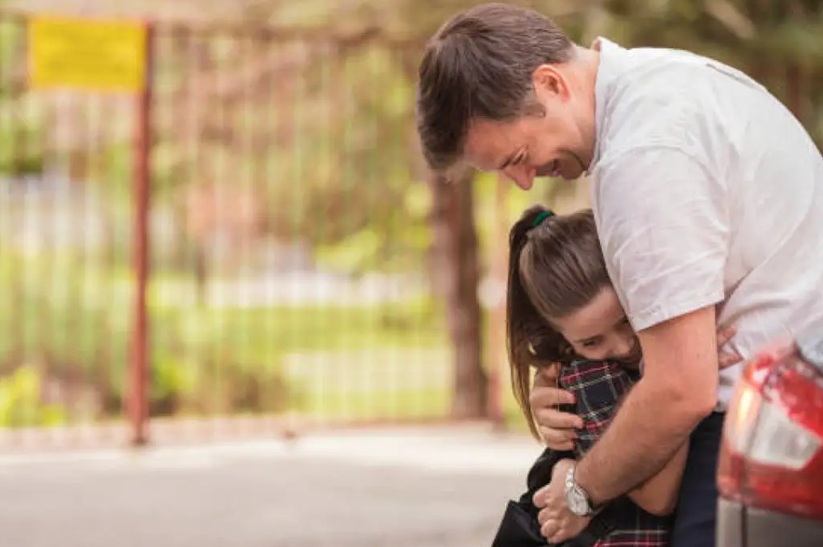
The Honda Civic’s tail lights dissolved into the gray October mist like twin red eyes slowly closing, carrying away the most precious thing in my world for another two weeks. I stood in the driveway of my rented duplex in suburban Columbus, Ohio, the bitter wind cutting through my windbreaker and chilling me to the bone, watching until the car disappeared completely around the corner of Maple Street. The custody arrangement was etched into my memory like a scar: “Every other weekend, two weeks in summer, alternating holidays.” A stranger in black robes—Judge Patricia Morrison, Family Court—had decided exactly how many hours per year I was allowed to be a father to my own child.
My name is Thomas Vaughn, I’m forty-two years old, and according to the state of Ohio, I’m what they call a “weekend father.” High school chemistry teacher at Lincoln High, divorced three years, living in a duplex I rent from Stuart Bass for twelve hundred a month. After the divorce, my ex-wife Kathy got the house we’d bought together—the three-bedroom colonial with the big backyard where Emma learned to ride her bike. Her mother Bernice Wright made sure of that, hiring Clifford Whitaker, the most aggressive and expensive divorce attorney in three counties. I got my daughter every other weekend and a mountain of debt from legal fees I’m still paying off.
I shoved my freezing hands deep into my jacket pockets, ready to retreat into the silence of my empty home where I’d spend the next fourteen days counting down until I could see Emma’s face again, when my fingers brushed against something unexpected. Paper, folded small and tight.
Emma’s note.
She’d pressed it into my palm during our goodbye hug just minutes ago, her small seven-year-old body trembling slightly against mine in a way that seemed like more than just the cold. Her brown eyes—my eyes, the same shade of amber-flecked hazel that stared back at me from the mirror each morning—had met mine with an intensity that didn’t belong on a second-grader’s face. “Don’t read until I’m gone, Daddy,” she’d whispered, so quietly I’d almost missed it over the sound of her mother’s impatient engine idling.
Seven years old and already keeping secrets. The thought made my chest constrict with something that had nothing to do with the October chill. I pulled out the folded scrap of notebook paper, the kind with the wide-ruled lines she was learning to write on in school. Emma’s careful handwriting emerged as I unfolded it, each letter formed with the concentrated effort of a child still mastering penmanship.
“Dad, check under your bed tonight. Grandma hid something there yesterday.”
The world stopped. The wind died. The distant sound of traffic on the main road faded to nothing. The only thing I could hear was the rushing of blood in my ears and the hammering of my heart against my ribs.
Grandma. Bernice Wright. My ex-mother-in-law, the woman who’d looked at me like I was a stain on her expensive imported carpet from the moment Kathy first brought me home to meet the family fifteen years ago. The woman who’d made it abundantly clear that a public school teacher with student loans and a ten-year-old Honda wasn’t good enough for her daughter. The woman who’d systematically worked to destroy my marriage from the inside, poisoning every conversation, questioning every decision, undermining every moment of happiness Kathy and I tried to build together.
She had been in my house yesterday?
My mind raced backward. Yesterday was Thursday. Kathy had texted Tuesday asking if Emma could stay an extra night because of some school event Friday morning near my district—a “Donuts with Dad” breakfast I’d actually been looking forward to. I’d agreed immediately, pathetically grateful for any additional hours with my daughter. Kathy had dropped Emma off Wednesday evening after work and picked her up Friday afternoon. Normal visitation extension. Nothing unusual. Nothing that would have given Bernice Wright access to my home.
Except apparently, she’d found a way in anyway.
How the hell did she have a key? I’d never given her one. Kathy swore she didn’t have one to give. Had Bernice had one made somehow? Picked my lock? The questions spiraled as I stood frozen in my driveway, the note trembling in my hand.
I was inside my house in seconds, the front door slamming behind me with a force that rattled the framed photo of Emma on the entry table. I moved down the narrow hallway with a speed that defied my age and the knee injury that still bothered me on cold days, a souvenir from my brief stint in the Army right after high school. The duplex was small—two bedrooms, one bathroom, a kitchen barely big enough to turn around in—but it was mine, or it would be once I finished paying rent to Stuart Bass each month. After the divorce, when Kathy got everything we’d built together and I got nothing but debt and heartbreak, this place had felt like failure. Now it was simply home. The place where I had Emma every other weekend. The place where we made pancakes on Saturday mornings and watched nature documentaries she pretended to find boring but secretly loved.
My bedroom was exactly as I’d left it that morning before school. The bed was made with military precision—a habit from basic training that had stuck with me through two decades of civilian life. The dresser was clear except for a framed photo of Emma and me at the Columbus Zoo last summer, both of us grinning with ice cream-sticky faces in front of the polar bear exhibit. The nightstand held a lamp, my phone charger, and the mystery novel I’d been reading fifteen minutes at a time before falling asleep exhausted each night.
Everything looked normal. Undisturbed. Safe.
I dropped to my knees beside the bed, the hard laminate floor digging into my kneecaps, and peered underneath the metal frame. At first, I saw nothing—just shadows, dust bunnies I should have vacuumed, and the corner of an old shoebox containing tax returns from five years ago.
I grabbed the heavy Maglite flashlight from my nightstand—another Army habit, always having a good flashlight within reach—and clicked it on. The beam sliced through the darkness under the bed, illuminating the forgotten debris of daily life.
Then I saw it. Pushed far back against the wall, nestled deep in the corner where the shadows were darkest and most concealing. A black duffel bag I had never seen before in my life.
My hand trembled as I reached out, my chemistry teacher’s brain already cataloging observations: heavy canvas material, military-style construction, relatively new based on the lack of wear on the fabric. I hooked my fingers through the nylon strap and pulled. It was heavy—much heavier than clothes or camping equipment. The weight distribution felt wrong, dense and solid rather than soft and shifting.
The zipper was unlocked, slightly open as if whoever had hidden it had been in a hurry. I pulled it wider with one finger, my whole body tensed as if the bag might contain a bomb or a snake.
Inside were plastic-wrapped rectangular packages. Dozens of them. Stacked with almost surgical precision.
White powder was clearly visible through the heavy-duty transparent plastic wrapping. Even before my conscious mind processed what I was seeing, my chemistry background kicked in with clinical detachment. I wasn’t just looking at “drugs” in some vague, frightening sense. I was looking at crystalline structures I recognized from both my education and, unfortunately, from the drug awareness training all teachers were required to attend each year. The texture, the color, the way it caught the light.
Methamphetamine. Crystal meth. And not user quantities, not even dealer quantities. This was distribution-level weight. I estimated at least twenty pounds, maybe more. Enough to put me away for twenty years minimum. Enough to ensure I never saw the outside of a prison cell again, never held my daughter again, never had another chance at anything resembling a normal life.
Jesus Christ.
I sat back on my heels, my legs suddenly unable to support my weight, all the air rushing out of my lungs in a single shocked exhalation. My mind raced through implications and consequences like neurons firing in an uncontrolled panic response. Bernice Wright had planted major felony quantities of methamphetamine in my house. If the police found this during any kind of random check—a “wellness visit” anonymously called in, a noise complaint followed by a cursory search, even a routine probation visit if she’d somehow engineered one—my life was over. Finished. Done.
Emma’s life would be destroyed too. I’d lose custody permanently, obviously. Convicted felons don’t get visitation rights, much less joint custody. Kathy would have full control, which meant Bernice would have full control, which meant my daughter would grow up under the thumb of a woman calculating and cruel enough to frame her own former son-in-law for drug trafficking.
This wasn’t just manipulation or dirty tricks in a custody battle. This was attempted murder of everything I had left. This was a calculated, methodical destruction of a human life.
But Emma had warned me. My brave, terrified seven-year-old daughter had risked the wrath of her grandmother—the woman who controlled her mother, their home, their money, their entire existence—to save her father.
Think, Thomas. Stop panicking and think like the scientist you are.
Panic is just a chemical reaction. Adrenaline flooding your system. Cortisol spiking. Amygdala hijacking your prefrontal cortex. I’d taught this to my students a hundred times. Fear is chemistry, and chemistry can be controlled. I forced myself to breathe slowly, deliberately, counting to four on each inhale and exhale, lowering my heart rate through sheer force of will. The initial shock gave way to something colder, harder, more calculating.
I didn’t touch the bag again. Instead, I pulled out my phone with hands that were steadier now, steadied by purpose rather than panic. I photographed the bag from multiple angles, making sure the timestamps were clearly visible in each shot. I photographed the underside of my bed frame, capturing the dust patterns that clearly showed where the bag had been dragged and pushed into its hiding place—disturbed areas in the dust that proved it hadn’t been there long. I documented the lack of forced entry at my bedroom windows, the intact lock on my bedroom door. I photographed everything with the methodical precision of a scientist documenting an experiment.
Then I did the one thing Bernice Wright would never in a million years have expected me to do. The one thing that went against every instinct of self-preservation and fear of authority that most people have.
I called 911.
“911, what is your emergency?” The dispatcher’s voice was professionally calm, prepared for anything from a heart attack to a house fire.
“My name is Thomas Vaughn. I live at 2847 Maple Street, Apartment B. I just found what appears to be a large quantity of methamphetamine hidden under my bed in my home. I need to report this immediately before anyone thinks it belongs to me.”
There was a pause on the line—not long, maybe two seconds, but long enough that I could practically hear the dispatcher’s confusion. “Sir… you’re reporting that you found drugs in your own residence?”
“Yes, ma’am. I believe they were planted here to frame me. My seven-year-old daughter left me a handwritten note warning me that her grandmother had hidden something under my bed yesterday. I haven’t touched the drugs except to unzip the bag to verify the contents. I need police here right now to document this properly before someone tries to claim they’re mine.”
“Officers are being dispatched to your location now, sir.” Her voice had shifted to a different kind of professionalism—alert, focused, taking me seriously. “I need you to exit the residence immediately and wait outside. Do not touch anything else. Do not allow anyone else to enter. Can you do that?”
“Yes, ma’am. I’m leaving now.” I was already moving, phone still pressed to my ear, grabbing my jacket from the hook by the front door.
“Stay on the line with me until officers arrive, Mr. Vaughn.”
I did as instructed, standing in my driveway again under the indifferent gray sky that had turned even darker in the twenty minutes since Emma left. The October cold bit deeper now, or maybe it was just the adrenaline wearing off, leaving me shaking and hollow. While I waited, listening to the dispatcher’s calm breathing on the line and the distant sound of approaching sirens, I made one more call on speaker phone.
Joseph Law. Physics teacher at Lincoln High. My closest friend for the past eight years and the most pragmatic, unflappable man I’d ever met. He lived exactly 2.3 miles away—he’d measured it once for some physics problem he was teaching.
“Joe, I need you to come to my place right now. Bring your camera. The good DSLR, not your phone.”
“Tom?” His voice carried concern immediately. He knew me well enough to recognize when something was catastrophically wrong. “You sound strange. What’s happening?”
“Police are coming. I need a witness who isn’t law enforcement. Someone I trust. Please, Joe. It’s about Emma.”
“I’m already getting my keys. Be there in five minutes.”
He made it in four, his ancient Subaru pulling up just as two patrol cars rounded the corner, lights flashing but sirens silent now that they’d reached the residential area. Joseph Law was sixty years old with steel-wool gray hair and a face weathered by decades of dealing with teenagers who thought physics was optional. He had the kind of steady, unshakeable demeanor that came from understanding how the universe actually worked—governed by laws that didn’t care about human drama or emotion. He took one look at my face, at the police cars, and his jaw tightened.
“What did she do?” he asked quietly, already pulling his professional camera from his bag.
“Bernice planted drugs in my house. A lot of drugs. Emma warned me.”
Joseph’s eyes widened fractionally—the most shock I’d ever seen him display. “That evil…” He bit off the rest of the sentence, which was probably more profane than I’d ever heard him use. “Okay. Let’s document everything.”
I explained quickly, showing him the photos on my phone as we stood by his car, our breath forming small clouds in the cold air. Two uniformed officers approached, followed by an unmarked sedan. A man emerged from the sedan, adjusting a cheap tie against the wind—mid-fifties, with the kind of tired but alert eyes that suggested he’d seen everything and was no longer surprised by human depravity but was still disappointed by it.
“Mr. Vaughn? I’m Detective Antonio Drew, Columbus PD.” He showed me his badge, then glanced at Joseph. “And you are?”
“Joseph Law. Friend and colleague. I’m here as a witness to ensure proper procedure is followed.”
Drew studied us both for a moment, then nodded slightly as if we’d passed some kind of test. “All right. Mr. Vaughn, tell me what’s going on.”
I explained everything as calmly as I could, keeping my voice level and professional—the same tone I used when explaining complex chemical reactions to confused students. I showed him Emma’s note, carefully unfolding it to display her childish handwriting. I showed him the timestamped photographs on my phone. I explained my ex-mother-in-law’s access to my house through some unknown means, her motivation stemming from years of bitter custody disputes, and the ongoing battle she’d waged to paint me as an unfit father.
Detective Drew listened without interrupting, his expression carefully neutral. When I finished, he was quiet for a long moment, studying me with those tired, intelligent eyes.
“Mr. Vaughn, I appreciate you calling this in. That was smart—probably the smartest thing you could have done.” He paused. “But you understand how this looks from my perspective.”
“Of course it looks suspicious,” I said immediately. “That’s exactly the point. That’s why someone planted it there—to make it look like mine. But ask yourself, Detective: if these were actually my drugs, why would I call you? Why would I have timestamped photographs documenting their discovery? Why would my seven-year-old daughter leave me a handwritten note warning me about them? What possible reason would I have to voluntarily invite law enforcement to find twenty pounds of methamphetamine in my house?”
Drew nodded slowly, something shifting in his expression—not quite belief, but something closer to consideration. “Walk me through your relationship with your ex-mother-in-law.”
I did, providing a condensed history of Bernice Wright’s systematic campaign against me. Her disapproval from day one. Her constant interference in my marriage. Her role in convincing Kathy to file for divorce. Her hiring of Clifford Whitaker, who’d eviscerated me in court while I struggled with a court-appointed attorney I couldn’t really afford. The custody arrangement that gave her maximum access to Emma while minimizing mine. Her comments—documented in court records—that I was “unstable,” “unreliable,” and “potentially dangerous” despite zero evidence supporting any of those claims.
“She’s been trying to get full custody of Emma since the divorce started,” I said. “She thinks I’m not good enough for her granddaughter. Never was. This would eliminate me completely. A convicted felon doesn’t get visitation rights.”
“We’ll need to take the bag into evidence,” Drew said. “We’ll need to process your home thoroughly. And we’ll need to talk to your daughter.”
“Talk to her,” I said immediately. “Please. But do it without her mother present if possible. And definitely without her grandmother in the room. Bernice controls that family completely. Emma was brave enough to warn me—give her the chance to tell the truth without Bernice staring her down and making her too afraid to speak.”
The detective studied me for another long moment. “You seem very calm for a man who just found twenty pounds of methamphetamine under his mattress.”
“I teach chemistry to teenagers, Detective,” I replied. “Staying calm during chaos is a survival skill. But make no mistake—I am absolutely furious. Someone tried to destroy my life and traumatize my child in the process. I want justice.”
They processed the scene for hours. Joseph stayed by my side the entire time, his expensive camera documenting everything—every police procedure, every evidence bag, every measurement and photograph the crime scene techs took. The drugs were logged, tagged, and removed in sealed evidence containers. They fingerprinted the bag, the individual bricks, my bed frame, the floor underneath. With my explicit permission, they searched my entire house from top to bottom, opening every closet, checking every drawer, even looking in my refrigerator and freezer. They found nothing else suspicious—no drug paraphernalia, no scales, no cash, no weapons. Just the normal detritus of a single father’s life: Emma’s toys in the living room, my teaching materials on the dining table, leftovers in the fridge.
Finally, around midnight, Detective Drew approached me on the porch where I’d been sitting for the past hour, drinking coffee Joseph had made in my kitchen and trying not to think about what would happen if this all went wrong.
“Mr. Vaughn, we’re done for tonight. Don’t leave town. We’ll be in touch.”
“What about my daughter?” The question came out more desperate than I intended.
“We’ll coordinate with Child Protective Services. Given the nature of the allegations—drugs in the home, a child potentially witnessing a crime—they’re required to open a case. Visitation will likely be suspended pending the investigation.”
The words hit me like a physical blow. Suspended. More time away from Emma. More uncertainty. More nights in this empty house wondering if I’d ever get her back.
“I understand,” I managed to say, though understanding didn’t make it hurt less.
After the taillights of the police cruisers finally faded into the night, Joseph made more coffee in my kitchen using the expensive beans he’d brought from his house because he knew my grocery-store brand wouldn’t cut it for this kind of night. I sat at my kitchen table, Emma’s note spread out before me like a battlefield map, and tried to process everything that had happened in the past six hours.
“You’re going to fight this,” Joseph said. It wasn’t a question.
“I’m going to end this,” I replied, looking up at my friend. “Bernice has been poisoning my relationship with Emma for three years. She convinced Kathy to divorce me. She convinced a judge I was an unfit father. She’s had her way with my life for too long, treating me like an inconvenience she could eliminate whenever she wanted.”
“What are you going to do?”
“I don’t know yet.” I stared at Emma’s careful handwriting. “But Bernice Wright made a mistake tonight. She involved Emma directly. She put my daughter in the middle of her scheme. She made Emma an accessory, a witness, a victim.”
The anger that had been simmering all evening crystallized into something harder, colder, more dangerous. “I’m going to find out how she got those drugs. I’m going to find out where they came from. And I’m going to make absolutely certain she pays for every ounce of pain she’s tried to cause.”
Joseph sipped his coffee, studying me over the rim of his mug. “You’ll need help.”
“I know. Will you help me?”
“What kind of question is that?” He actually smiled, grim but genuine. “Of course I will. Let’s start by figuring out how a wealthy socialite widow with a six-figure bank account got her hands on twenty pounds of crystal methamphetamine.”
The weekend crawled by with agonizing slowness. No word from Kathy. No contact with Emma—I didn’t dare call and risk getting her in trouble with Bernice, who would absolutely interrogate her about what she’d said to me. I spent Saturday in my home office researching, documenting, and preparing. Every piece of correspondence with Kathy’s attorney. Every court order. Every text message. Every email. I built a timeline of Bernice’s interference in my life, organized and indexed like a research paper.
Joseph came over Sunday morning with pastries from the good bakery downtown and his laptop. “I did some digging,” he said, setting up at my kitchen table and opening what appeared to be a complex spreadsheet. “Bernice Wright isn’t just a wealthy widow living off her late husband’s money. Robert Wright owned Wright Commercial Properties before he died fifteen years ago. Warehouses, storage facilities, industrial rental units, a few residential properties in the less desirable parts of town.”
He spun the laptop around so I could see the screen. “When Robert died, Bernice inherited everything—the whole portfolio. She’s been managing it ever since. And here’s where it gets interesting: three of those properties have been flagged in police reports over the years. Nothing stuck, no charges filed, but there were investigations. Suspected drug activity at a warehouse on the East Side in 2019. Illegal gambling at a storage facility in 2021. Another drug investigation at a different warehouse last year.”
I leaned over his shoulder, reading the public police reports he’d pulled from the Columbus PD database. “She has criminal tenants?”
“She has a pattern of renting to people with criminal records who pay cash and don’t ask questions about why the rent is unusually low.” Joseph pulled up another document. “And get this: one of her current tenants is a man named Andre Gillespie. Arrested twice for drug trafficking—once in 2018, once in 2020. Never convicted because witnesses mysteriously became uncooperative. He currently rents Warehouse 347 on East Industrial Avenue from Wright Commercial Properties.”
“You think she got the drugs from him?”
“I think it’s a working theory worth exploring.” Joseph sat back, closing the laptop. “The question is: how do we prove it without getting ourselves arrested for obstruction of justice?”
“We don’t prove it ourselves,” I said slowly, the plan forming even as I spoke. “We just point the police in the right direction and let them do their jobs.”
Monday morning arrived gray and cold. I went to work despite my attorney’s advice to take time off and lie low. Arnold Yates had called Sunday evening, his voice tight with stress. Arnold was my court-appointed attorney from the divorce—not a specialist, not experienced with complex cases, just a general practice lawyer who’d drawn the short straw when the court assigned him to represent an indigent former husband who couldn’t afford private counsel.
“Thomas, this is serious,” Arnold had said, stating the obvious in the way lawyers do when they’re nervous. “Even though you called the drugs in yourself, possession charges could still potentially be filed. You’ll need to prove definitively that they were planted. And custody-wise… CPS is going to be aggressive. They have to be. Drugs in a home where a child visits? That’s their worst nightmare.”
At Lincoln High, I went through the motions of teaching. First period AP Chemistry, second period regular Chemistry, planning period, third period freshman Science. I lectured about molecular structures and chemical bonds while my mind worked the actual problem: how to protect Emma and prove Bernice’s guilt. During my lunch period, while eating a sandwich I couldn’t taste in the empty classroom I used for my planning time, my phone buzzed with a call from an unknown number.
“Mr. Vaughn? This is Detective Drew.”
My heart hammered against my ribs. “Detective.”
“We interviewed your daughter this morning with a CPS caseworker present. No parents in the room, just the social worker, myself, and Emma.”
I closed my eyes, gripping the phone so hard my knuckles went white. “And?”
“She confirmed everything. Your ex-mother-in-law was at your residence Thursday morning between approximately nine and eleven AM. Emma said her grandmother told her to stay in the living room watching cartoons while she ‘put something away for Daddy’ in your bedroom. Your daughter got worried because, and I quote, ‘Grandma seemed sneaky and kept telling me not to tell Mommy we were at Daddy’s house.’”
Relief flooded through me so powerfully I had to sit down. “Thank you. Thank you for believing her.”
“We’re pursuing this as a potential frame job, Mr. Vaughn. But I need to ask: do you have any idea where your ex-mother-in-law might have obtained twenty pounds of methamphetamine?”
“Actually, Detective, I might. A friend of mine did some research into Bernice Wright’s business holdings. Can I share some information he discovered?”
I told him about the properties, about Andre Gillespie, about the pattern of police investigations at Wright-owned locations. Drew was silent for a long moment.
“That’s… interesting. Very interesting. Let me look into this, Mr. Vaughn. In the meantime, your visitation is suspended pending the CPS investigation. I’m sorry, but that’s standard procedure.”
The words hurt even though I’d expected them. “I understand.”
“Your daughter asked the social worker to give you a message.” Drew’s voice softened slightly.
“What message?”
“She said, ‘Tell Daddy I’m sorry I couldn’t hide it better.’ Apparently she tried to move the bag herself when she realized what her grandmother had done. She couldn’t lift it—it was nearly half her body weight—so she left you the note instead.”
My vision blurred with tears I hadn’t known I was holding back. My seven-year-old daughter had tried to move a twenty-pound bag of drugs to save me. She’d risked everything to protect her father.
“Thank you for telling me, Detective.”
After school, I didn’t go home to my empty duplex. I drove to the industrial district on the East Side, to the address Joseph had found. Warehouse 347. A squat concrete building surrounded by chain-link fence, paint peeling, windows either broken or covered with plywood. The kind of place that looked abandoned until you noticed the fresh tire tracks in the gravel lot and the security cameras mounted on the corners.
I parked two blocks away, hidden between a vacant lot and an abandoned delivery truck. I pulled out the birding binoculars I’d bought years ago for a nature photography phase I’d never really pursued, and I watched.
For two hours, nothing happened. The autumn sun dropped lower, casting long shadows across the industrial wasteland. I was about to give up when a black SUV with tinted windows pulled up to the warehouse. A man got out—mid-thirties, muscular, moving with the casual confidence of someone who’d never had to worry about being challenged. He had a key. He opened the warehouse and went inside.
I took photos with my phone, using the binoculars to steady my hand for better zoom. Timestamped. Dated. Geotagged. I started a file on my laptop that night titled simply “Documentation.”
This was just the beginning.
Tuesday brought the call I’d been both dreading and expecting. Kathy’s number lit up my phone screen during my planning period.
“Thomas, what the hell did you tell the police?” Her voice was shrill, edged with something I hadn’t heard from her in years: genuine panic. “They’re saying Mother planted drugs in your house! That’s completely insane! It’s ridiculous!”
“Is it?” I kept my voice level, professional, the same tone I used when explaining to students why they couldn’t retake a test they’d failed through their own lack of preparation. “Your mother was in my house without my knowledge or permission, Kathy. Emma confirmed it. The police found twenty pounds of methamphetamine. What exactly do you think happened?”
“I think you’re trying to frame my mother because you’re bitter about the divorce!” She was shouting now, and I could picture her pacing in the living room of the house that used to be ours. “You’ve never forgiven her for helping me get a fair settlement!”
“A fair settlement where I lost everything and you got the house, the car, and primary custody despite us being equal parents? That settlement?” I let the bitterness I’d been suppressing for three years seep into my voice. “Kathy, listen to yourself. I called the police myself. I have timestamped evidence. Our daughter—our seven-year-old daughter—warned me because she saw Bernice hide something in my bedroom. Do you really think I’m making this up?”
Silence on the other end, long enough that I thought she might have hung up.
“Mother said…” Her voice was quieter now, uncertain. “She said she was just checking on Emma. Making sure you were taking proper care of her.”
“By hiding twenty pounds of crystal meth under my bed? That’s her idea of a welfare check?” I let the absurdity hang in the air. “Kathy, your mother has controlled every aspect of your life since we got married. She hated me from day one because I wasn’t rich enough, wasn’t connected enough, wasn’t good enough for her perfect daughter. She convinced you to divorce me. She fought for maximum custody. And now she’s tried to frame me for a felony to eliminate me completely from Emma’s life.”
“She wouldn’t do that. She loves Emma. She would never—”
“She would, and she did. The police have evidence. They have Emma’s testimony. They have the drugs, which they’re processing for fingerprints right now.” I paused, letting that sink in. “And Kathy, if you continue protecting her, you’re going to lose Emma too. CPS is investigating. They want to know if you were complicit, if you knew what your mother was planning.”
“I wasn’t! I didn’t know anything!” The panic was back, full force.
“Then help them. Tell them the truth about your mother’s control. About how she got access to my house—because I never gave her a key. Tell them about her properties and the kinds of people she associates with through her rental business.”
Another long silence. I could hear her breathing, could practically hear the gears turning as she tried to process information that contradicted everything her mother had told her.
“I… I need to think,” she finally said.
“Think fast, Kathy. Because Emma’s safety and future are on the line, and your mother has already proven she’s willing to destroy lives to get what she wants.”
She hung up without saying goodbye.
The investigation moved faster than I expected. Detective Drew was thorough and apparently persuasive when it came to getting search warrants. By Wednesday, the news broke: Columbus PD had raided Warehouse 347 after receiving “credible information” about drug trafficking. Three arrests, including Andre Gillespie. Seizure of narcotics, cash, and financial records. The local news ran the story with helicopter footage of police cars surrounding the warehouse.
I watched the coverage on my laptop while eating dinner alone, and I smiled. Not a happy smile—there was no happiness in any of this—but a smile of satisfaction at seeing the first domino fall.
Thursday afternoon, my phone rang again. Detective Drew.
“Mr. Vaughn, I thought you’d want to know: Andre Gillespie is cooperating. He’s confirmed that Bernice Wright is his landlord. He’s also confirmed that she was aware of his… business activities. Apparently, he’s been paying her significantly above market rate for the warehouse rental. Protection money, essentially.”
“Can you prove that?”
“We have financial records showing payments to her personal account that are three times the stated rent. We have text messages between them discussing ‘arrangements’ and ‘discretion.’ We have enough to pursue charges.” Drew paused. “We’re bringing her in tomorrow morning. Thought you should know.”
I closed my eyes, feeling something release in my chest. “Thank you, Detective.”
“Don’t thank me yet. This is going to be a long process. She’ll hire the best attorney money can buy. It could take months to get to trial.”
“I don’t care how long it takes. I just want justice.”
Friday morning, Bernice Wright was arrested at her home—the sprawling estate in the exclusive suburb where no one locked their doors because crime was something that happened to other people in other neighborhoods. She was charged with conspiracy to distribute methamphetamine, money laundering, and tampering with evidence. Bail was set at two million dollars. She posted it within hours, barely blinking at the cost.
But the damage was done. The arrest was public record. The news coverage was extensive. “Wealthy Widow Arrested in Drug Scheme” made the front page of the Columbus Dispatch. Bernice Wright’s carefully cultivated reputation as a pillar of the community crumbled in a single news cycle.
And then came the emergency custody hearing.
The courtroom was smaller than I remembered from the divorce proceedings—family court, fourth floor of the county courthouse, Judge Annette Mills presiding. Mills had a reputation for being fair but tough, unwilling to tolerate manipulation or games from either side. She was in her early sixties, with steel-gray hair cut short and eyes that missed nothing.
The CPS caseworker testified first, a woman named Sarah Chen who’d been investigating our family since the drugs were found. She detailed her interviews with Emma, with Kathy, with Bernice’s neighbors and business associates. She described Emma’s clear fear of her grandmother, her obvious relief at being able to tell the truth away from Bernice’s influence. She recommended that Emma be placed with me immediately and that Bernice Wright be prohibited from any contact pending resolution of the criminal charges.
Then Kathy testified. She looked smaller somehow, diminished, wearing a simple dress instead of her usual designer clothes. When asked about her mother’s arrest, she admitted that she’d been “shocked” and “betrayed.” She described years of Bernice’s control, the way her mother had isolated her from friends, made all major decisions about Emma’s upbringing, even controlled their finances.
“I thought she was helping me,” Kathy said, her voice barely audible. “I thought she wanted what was best for Emma. I didn’t know…” She trailed off, unable or unwilling to finish the sentence.
“Do you believe your mother planted drugs in your ex-husband’s home?” Judge Mills asked directly.
Kathy looked at her hands. “I… I think she’s capable of it. The police have evidence. Emma told the social worker what she saw. I can’t ignore that anymore.”
“What is your position on custody?”
“I think Emma should be with her father. Full custody. I think… I think my home isn’t safe right now, not with my mother’s influence. And Thomas is a good father. He always was. I just couldn’t see it because my mother convinced me otherwise.”
Judge Mills made notes, her expression carefully neutral. Then she turned to me.
“Mr. Vaughn, you’ve had quite an ordeal.”
“Yes, Your Honor.”
“Your ex-mother-in-law stands accused of planting distribution-level quantities of methamphetamine in your home. That’s an extraordinary allegation.”
“It’s also true, Your Honor. My daughter warned me. She risked her grandmother’s anger and possible retaliation to protect me. That level of bravery shouldn’t be necessary for a seven-year-old child.”
“How do I know you’ll provide a stable environment for your daughter?”
“I’m a teacher. I’ve had the same job at Lincoln High for eight years. I’ve never missed a child support payment, never missed a scheduled visitation, never been anything but present and loving for my daughter. I love Emma more than anything in this world, and I will spend every single day of my life proving she made the right choice in trusting me with the truth.”
Judge Mills studied me for a long moment, then reviewed the CPS report, the police reports, the stack of evidence that had accumulated in just one week.
“I am granting full physical custody to Mr. Thomas Vaughn, effective immediately,” she said. “Ms. Kathy Vaughn will retain visitation rights—supervised initially—until we’re satisfied that she can maintain appropriate boundaries with her mother. Bernice Wright is hereby prohibited from any contact with the minor child pending resolution of the criminal charges against her.”
The gavel came down with a decisive crack.
I had won.
Emma moved in the following Friday. Kathy brought her over in the late afternoon, when the autumn sun was already starting to set. She pulled up in the Honda Civic with two suitcases, a backpack full of books, and the stuffed elephant Emma had slept with since she was two years old.
“Be good for Daddy,” Kathy said, hugging Emma tight. There were tears on her face. “I’ll see you next weekend for our visit, okay? I love you so much.”
“I love you too, Mommy.” Emma nodded solemnly, then ran to me.
I caught her, lifting her up even though she was getting almost too big for it, feeling her arms wrap around my neck and hold on like she was afraid I might disappear if she let go.
“I missed you, Daddy.”
“I missed you too, baby. So much.”
After Kathy drove away, wiping tears from her face, Emma and I went inside. Joseph had helped me prepare—we’d painted one wall of her bedroom lavender, her favorite color. We’d hung curtains with butterflies. We’d bought new sheets with stars that glowed in the dark. I’d even assembled the bookshelf she’d been wanting, though it had taken me three hours and some creative swearing.
That night, after unpacking and eating pizza and watching a movie curled up together on the couch, Emma and I sat in her new room. She was quiet, processing everything, trying to understand the seismic shifts in her young life.
“Daddy… is Grandma going to jail?”
I chose my words carefully, aware that despite everything, Bernice was still her grandmother. “Grandma did some very bad things. She’s going to have to answer for them in court. But that’s not your fault, sweetheart. You were incredibly brave to warn me. You saved me.”
She nestled against my side. “Are you going to make her pay?”
The question surprised me. Seven years old, and she already understood the concept of consequences and accountability.
“The law will make her pay,” I said. “That’s how justice works.”
But privately, sitting there with my daughter finally home and safe, I knew the legal system alone wouldn’t be enough. Bernice had posted bail. She was home in her mansion, comfortable and plotting with her expensive attorneys. She’d tried to destroy my life and put me in prison for decades, and she was sleeping in her own bed as if nothing had happened.
I wanted more. I wanted her to feel the same powerlessness and fear she’d tried to inflict on me. I wanted her entire world to collapse the way she’d tried to collapse mine.
I wanted justice, yes.
But I also wanted revenge.
Over the following weeks, while Emma adjusted to her new school and her new routine of living with me full-time, I went to work dismantling Bernice Wright’s life with the same methodical precision I brought to complex chemistry problems.
Joseph and I compiled every piece of information we’d gathered—every police report, every suspicious business dealing, every connection to criminal tenants. We organized it beautifully, printed it, bound it, and delivered it anonymously to the FBI’s financial crimes division. Money laundering is federal jurisdiction, after all.
But that was just the foundation.
I started leaking information carefully, strategically, through channels that couldn’t be traced back to me. Former students who’d gone into journalism. Anonymous tips to local bloggers who covered crime stories. The narrative spread: “Wealthy Widow’s Secret Criminal Empire.” The story went viral in Columbus, then spread to statewide news. Bernice Wright became synonymous with corruption and hypocrisy—the wealthy socialite who’d built her fortune on the backs of criminals and drug dealers.
Next, I targeted her money. I couldn’t touch her accounts directly, but the IRS could. An anonymous tip about massive discrepancies in her tax filings—rental income that didn’t match her reported earnings, suspicious business deductions—led to a comprehensive audit. State regulatory agencies received detailed complaints about her properties: building code violations, safety hazards, illegal modifications. Insurance companies received documentation of fraudulent claims.
I approached tenants in Bernice’s properties—not the criminals like Andre Gillespie, but the regular people who were trying to make ends meet and didn’t realize their landlord was using them as cover for her illegal operations. I connected them with legal aid organizations. I helped them understand their rights. Most of them moved out within a month, leaving Bernice’s properties empty and generating no income.
Within two months of Emma coming to live with me, Bernice’s business empire was collapsing. Tenants fled. Properties sat vacant, costing her money instead of generating it. Federal and state investigations multiplied. Her assets were frozen pending multiple legal proceedings. The mansion went into foreclosure because she could no longer make the payments.
And through it all, I made sure she knew it was me.
I sent her a letter. Simple. Typed on my home computer and printed at the library. Completely untraceable.
“You tried to take my daughter and destroy my life. Instead, you lost everything. This is what justice looks like.”
The trial began the following spring, eight months after that Friday afternoon when Emma had slipped a note into my pocket. The Franklin County Courthouse was packed with reporters, curious onlookers, and former business associates of Bernice’s who were suddenly very interested in distancing themselves from her.
The prosecution’s case was overwhelming. Andre Gillespie testified about his arrangement with Bernice—how she’d knowingly rented him warehouse space for drug operations, how she’d taken payments far above market rent in exchange for “discretion,” how she’d once explicitly told him that as long as the money kept coming, she “didn’t need to know the details.” A dozen other tenants and former tenants testified to similar arrangements. Financial experts dissected her money laundering operations with PowerPoint presentations and spreadsheets that made even the jury’s eyes glaze over.
And then Emma testified. My eight-year-old daughter, who’d grown braver and stronger over the past months of stability and safety, sat in the witness box and told the judge and jury exactly what she’d seen that Thursday morning.
“Grandma seemed really nervous,” Emma said in her clear, serious voice. “She kept looking around like she didn’t want anyone to see her. She told me to watch TV and not move from the couch. She went into Daddy’s room and I heard dragging sounds. When she came out, she was sweaty and she told me we had to leave and I could never, ever tell Mommy or Daddy that we’d been there. She said people who tell family secrets are traitors.”
“Why did you write your father a note?” the prosecutor asked gently.
“Because I knew Daddy would get in trouble if I didn’t warn him. I tried to move the bag myself but it was too heavy. So I wrote the note.” Emma looked directly at Bernice, who sat at the defense table with her expensive attorney and a face like carved stone. “Daddy needed to know what Grandma did, even if it made her mad at me.”
The jury deliberated for seven hours. When they returned, the forewoman stood and read the verdict: guilty on all counts. Conspiracy to distribute methamphetamine. Money laundering. Tampering with evidence. Obstruction of justice.
At sentencing two weeks later, Judge Mills—the same judge who’d given me custody of Emma—looked down at Bernice Wright from the bench.
“Mrs. Wright, you have systematically used your wealth and position to facilitate criminal activity in this community. You have corrupted legitimate businesses for illegal purposes. Most egregiously, you attempted to frame an innocent man—your own former son-in-law—and send him to prison for decades in order to gain control of your granddaughter. You have shown no remorse, no acknowledgment of wrongdoing, and no indication that you understand the harm you’ve caused.”
Bernice stood straight, defiant even in defeat, her chin raised in the aristocratic way that had once intimidated me.
“I sentence you to twenty years in federal prison. You will be eligible for parole after serving fifteen years.”
The gavel cracked like a gunshot.
Bernice Wright was seventy-three years old. She would die in prison, and we both knew it.
I felt Emma’s hand slip into mine as we sat in the gallery watching the bailiffs approach Bernice.
“Is it over, Daddy?”
“It’s over, sweetheart. You’re safe now. We’re both safe.”
We walked out of the courthouse into the bright May sunshine. Kathy was waiting outside, and something in her expression had changed over the past months—she looked lighter, unburdened, finally free of her mother’s suffocating control. We’d been cautiously rebuilding our co-parenting relationship, learning to communicate directly instead of through lawyers and anger.
“Thank you,” she said quietly. “For protecting her. For doing what I was too scared to do.”
“She’s our daughter. I’d do anything to keep her safe.”
“I know. I see that now.”
A year later, on a warm October afternoon almost exactly like the one when this all began, Joseph and I sat on my front porch drinking coffee while Emma played in the yard with a friend from school. The duplex had been replaced by a small house I’d been able to buy—not fancy, but mine, with a real yard and three bedrooms and a kitchen big enough to cook in.
“You ever regret it?” Joseph asked, watching Emma chase butterflies in the grass. “The revenge part? Systematically dismantling her entire life?”
I thought about the question seriously, because Joseph deserved a serious answer. “No. No regrets.”
“She’s in prison for twenty years. You got Emma. You won.”
“I won because I was smarter and more patient than she was. I won because I loved Emma more than Bernice loved control.” I took a sip of coffee. “She tried to send me to prison for decades. She tried to take my daughter permanently. She made Emma an accomplice to a felony. She put my seven-year-old in a position where she had to choose between protecting her father and obeying her grandmother. That’s not a game. That’s war.”
“And you won the war.”
“I didn’t just win. I eliminated the threat completely.” I watched Emma’s carefree laughter, heard the innocence that had been preserved because I’d acted decisively. “She made a choice when she planted those drugs. She chose to try to destroy me. I just made sure the consequences were thorough enough that she could never try again.”
“That’s not revenge,” Joseph mused. “That’s justice with extreme prejudice.”
“Call it what you want. I call it being a father.” I smiled, feeling genuine contentment for the first time in years. “Bernice Wright is in a federal prison in West Virginia. Emma is here with me, safe and happy and thriving. That’s the only outcome that ever mattered.”
Emma ran up to the porch, breathless and grinning. “Daddy! Can Sarah stay for dinner? Her mom said it’s okay if you say yes!”
“Of course she can.” I ruffled her hair. “Go tell her mom thank you, and we’ll order pizza.”
As Emma ran off, her voice carrying across the yard in pure joy, I thought about that note she’d slipped into my pocket so long ago. Those careful, childish letters that had saved my life and changed everything.
I’d framed the original note—Emma’s handwriting preserved behind glass—and it hung in my office at school now. A reminder that truth matters, that courage can come from the smallest and most unexpected sources, and that sometimes the greatest revenge isn’t destruction for its own sake.
Sometimes the greatest revenge is simply living well, protecting what matters most, and making sure the people who tried to harm you can never reach you or your loved ones again.
Bernice was in prison. Emma was home. And I was finally, completely free.
That was justice enough.