For more than a decade, our Sundays were sacred — not because of religion, but because of routine. Pancakes sizzling in butter. Cartoons humming softly in the background. Brian reading the news on his tablet while Kiara and I argued over chocolate chips or blueberries. It was simple, ordinary, and ours. I used to believe that ordinary meant safe.
Brian and I had been together for twelve years, married for ten. We weren’t the passionate, dramatic type. We were steady. Predictable. The kind of couple people described as “solid.” We built a life on shared calendars, mutual respect, and long-term planning. I thought that was enough.
Religion had never been part of our story. We didn’t attend church on holidays. We didn’t pray before meals. When we got married, it was in a botanical garden under an open sky, officiated by a retired judge who told jokes during the ceremony. Faith simply wasn’t our language.
I work in marketing for a nonprofit organization. My days are filled with grant proposals, fundraising events, and social media campaigns. Brian works in finance, overseeing corporate accounts. His job is high-pressure, numbers-driven, and relentless. Still, he always claimed he thrived under stress.
Our daughter, Kiara, had just turned nine. She was bright, curious, and fiercely observant. Sundays were her favorite day. She would crawl into our bed before eight, demanding pancakes and declaring it “family day.” We rarely said no.
That’s why the first time Brian mentioned church, I laughed.
We were halfway through breakfast when he said it casually, like he was suggesting a new grocery store.
“I think we should start going to church,” he said, cutting into his pancakes.
I blinked. “I’m sorry — what?”
“Church,” he repeated calmly. “On Sundays. As a family.”
I studied his face, waiting for the punchline. It never came.
“You once called church weddings ‘a hostage situation with cake,’” I reminded him.
He gave a faint smile. “People change.”
Something in his tone made me pause. It wasn’t conviction. It was calculation.
He said he’d been feeling stressed. Burned out. Overwhelmed at work. He said he needed a reset. A place to breathe. He mentioned a pastor whose sermons were positive and grounding. He talked about community, about wanting Kiara to grow up with values.
I didn’t want to be the wife who mocked growth. So I agreed.
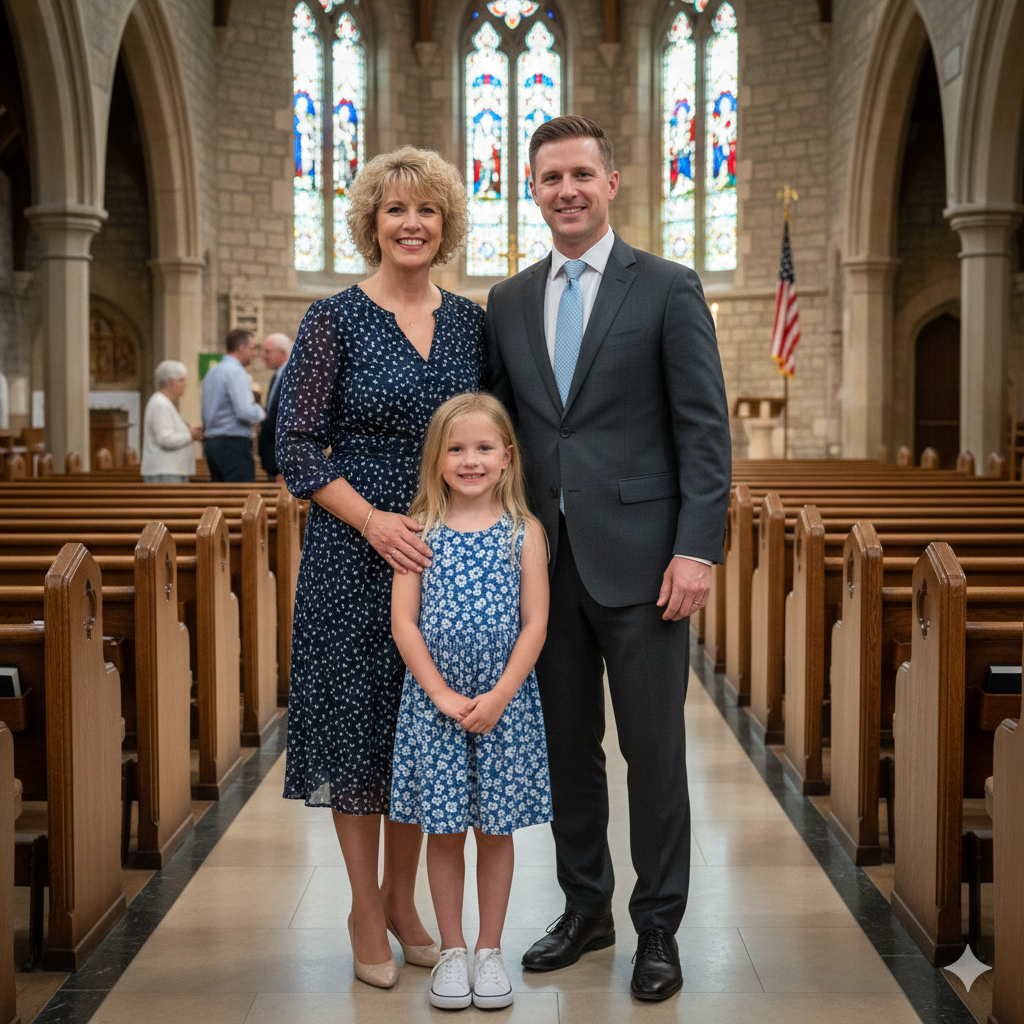
The first Sunday felt like wearing someone else’s clothes. The church was bright and polished, filled with warm handshakes and rehearsed smiles. We sat in the fourth row — not too close, not too far. Brian seemed to know exactly where he wanted to be.
Kiara scribbled on a children’s bulletin while I studied stained-glass windows and counted minutes.
Brian, on the other hand, looked peaceful. Focused. Intent.
Week after week, the pattern continued. Same row. Same smiles. Same lingering conversations afterward. He shook hands with ushers, offered to carry donation bins, laughed a little too loudly at inside jokes.
At first, I thought it was harmless. Maybe even healthy.
Then came the Sunday that changed everything.
After the service, Brian told Kiara and me to wait in the car. He said he needed the restroom.
Ten minutes passed.
Then fifteen.
My calls went unanswered. My texts unread.
A tightness formed in my chest — not panic exactly, but instinct.
I asked a kind older woman, Marianne, to watch Kiara for a few minutes. She agreed cheerfully, unaware she was standing guard over the last moment of my ignorance.
Inside, the men’s restroom was empty.
That’s when I saw him through the garden window.
He stood facing a tall blonde woman in a cream sweater and pearls. She looked composed, arms crossed defensively. Brian stood too close.
The window was slightly open. I heard everything.
“Do you understand what I did?” he said, his voice strained. “I brought my family here so you could see what you lost.”
My heart stopped.
“We could’ve had this,” he continued. “A family. More kids. The perfect life. I’m ready now. I’ll do anything.”
Anything.
The woman’s response was calm but cutting.
“I feel sorry for your wife,” she said. “And your daughter.”
He tried to interrupt. She silenced him with a raised hand.
“This isn’t love,” she continued. “It’s obsession. If you contact me again, I’ll file a restraining order.”
She walked away without looking back.
Brian remained frozen, like a man watching his fantasy evaporate.
I stepped back before he could see me.
I don’t remember walking to the car. I only remember buckling Kiara in and staring at the steering wheel, trying to convince myself I had misheard.
When Brian returned, he kissed our daughter’s forehead and apologized for the “bathroom line.”
I smiled.
And I began to wait.
The following Sunday, I was ready.
After the service, when Brian slipped away again, I approached the blonde woman. Her name was Rebecca.
“I’m Brian’s wife,” I told her.
She didn’t look surprised.
“I heard everything,” I said.
Rebecca showed me her phone.
Years of messages. Some pleading. Some angry. Some romantic in a way that made my stomach turn. Many unanswered.
A recent one showed a photo of the church sign with the caption: “I see you.”
“He’s been doing this since high school,” she explained. “Letters. Showing up at jobs. Finding new numbers.”
I felt something inside me fracture permanently.
This wasn’t a momentary lapse. It was a pattern.
That night, after Kiara slept, I confronted him.
“I know,” I said simply.
He denied it at first. Then minimized it. Then reframed it.
“You misunderstood.”
“It’s ancient history.”
“She didn’t even say yes.”
That was his defense.
Not that he hadn’t tried — only that he had failed.
I told him my lawyer would be in touch.
He looked stunned. As if consequences were theoretical things that happened to other men.
“What am I supposed to tell Kiara?” he asked.
“The truth,” I said. “For once.”
The days that followed were heavy but clarifying.
I moved into the guest room.
I scheduled consultations.
I documented everything.
Brian oscillated between apology and indignation. He said I was overreacting. He said I was destroying our family. He said it was emotional, not physical — as though that distinction absolved him.
But betrayal isn’t measured by touch alone.
It’s measured by intention.
And his intention had been clear: we were props in a performance meant for another woman.
The hardest conversation was with Kiara.
We didn’t tell her details. Only that Mommy and Daddy were going to live in different houses. That it wasn’t her fault. That we both loved her.
She cried quietly, asking if we would still have pancakes on Sundays.
“Yes,” I told her. “We’ll always have pancakes.”
Just not together.
The divorce moved forward faster than Brian expected. Documentation has a way of removing illusions. His attempts to reconcile grew weaker when he realized I would not bend.
Rebecca filed her own legal protections.
Brian’s carefully constructed narrative collapsed under reality.
Friends were shocked. Some tried to mediate. Others chose sides. I chose silence.
Healing didn’t arrive dramatically. It came in small acts: changing passwords. Rearranging furniture. Repainting the bedroom walls.
I stopped going to that church.
Not because of faith — but because I refused to let that building symbolize my humiliation.
Months later, when the paperwork was finalized, I felt grief — but also relief.
The man I had loved was real in some ways. But the version of our marriage I believed in had been built on omission.
I wasn’t his great love story.
I was his consolation prize.
And I deserved more than being someone’s backup plan.
One Sunday morning, weeks after he moved out, Kiara crawled into my bed again.
“Pancakes?” she asked.
I smiled.
In the quiet kitchen, as batter hit the pan, I realized something important.
Our Sundays were sacred after all.
Not because of church.
But because they reminded me that love — real love — doesn’t need an audience.
It doesn’t perform.
It doesn’t chase ghosts.
It stays.
And this time, I chose to stay for myself.