When I asked why, she whispered, “I don’t know… but we have to leave. Soon.” I didn’t think much of it. But that night, she shook me awake and said, “Mom… look out the window.”
After my divorce, I moved into a new house with my 10-year-old daughter. A few days later, she said, “Mom, I don’t think we should stay here.” When I asked why, she whispered, “I don’t know… but we have to leave. Soon.” I didn’t think much of it. But that night, she shook me awake and said, “Mom… look out the window.”
Three weeks after my divorce was finalized, I moved with my ten-year-old daughter into a rental house on the edge of Cedar Falls, Iowa, and told myself it was the beginning of something better.
The house was small but clean, with pale siding, a fenced backyard, and a row of maple trees that turned gold in the late afternoon light. After the apartment I’d shared with my ex-husband during the final miserable year of our marriage, it felt like breathing room. No slammed doors. No tense silences stretching across dinner. No wondering whether every ordinary conversation would somehow become an argument about money, custody, or what kind of mother I was failing to be.
My daughter, Emma, had taken the divorce harder than she let on. She was quiet by nature, thin and watchful, with the kind of serious gray eyes that made adults speak more carefully around her. Since the split, she had become even more observant. She noticed things I missed: a missing earring on the floor, a strange car driving past twice, a tone in someone’s voice that meant they were lying. My ex used to call her “too sensitive.” I called her careful.
The first few days in the new house were ordinary enough. We unpacked dishes, argued about where to hang her bookshelf, and ate takeout on overturned moving boxes while the television played quietly in the background. I kept telling her this place would feel like home soon. She nodded, but never with much conviction.
Then, four days after we moved in, she stood in the kitchen while I was rinsing strawberries and said, very softly, “Mom, I don’t think we should stay here.”
I looked over my shoulder. “Why?”
She shrugged, but it was a strained, uncomfortable movement, like her body knew something her mind couldn’t explain. “I don’t know. I just think we have to leave. Soon.”
I smiled a little, because what else was I supposed to do? “New houses always feel weird at first.”
Emma didn’t smile back. “It’s not that.”
I dried my hands and crouched in front of her. “Did something happen? Did someone say something to you?”
“No.”
“Did you see someone around the house?”
She hesitated.
That caught my attention. “Emma?”
She looked toward the back door, then back at me. “I saw a man yesterday.”
My stomach tightened. “Where?”
“By the fence. Just for a second.”
“What did he look like?”
“I don’t know. He had a dark jacket. He went away when I looked at him.”
That was unsettling, but not impossible. We were in a new neighborhood. Maybe a neighbor had cut through the yard. Maybe a utility worker had been checking something near the property line. I asked if he’d spoken to her. He said no. I asked if she’d seen him again. She said no.
I should have taken it more seriously then.
Instead, I locked the back door, checked the windows before bed, and told myself she was anxious because everything in our lives had changed too fast.
At 2:17 a.m., Emma shook me awake so hard my teeth clicked together.
“Mom,” she whispered. Her voice sounded wrong—thin, urgent, terrified. “Mom… look out the window.”
Still half asleep, I pushed myself up on one elbow. Moonlight from the gap in the curtains washed the room in pale blue. Emma stood barefoot beside my bed in dinosaur-print pajama pants, her face white.
“What is it?”
She pointed toward the front of the house.
I pulled the curtain back two inches.
A man was standing across the street, motionless under the dead streetlamp, staring directly at our house.
And in his hand was something that looked exactly like a camera.
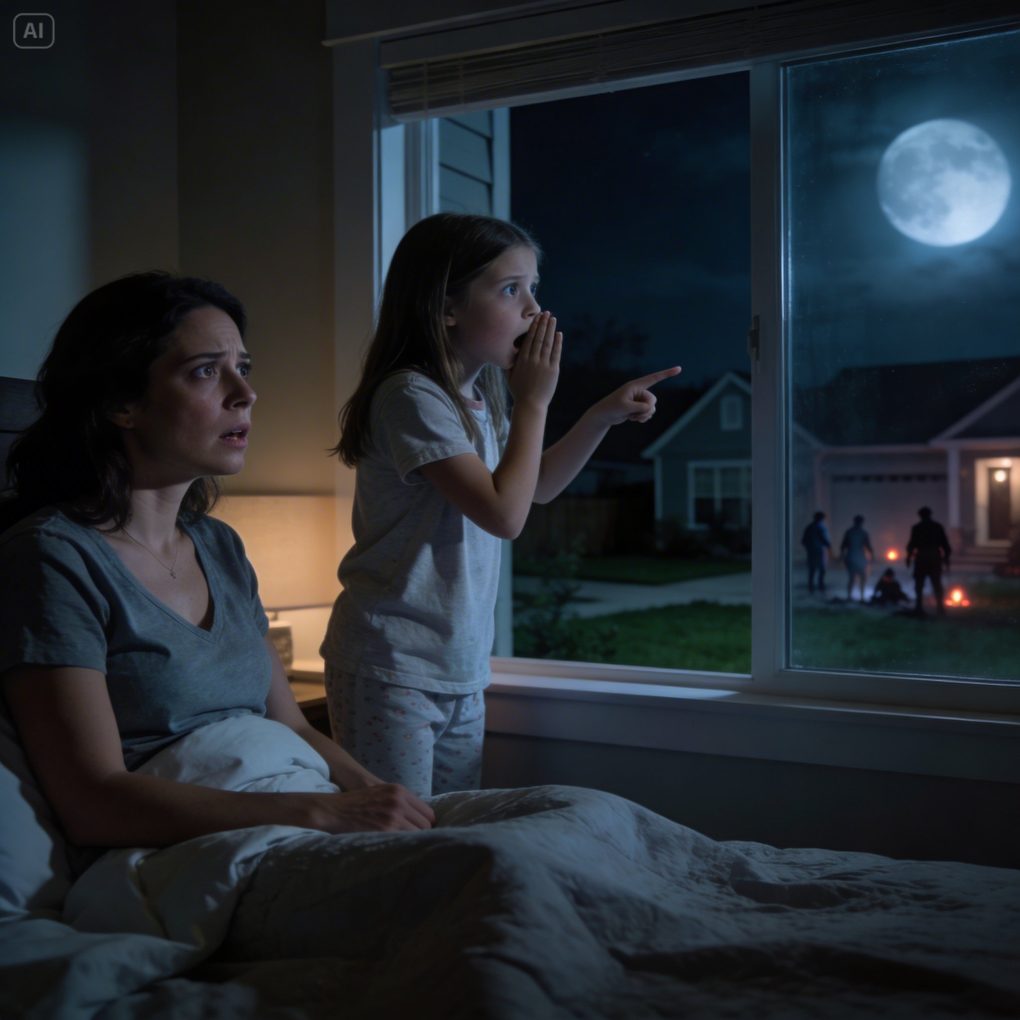
Every trace of sleep left my body at once.
I dropped the curtain and pulled Emma down beside the bed with me, keeping my voice low. “Did he see you?”
She shook her head, breathing too fast. “I just woke up and looked outside. He was already there.”
I reached for my phone on the nightstand with a hand that did not feel fully connected to me anymore. It was one thing to hear your child say a house felt wrong. It was another to find a stranger outside in the middle of the night, standing still and watching your windows.
I dialed 911.
While the phone rang, I risked another glance through the curtain.
He was still there.
Tall. Dark jacket. Baseball cap pulled low. One arm bent up near his chest, holding something rectangular. A camera, or maybe a phone. He wasn’t pacing or smoking or talking to anyone. He was simply watching the house with the fixed concentration of someone who was waiting.
The dispatcher answered. I kept my voice controlled and gave the address, describing the man, the street, the fact that my ten-year-old daughter had seen someone near the fence the day before. The dispatcher told me officers were on the way and instructed us to stay inside, away from the windows.
Emma crawled into my bed and pressed against my side. I wrapped one arm around her and listened.
That was when I heard it.
Not from outside.
From downstairs.
A soft metallic sound.
Then another.
Someone touching the back doorknob.
My whole body locked.
Emma felt it too. She looked up at me, eyes wide. “Mom?”
I put a finger to my lips.
The sound came again. Slower this time. Deliberate. A faint test of the lock, then silence, then the scrape of something against the frame. Not enough noise to wake a deep sleeper. Exactly enough to tell anyone awake that they were not imagining things.
I told the dispatcher in a whisper what I was hearing. Her voice sharpened immediately. “Units are two minutes out. Stay where you are. Do not go downstairs.”
But then headlights swept across the front of the house.
I peered through the curtain again just in time to see the man across the street step backward into shadow and disappear between two parked cars.
By the time the police arrived, he was gone.
Two officers searched the yard with flashlights while a third came inside to inspect the doors and windows. Emma refused to leave my side. Officer Jensen, a broad-shouldered woman in her forties with a calm farm-country voice, found fresh scrape marks near the back lock and a muddy print under the kitchen window. Not enough for certainty. More than enough for me.
“Could be someone testing houses,” she said. “Could also be someone who knows you’re here.”
That line landed harder than she intended.
Knows you’re here.
My divorce had not been friendly. My ex-husband, Travis, never hit me, never did anything that would make people use the word abusive too quickly. But he specialized in control that wore the face of practicality. He tracked spending, questioned my work hours, insisted on having access to every password “for transparency.” When I finally left, he acted more offended than heartbroken, as if I had breached a contract rather than ended a marriage. The custody arrangement gave Emma and me weekdays, him every other weekend. He knew the town, but not the exact address yet. I had delayed telling him because I wanted one peaceful week before the logistical warfare started.
Officer Jensen asked the obvious question anyway. “Anyone angry enough to scare you?”
I hesitated.
Emma answered before I did. “My dad.”
The room went still.
I turned to her. “Emma—”
But she was already staring at the officer with a strange exhausted honesty. “He said we wouldn’t last long without him,” she murmured. “And he told me not to get too attached to the new house.”
The officer’s eyes flicked to mine.
A cold pressure began building behind my ribs.
Because Emma had never told me that.
And because suddenly, horribly, I remembered something else.
When I unpacked the hall closet on the first day, I had found a key taped high inside the doorframe with a strip of gray duct tape.
At the time, I thought the previous tenant had forgotten it.
Now I wasn’t so sure.
Officer Jensen asked to see the key.
I led her to the hall closet while the other officer photographed the scrape marks on the back door. The key was still where I had left it on the top shelf in a mug full of loose screws and batteries. Brass. Newer than the other house keys. Unlabeled.
Jensen held it up between two gloved fingers. “Who showed you the house before move-in?”
“A leasing agent named Brent,” I said. “He did the walkthrough, gave me the paperwork, took the deposit.”
“Did you meet the owner?”
“No.”
That turned out to matter.
By sunrise, two things had already happened. First, the officers confirmed the key fit the side entrance deadbolt perfectly. Second, a neighbor’s doorbell camera caught a partial image of the man who had stood across the street—a man with Travis’s height, Travis’s build, and Travis’s old habit of tugging his cap low when he didn’t want to be recognized.
He denied everything when the police called him that morning.
Then the property company called me back.
The woman from the main office sounded tense before she even finished introducing herself. Brent, the leasing agent, had been terminated the previous month, she said, but was still under internal review because he had been accessing old tenant files and showing properties outside approved procedures. When she checked my lease, she found something stranger: my address had originally been sent to a non-applicant contact three days before I signed.
That contact was Travis.
Not officially, of course. Not with his own email. He had used an older joint account we once shared for utility bills, one I thought had been closed. Brent had apparently forwarded him the available listings after Travis claimed he “wanted to help his ex-wife and daughter find something safe nearby.”
Nearby to what became clear fast. Brent was not just a lazy leasing agent. He had grown up with Travis. They’d played baseball together in high school. That was how Travis knew about the house before I did. That was how a hidden key had been left inside. That was why he felt comfortable telling Emma not to get attached.
He had arranged for us to move into a house he could access whenever he wanted.
The police obtained a warrant by that afternoon. Brent’s phone records showed calls with Travis the week before move-in and again the night we saw the man outside. One text from Brent read: Still taped where we left it. Just don’t be stupid. Another from Travis answered: I only need to scare her enough to come back.
That sentence finished whatever doubt remained.
When detectives searched Travis’s truck, they found a folder with printed copies of my lease, our custody calendar, and photographs of the house taken from different angles—including one of Emma getting out of my car two days earlier. In the back seat was a camera with a telephoto lens.
He insisted he had never meant to hurt us. He said he was “monitoring the neighborhood.” He said he only touched the back door to “test whether the landlord had secured the place.” He said he panicked when the police arrived and left because he knew how bad it looked.
What he could not explain was why he had kept the spare key concealed inside my house.
Or why he had been watching from across the street at two in the morning.
Or why a man who claimed he only wanted to protect his family had chosen fear as his method.
Brent was charged with unlawful entry-related offenses and evidence tampering tied to the hidden key arrangement. Travis was charged with stalking, attempted unlawful entry, and violation of temporary protective conditions once the court moved fast on my emergency filing. The family court judge did not appreciate his version of “concern.”
Emma and I did leave the house after that—but not because of a ghostly feeling or some supernatural warning.
We left because my daughter had sensed what I was still trying not to see: that danger does not always arrive screaming. Sometimes it stands very still under a broken streetlamp and watches to see whether you’re willing to doubt yourself.
We moved to a secured townhouse complex fifteen minutes away. This time I did not handle the paperwork alone. My attorney did. The address stayed sealed from Travis until the court required structured disclosure through counsel, along with strict conditions.
A week after the move, Emma climbed into the passenger seat while I was parked outside her school and said, almost shyly, “I’m sorry I didn’t tell you sooner that Dad said weird things.”
I looked at her. “Why didn’t you?”
She picked at the strap of her backpack. “Because I thought maybe if I didn’t say them out loud, they wouldn’t happen.”
I reached over and took her hand.
“That’s not your job,” I said. “Your job is to tell me. My job is to believe you.”
She nodded, and for the first time in weeks, she looked like a child again instead of a little guard dog standing watch over both our lives.
That night, in the new place, she slept without waking me.
But I didn’t sleep much.
Not because I was afraid of the window.
Because I kept thinking about how close I had come to dismissing her again.
She said we shouldn’t stay.
She said we had to leave soon.
And when the truth finally came into focus, it was not some impossible mystery waiting outside.
It was the familiar face of a man who could not accept that we were already gone.