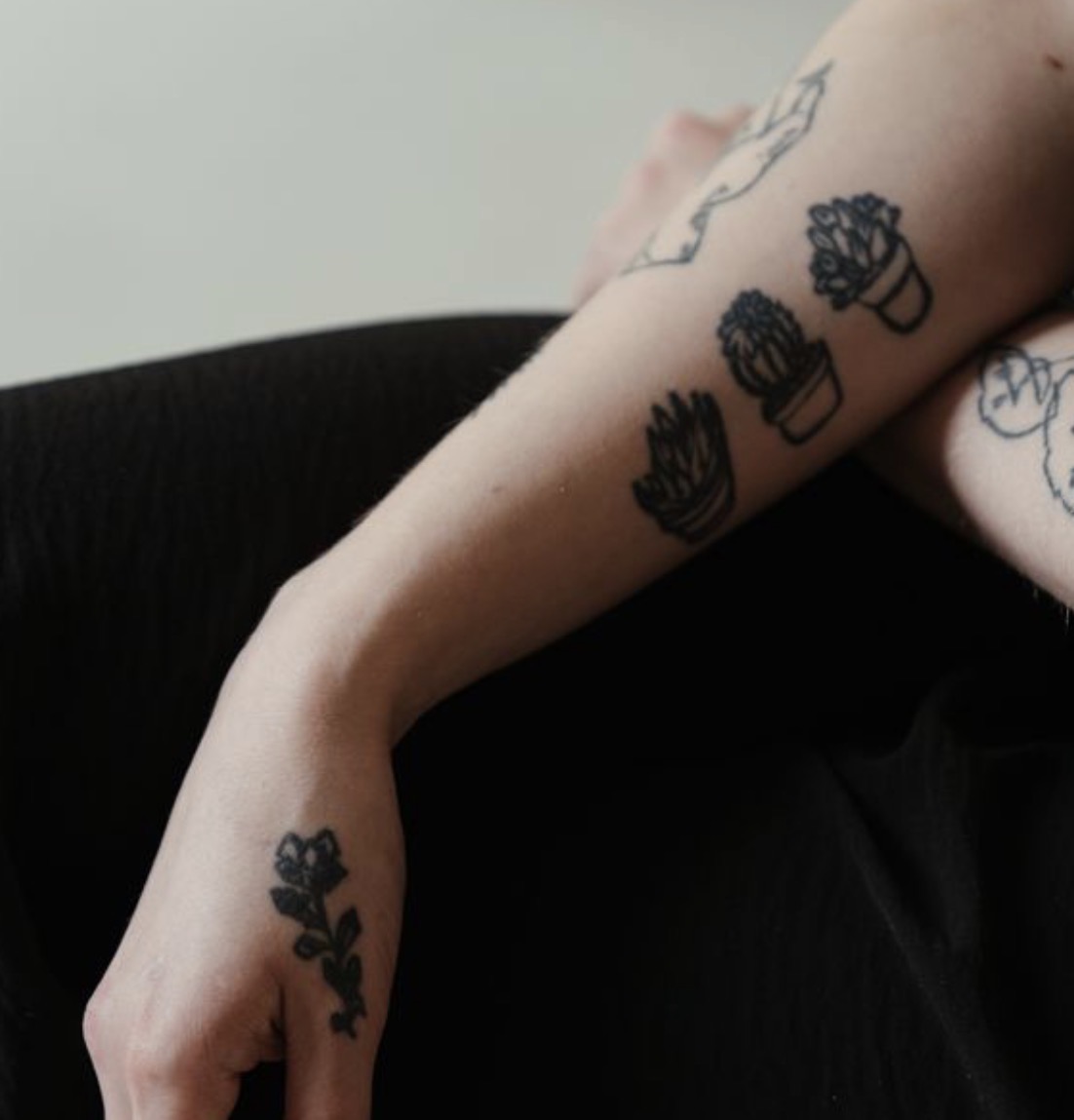
For as long as I could remember, my mother had a tiny blue flower tattooed on the inside of her left wrist, and for just as long, she refused to explain it.
The tattoo was simply part of her, the way her particular way of taking her coffee was part of her, or the specific laugh she gave when something genuinely caught her off guard, a short surprised bark that always made me smile no matter my mood. It was a small blue flower, no bigger than a coin, sitting where the skin is thin and pale and you can see the faint blue lines of the veins underneath. Five little petals. A stem. Nothing elaborate. The kind of thing you might doodle in the margin of a notebook without thinking about it.
I had traced it with my finger when I was a child, sitting in her lap on the porch on summer evenings, following the outline over and over the way children do with the small permanent features of the people they love.
“Where did you get it?” I asked her once. I must have been seven, maybe eight.
She smiled down at me, the warm easy smile that was her default expression.
“I got it when I was young,” she said.
“Does it mean something?”
“It means I was young, and I made a decision.” Then she kissed the top of my head, and that, as always, was the end of the conversation.
I asked a few more times over the years, in the way you circle back to a small mystery that never quite resolves. When I was eleven and going through a phase of thinking tattoos were the coolest thing imaginable. When I was fifteen and briefly convinced I would get one exactly like it someday, a matching flower, mother and daughter. When I was in my twenties and simply curious about the woman my mother had been before she was my mother, the version of her that existed in the years I could never reach. Every single time, I got some version of the same gentle non answer. I was young. I made a decision. A kiss on the head, or a squeeze of the hand, and then a change of subject so smooth I usually didn’t notice it happening until the conversation had already moved on to something else entirely.
There was one time, when I was around nineteen and home from college for the summer, that I pushed harder than usual. We were doing dishes together, her washing and me drying, and I asked again, and when she gave me the usual answer I said, half joking, “Come on, Mom, it’s just a tattoo, why is it such a state secret?” And she’d gone quiet for a moment, her hands still in the soapy water, and something had passed over her face that I didn’t have the maturity to recognize then. Not annoyance. Something closer to sadness. “Some things,” she’d said finally, handing me a plate, “are just for me, Emma. You’ll understand when you’re older.” I’d rolled my eyes and let it go, the way you do at nineteen. I understand now that she wasn’t being evasive to be difficult. She was standing at the edge of telling me the whole truth, and she stepped back, the way she always did.
Eventually, I stopped asking.
My mother, Helen, was a woman of full and generous presence, the kind of person who gave a great deal of herself to everyone around her and never seemed to keep score. She was the one who organized the meal train when a neighbor got sick. She remembered every birthday, sent every card, showed up with a casserole and a listening ear whenever anyone she knew was going through something hard. She had spent her whole working life as a nurse, and even in retirement she carried that quality of steady competence, the sense that if something went wrong, Helen would know what to do and would do it without any fuss.
The tattoo was the one small thing she kept entirely to herself. In a life defined by openness and generosity, it was the single locked drawer. And over the years, I had learned to respect that. Everyone is entitled to one thing that is only theirs, I figured. Even the most open person needs a corner of privacy. So I let her have her little blue flower and its unexplained history, and I stopped wondering about it, mostly.
She was sixty three now, and I was thirty two, and we had the kind of relationship I felt genuinely, uncommonly lucky to have. It was easy and warm, built over three decades out of small consistent kindnesses in both directions. We talked on the phone a few times a week about nothing in particular. She still worried about whether I was eating properly, and I still worried about whether she was overdoing it in her garden. We were, in the simplest and best sense, close. Not because we tried to be, but because we just were.
My father had passed away six years earlier, a heart attack that took him in his sleep, quick and without warning, and losing him had drawn my mother and me even closer. We were each other’s person after that. I’d helped her sort through the estate paperwork, the life insurance, the business of untangling a shared life of forty years, and in the long slow months of her grief I’d learned things about my parents’ marriage I’d never known, small tender details. She’d leaned on me, and I’d been glad to be leaned on. If you’d asked me, in the waiting room that morning, whether there was anything significant about my family I didn’t know, I would have laughed. I thought I knew all of it. I thought there were no more surprises left to find.