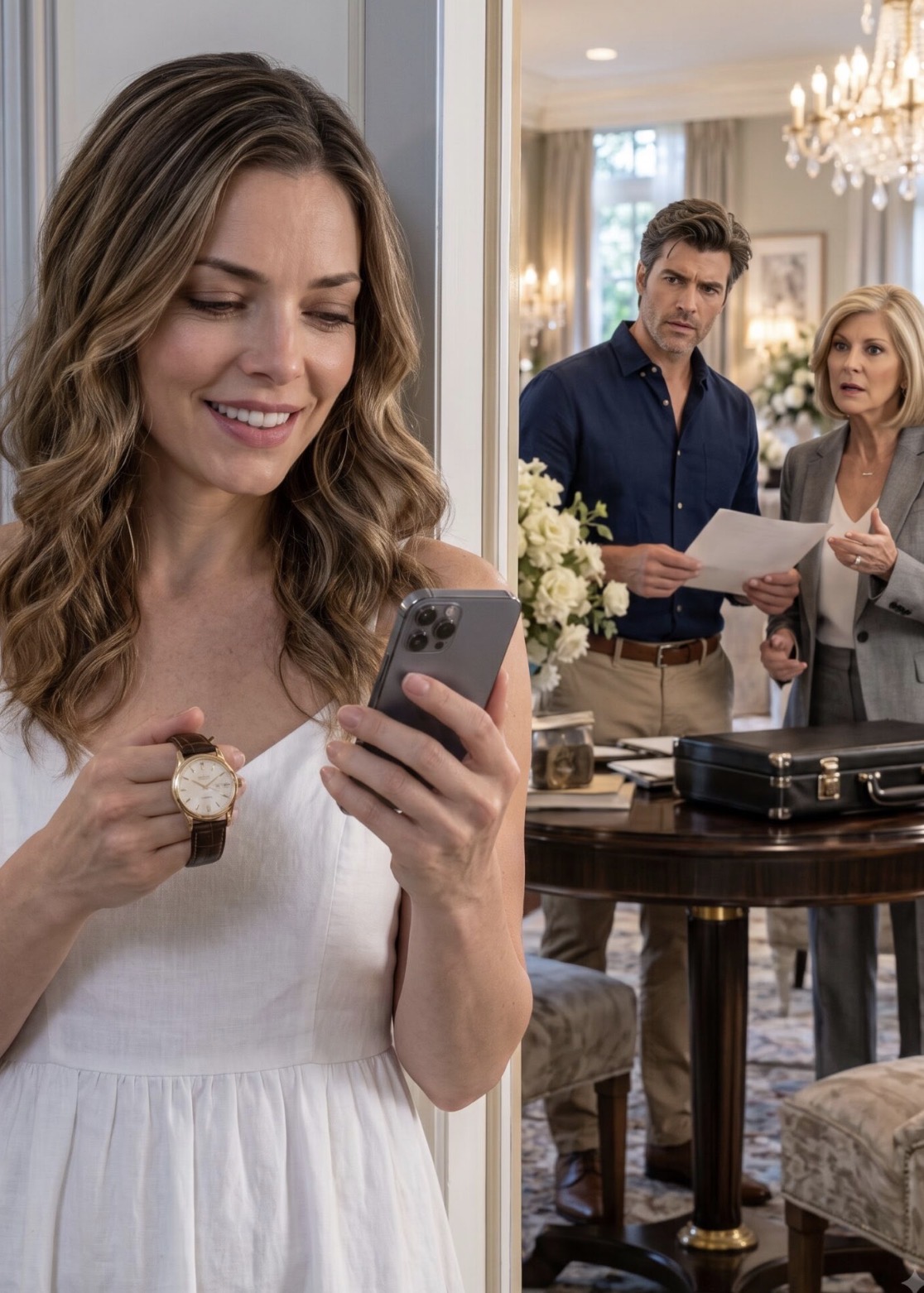
Three hours before my wedding, I returned home for my late father’s watch. Before I reached the front door, I heard my fiance say my name through the open kitchen window.
Then his mother laughed and said, “In three hours, it will be too late for her to walk away.”
I stood on the porch in my wedding shoes, holding my breath while the future I had trusted came apart sentence by sentence.
Ten minutes later, I canceled the ceremony.
The call I made after that uncovered far more than a broken engagement.
The Conversation Behind the Door
At 12:14 that afternoon, I should have been in the bridal suite at the Larkspur Hotel, letting my cousin Hannah pin the last pearl into my hair. Instead, I was standing outside the home my father had left me, listening to Adrian Cole explain why marrying me was the smartest business decision he had ever made.
I had driven back for one reason. My father’s watch was still in the small safe upstairs. It was an old silver timepiece with a worn leather strap, nothing a jeweler would place in a display window. To me, it was priceless. Dad had worn it through every difficult meeting, every celebration, and every ordinary Sunday breakfast of my childhood. I had planned to fasten it around the stems of my bouquet so that some part of him would be with me when I walked down the aisle.
Adrian and his mother, Diane, were supposed to be at the hotel taking family photographs. Yet Adrian’s dark sedan sat two houses down, half hidden beneath a maple tree. I might have called him if I had not heard Diane’s voice drifting through the partly open kitchen window.
“Only three more hours,” she said. “Once the marriage is official, she will stop resisting every sensible suggestion.”
Adrian gave a quiet laugh. It was a sound I knew well, but there was no affection in it now. “After the honeymoon, I’ll have her sign the management authorization. Then the house, the company access, and the Piermont Avenue property will finally be handled properly.”
My fingers closed around the porch rail. Piermont Avenue was not simply a building. It was the headquarters of Hartley Maritime Solutions, the company my father, Jonathan Hartley, had built over thirty-five years. He had begun with one rented office, a secondhand desk, and a promise that his work would always carry his name honestly. When he died eighteen months earlier, the building and the controlling shares passed into the Hartley Family Trust.
Diane lowered her voice, although not enough. “Your father was right about one thing. If a man cannot build wealth quickly, he should marry into it.”
“I’m doing better than that,” Adrian replied. “I’m marrying someone grief has made too soft to protect what she owns.”
For a moment, the porch seemed to tilt beneath me. This was the man who had stood beside my father’s grave with his arm around my shoulders. He had chosen the funeral flowers when I could not bear to look at another arrangement. He had answered my phone, made tea I never drank, and whispered into my hair, “You will never be alone again.” I had believed those words were love. Outside that window, I finally heard the calculation hidden inside them.
Diane asked about an amendment. Adrian said it was in his briefcase and that my name was already on the forms. Then she mentioned Piermont Avenue again, calling it “the real prize.”
Something inside me went still. The pain did not disappear, but it moved aside for a colder instinct my father had taught me to trust. When a person reveals his purpose, Dad used to say, do not argue before you understand the whole plan.
I took out my phone, started a recording, and remained beneath the window until they stopped talking.
The Papers in the Briefcase
I circled the house and entered through the basement door. The old hinges gave a faint sigh, and I waited at the bottom of the stairs until I heard Adrian and Diane move into the living room. Then I slipped up the back staircase, gathering the skirt of the simple white dress I had worn for the morning photographs.
The bedroom looked exactly as I had left it. My veil rested across the bed. A framed photograph of Dad stood on the dresser, his smile steady and familiar. For one dangerous second, I wanted to sit on the floor, call off the entire day, and let someone else decide what happened next.
Then I looked at his photograph and remembered the final year we worked together. He never raised his voice in a crisis. He asked for documents, dates, and facts. Grief had made it difficult to breathe on many days, but it had also forced me to learn every detail of what he had entrusted to me. I opened the safe and placed his watch in my palm.
On the desk beside me, Adrian’s leather briefcase stood open.
I did not have to search. A folder lay across the top, labeled with the address of my house. Inside were property authorization forms granting Adrian broad power to manage it. Both our names had been typed in, and blank signature lines waited at the bottom. Under those pages was a photocopy of the Hartley Family Trust summary, including sections that described voting control and restrictions on the Piermont Avenue property.
I had never given him that document.
My first response was disbelief. I tried to invent an innocent explanation because the mind resists accepting betrayal from someone it loves. Perhaps he had planned to discuss the papers with me. Perhaps the copy had come from a harmless source. Then I remembered his words outside the window: too soft to protect what she owns.
I photographed every page, returned the folder exactly as I had found it, and carried my father’s watch downstairs. Adrian and Diane were still talking in the front room. Neither of them heard me leave.
At twelve twenty-six, I sat in my car at the end of the street and called the Larkspur Hotel. My hands were trembling so badly that I had to press the phone against the steering wheel.
“This is Evelyn Hartley,” I told the wedding coordinator. “Please cancel today’s ceremony and reception.”
There was a stunned pause. “The entire wedding, Ms. Hartley?”
I closed my fingers around Dad’s watch. “The entire wedding.”
My next call was to Samuel Reed, my father’s longtime attorney and the one person who had repeatedly urged me never to sign important documents during an emotional transition.
“Samuel,” I said, watching the house in my rearview mirror, “I think Adrian has finally shown me why he wanted to marry me.”
His voice changed at once. “Do you have evidence?”
“A recording, photographs, and paperwork he never showed me.”
“Then do not confront him. Come directly to my office.”
For the first time since I reached the porch, tears filled my eyes. They were not for the wedding. They were for the woman I had been that morning, the woman who still believed she was driving toward a husband and a new family.
I wiped my face, started the car, and drove downtown.